


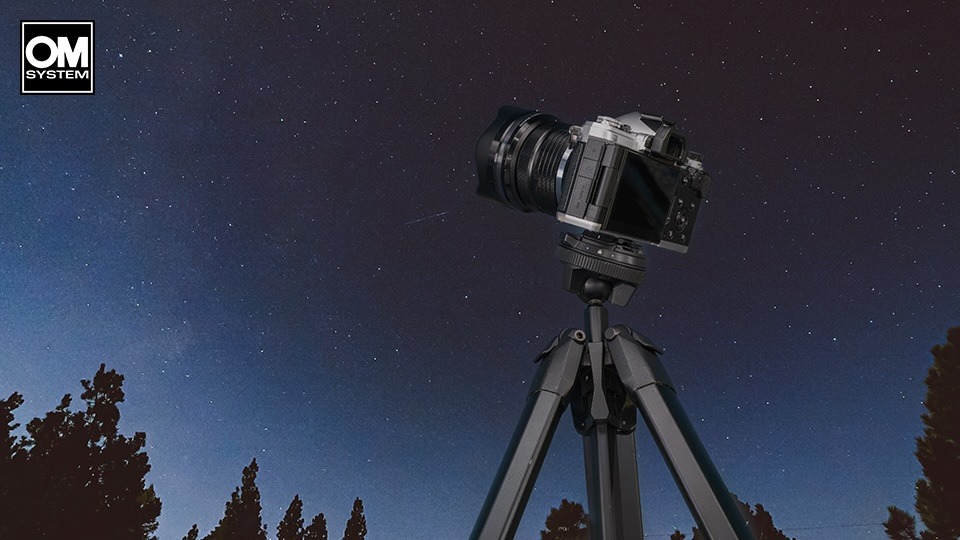


OM System’s Dedicated Astrophotography Camera Arrives Stateside – Built on a Much Better Platform Than Before
What if your camera could see colors the human eye can’t? That’s the promise behind OM System’s OM-3 Astro – a purpose-built astrophotography camera that’s finally, after years of waiting, available to photographers in the United States.
Here’s the backstory. Back in July 2024, OM System quietly released the E-M1 Mark III Astro in Japan. It was a modified version of their aging flagship with a tweaked IR-cut filter designed to capture hydrogen-alpha wavelengths – the deep red light emitted by nebulae that standard cameras deliberately block.
Astrophotographers in the US watched from the sidelines as the camera slowly rolled out to Australia, then Europe. North America? No plans.
That changes now. The OM-3 Astro is built on the significantly upgraded OM-3 platform, and the difference matters. We’ve spent time with the OM-3 and really enjoyed shooting with it – so the idea of that body tuned specifically for night sky work is exciting.
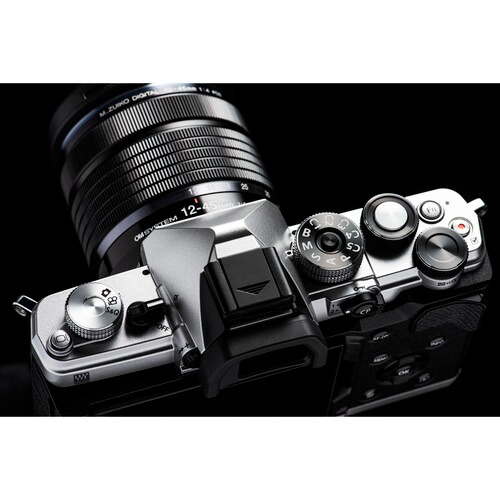
What Makes This Camera Special
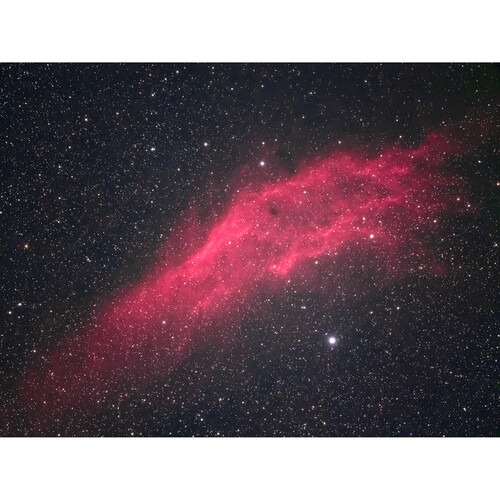
Let’s start with the headline feature. The OM-3 Astro uses a modified infrared-cut filter in front of its 20.4-megapixel stacked BSI sensor that achieves 100% transmission of hydrogen-alpha (Hα) wavelengths at 656 nanometers.
For those new to astrophotography: Every digital camera has an IR-cut filter sitting in front of the sensor. Its job is to block certain wavelengths of light so your daytime photos look natural. The problem is that this filter also blocks about 75% of the deep red light emitted by nebulae – those beautiful clouds of ionized hydrogen gas scattered throughout our galaxy.
The Astro modification removes that block, letting all of that gorgeous crimson light reach the sensor. The result is vivid, richly colored nebula images straight from the camera.
The trade-off is straightforward. This camera will produce a reddish-pink color cast in normal daylight photography. OM System is upfront about it – they don’t recommend the OM–3 Astro for general photography. You can work around it with custom white balance or a UV/IR hot-mirror filter on your lens, but this is a dedicated tool. Think of it like a macro lens – sure, you could use it for other things, but that’s not what it’s designed for.
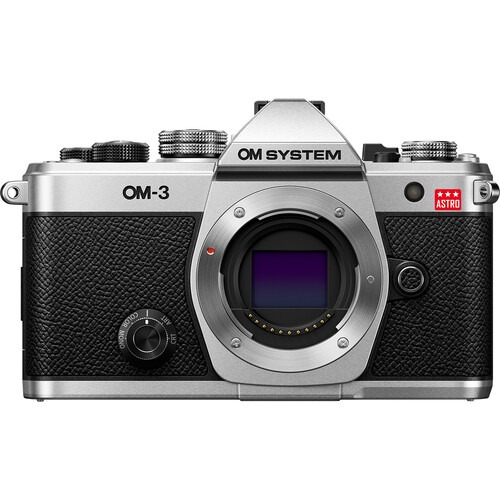
Why the OM-3 Platform Works
The original E-M1 Mark III Astro was built on a five-year-old body with an older sensor and processor. It worked, but it had limitations. The OM-3 Astro gets a substantial upgrade under the hood.
Stacked BSI sensor. The OM-3 uses a 20.4MP Stacked Back-Side Illuminated Live MOS sensor paired with the TruePic X Dual Quad Core processor – the same imaging pipeline found in the OM-1 Mark II. For astrophotography, this means faster readout speeds, better noise handling, and improved color accuracy compared to the older E-M1 Mark III’s conventional CMOS sensor.
1053-point Quad Pixel AF. The E-M1 Mark III (https://bhpho.to/3UI3YjT) had 121 cross-type AF points. The OM-3 has 1053. While autofocus points might seem irrelevant for astrophotography, this dramatically improves the Starry Sky AF system’s ability to detect and lock onto stars across the frame.
Better stabilization. The OM-3 offers up to 7.5 stops of image stabilization (with compatible lenses), compared to 7 stops on the E-M1 Mark III. For handheld star shots – yes, that’s a real thing with this system – every fraction of a stop helps.
Three custom modes instead of two. The OM-3 Astro comes with C1 preset for stacking astrophotography, C2 for stacking starry landscapes, and a new C3 mode for handheld starry landscape shooting. The E-M1 Mark III Astro only had C1 and C2.
New color profiles. COLOR1 is optimized specifically for astrophotography and red nebulae. COLOR2 is tuned for starry landscape scenes. These are unique to the Astro version and give you much better starting points for night sky color rendering right out of the camera.
The Computational Advantage
This is where OM System’s approach makes sense. Rather than relying solely on raw sensor performance to compete with larger formats, the OM-3 Astro leans heavily into computational photography features that no other dedicated astro camera offers.
Handheld High Res Shot for Astrophotography. Here’s the cool part. OM System’s Handheld High Res Shot mode captures 12 frames and composites them in-camera into a single 50-megapixel image.
When you mount the camera on a tripod or equatorial mount, this mode doubles as an in-camera stacking system. It aligns each frame automatically, corrects for the diurnal motion of the stars (that slow drift caused by Earth’s rotation), and even compensates for minor tracking errors on an equatorial mount.
The result is a high-resolution composite with significantly reduced noise – no laptop, no stacking software, no post-processing workflow required.
Think about that… what traditionally requires shooting dozens of frames, hauling them into DeepSkyStacker or Sequator, manually aligning, and processing – the OM-3 Astro handles in a single button press.
Is it as flexible as dedicated stacking software? No. But for getting clean, detailed results in the field with minimal fuss, it’s remarkable.
Starry Sky AF. Most astrophotographers have lived through the misery of manual focusing in pitch darkness, only to discover soft stars hours later when reviewing on a computer screen. The OM-3 Astro’s Starry Sky AF analyzes star patterns and automatically locks focus on celestial subjects. Point your focus area at a bright star, press the button, wait a few seconds while the camera works its magic, and focus locks. Seems like a wonderful tool for astrophotography.
Live Composite Mode. Want star trails without stacking hundreds of frames in Photoshop? Live Composite continuously blends multiple exposures in-camera, adding only new light to the frame. You can watch your star trails build up in real time on the LCD. Shoot a 20-minute star trail without overexposing the foreground. It’s one of those features that makes you wonder why every camera doesn’t do this.
Night Vision Mode. It has a red overlay for the screen and viewfinder that helps preserve your vision when your eyes are acclimated to the pitch dark. Small detail, big deal. Anyone who’s had their night vision destroyed by a bright LCD at 2 AM knows exactly what this solves.
The Sensor Size Conversation
Let’s be real about this, because ignoring it would be doing you a disservice. The OM-3 Astro uses a Micro Four Thirds sensor – roughly a 2x crop compared to full-frame. In low-light imaging, physics matters. A smaller sensor collects less light, which means more noise at high ISOs. Most users shoot Milky Way images around ISO 1600-3200 on MFT, and noise becomes pronounced beyond that.
Full-frame sensors offer 2-3 stops of advantage in noise performance. APS-C sensors sit about one stop ahead. Dynamic range is more limited too – around 12 stops at base ISO versus 14-15 for modern full-frame sensors.
So why would anyone choose this for astrophotography?
- The 2x crop factor delivers twice the depth of field at any given aperture. This means more forgiveness in focus accuracy when you’re working in total darkness. Even if your focus is slightly off, you’re more likely to maintain sharp stars across the frame.
- Lighter, faster lenses. MFT lenses are compact and nimble. The equivalent full-frame fast ultra-wide lenses are heavy and expensive. When you’re hiking to a dark-sky location carrying a tripod, tracking mount, and accessories, weight adds up fast.
- Computational features compensate. A 12-frame High Res Shot composite dramatically reduces noise through stacking. These composites can rival single APS-C exposures at equivalent total exposure time.
- Portability is real. The OM-3 Astro weighs roughly 415 grams body-only. Add an MFT wide-angle lens and you have a weather-sealed astrophotography kit that fits in a jacket pocket. IP53-rated splash and dust resistance means you can shoot all night in cold, dewy conditions without worrying.
- No other dedicated astro camera offers these computational features. Not the Nikon D810A. Not the Canon EOS Ra (discontinued). Starry Sky AF, Live Composite, in-camera stacking with star alignment – these are unique to OM System.
What’s in the Box (and What’s Not)
The OM-3 Astro body ships at $2,499.99 in the US. That’s $500 more than the standard OM-3 (currently discounted to around $1,699). Pre-orders are open now at B&H Photo and through OM System’s website, with shipping expected to begin in March. This is a made-to-order camera, so expect some wait time.
Important: The body-mount filters are sold separately this time. The E-M1 Mark III Astro bundled them. For the OM-3 Astro, you’ll need to purchase them on their own.
- BMF-LPC01 Body Mount Light Pollution Suppression Filter – $339.99
- BMF-SE01 Body Mount Soft Filter – $229.99
Both filters mount inside the camera body between the lens mount and sensor, which means they work with any lens – including fisheyes and ultra-wides that can’t accept front-mounted filters. The light pollution filter blocks wavelengths from sodium and mercury vapor streetlights, making suburban astrophotography much more productive. The soft filter creates controlled star bloom effects, making bright stars more prominent with enhanced color saturation.
Compatibility note: These filters also work with the standard OM-3, OM-1, OM-1 Mark II, and the older E-M1 Mark III. Even if you don’t buy the Astro body, the filters can enhance your existing OM System kit for night sky work..
Lens Recommendations for Night Sky Work
The Micro Four Thirds mount has strong options for astrophotography. The 2x crop factor means you need wider focal lengths to get the same field of view, but MFT glass tends to be sharp, compact, and well-corrected.
- M.Zuiko Digital ED 7-14mm f/2.8 PRO – The gold standard for MFT astrophotography. The 14-28mm equivalent coverage captures expansive Milky Way panoramas. Weather sealed for long cold nights. Sharp wide open, though stopping down to f/4 tightens star points at the edges.
- M.Zuiko Digital ED 8mm f/1.8 Fisheye PRO – That bright f/1.8 aperture is a real asset on a smaller sensor. The 180-degree field of view creates stunning hemisphere star maps. At just 315 grams, it’s absurdly portable for what it captures.
- M.Zuiko Digital ED 12mm f/2.0 – Exceptional sharpness with minimal coma distortion (that’s the lens aberration where off-axis stars get stretched into little comet tails). The 24mm equivalent works well for constellation photography, and the snap-focus ring pairs nicely with Starry Sky AF.
- M.Zuiko Digital ED 8-25mm f/4.0 PRO – The f/4.0 aperture limits untracked low-light performance, but this lens excels for tracked astrophotography where longer exposures compensate. The 16-50mm equivalent range covers wide Milky Way compositions to tighter nebula framing.
Quick exposure math: The 400 Rule helps determine maximum shutter speed before star trailing. For a 12mm lens on MFT: 400 ÷ (12mm × 2) = about 16 seconds. Round down to 15 for safety. Better yet, use an app like PhotoPills with its NPF calculator for more precise results that factor in pixel pitch and aperture.
Practical Tips for Getting Started
Disable Long Exposure Noise Reduction unless you’re shooting single exposures. With NR off, the camera won’t waste time with dark-frame subtraction between shots. You’ll capture back-to-back exposures with no gap – perfect for stacking later.
Use the built-in intervalometer to program exposure sequences. Stack 10-20 frames in software like Sequator (Windows) or Starry Landscape Stacker (Mac) to dramatically reduce noise and pull out Milky Way detail.
Consider a small star tracker like the Sky-Watcher Star Adventurer or iOptron SkyGuider. Tracked 4-minute exposures at ISO 800 vastly outperform untracked 15-second exposures at ISO 6400. The OM-3 Astro’s compact size makes it ideal for portable tracking mounts.
Manage your power. The OM-3 supports USB Power Delivery. Connect a USB-C power bank and the camera runs from external power indefinitely (battery must stay installed). Essential for overnight timelapses or long stacking sessions.
Deal with dew. Weather sealing protects the body, but condensation on the lens front element is a reality on humid nights. Bring a dew heater band or lens wipes. The articulated LCD helps when composing at awkward angles toward the zenith.
Who Is This Camera For?
If your primary interest is capturing emission nebulae, the hydrogen-alpha sensitivity gives you access to cosmic structures that remain largely invisible to standard cameras. Combined with the computational photography features, the OM-3 Astro represents the most capable and affordable dedicated astrophotography platform available right now.
If you primarily photograph galaxies or general night sky scenes without specific emphasis on nebulae, the standard OM-3 with good post-processing technique might serve you nearly as well. Hydrogen-alpha sensitivity is most relevant for nebula work.
For photographers already invested in Micro Four Thirds, the OM-3 Astro eliminates the need for third-party sensor modifications (typically $350-600 and warranty-voiding). You get factory warranty coverage, pre-configured astro settings, and a much newer imaging platform than the older E-M1 Mark III Astro offers.
And for those who’ve been watching from afar as this camera rolled out across Japan, Australia, and Europe over the past two years? Welcome to the party.
The OM-3 platform is a genuine step up, and US astrophotographers finally have a factory-fresh, warranty-backed tool built for revealing the starry starry night.
Quick Reference
| Details | |
| Price | $2,499.99 USD (body only) |
| Sensor | 20.4MP Stacked BSI Live MOS (Micro Four Thirds |
| Processor | TruePic X Dual Quad Core |
| AF Points | 1053-point Quad Pixel Cross-Type |
| Stabilization | 5-axis, up to 7.5 stops (with compatible lenses) |
| High Res Shot | 50MP (12-frame composite) / 80MP (tripod mode) |
| Weather Sealing | IP53 rated |
| Weight | Approx. 415g (body only) |
| Availability | Pre-order now, shipping March 2026 |
| Light Pollution Filter | BMF-LPC01 – $339.99 (sold separately) |
| Soft Filter | BMF-SE01 – $229.99 (sold separately) |
Have questions about the OM-3 Astro or astrophotography? Drop us a line at [email protected].





Elevate Your Vision


Read this story and all the best stories on The Luminous Landscape
The author has made this story available to Luminous Landscape members only. Upgrade to get instant access to this story and other benefits available only to members.
Why choose us?
Luminous-Landscape is a membership site. Our website contains over 5300 articles on almost every topic, camera, lens and printer you can imagine. Our membership model is simple, just $2 a month ($24.00 USD a year). This $24 gains you access to a wealth of information including all our past and future video tutorials on such topics as Lightroom, Capture One, Printing, file management and dozens of interviews and travel videos.
- New Articles every few days
- All original content found nowhere else on the web
- No Pop Up Google Sense ads – Our advertisers are photo related
- Download/stream video to any device
- NEW videos monthly
- Top well-known photographer contributors
- Posts from industry leaders
- Speciality Photography Workshops
- Mobile device scalable
- Exclusive video interviews
- Special vendor offers for members
- Hands On Product reviews
- FREE – User Forum. One of the most read user forums on the internet
- Access to our community Buy and Sell pages; for members only.
You may also like