




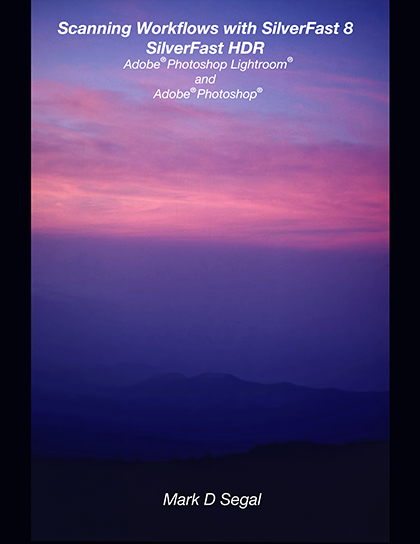
SilverFast has been one of the premiere applications for scanning film and prints since LaserSoft Imaging A.G. released Version 1.0 in 1995. The application grew and matured over the years, being used by very large numbers of people all over the world. In September 2011 the company released Version 8.0. This version is fully up-to-date with contemporary Macintosh and Microsoft computer operating systems and provides 64-bit compatible drivers for a number of scanners – the Nikon line, for example, that are no longer manufactured. The application’s code and user interface have changed fundamentally, and for the better.
Over the last year of its redevelopment, Mark Segal , a regular contributor on The Luminous Landscape, author of several articles on scanning with SilverFast as well as seminar leader and instructor on the use of SilverFast, assisted LaserSoft Imaging as one of its foremost external beta testers. At the same time, Mark identified the need for a comprehensive book describing how to use the new application in its own right, and in the context of complementary external image editing applications such as Adobe® Photoshop® and Adobe® Photoshop Lightroom®.
As Mark puts it, “So many people keep wondering about what’s best to do where in a scanning workflow, because there are numerous options and conceivable workflow sequences, so how to manage all this successfully can be a bit bewildering. Then there are perennial questions about colour management – how does one make sure that the scan preview on a monitor and the image that emerges from a printer will look about the same? So I decided that it would be worthwhile producing a volume that not only provides clear instruction on every aspect of using SilverFast 8 and Silver HDR 8, but also how to integrate these applications in post-scan workflows.”
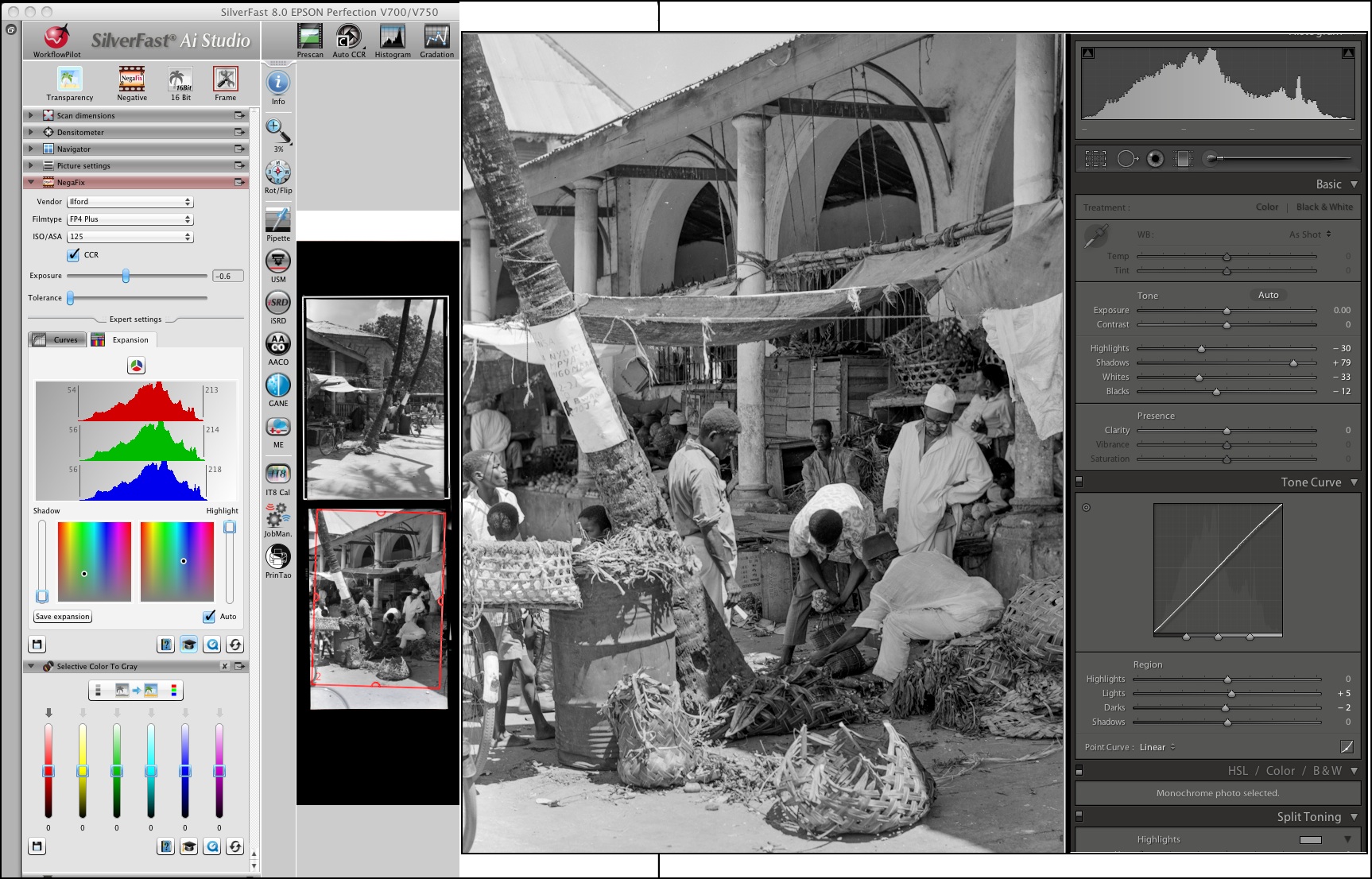
Zanzibar 1970; Graflex 2 !/4 * 3 1/4 Ilford FP4 Film;
Scanned and Edited in SilverFast 8 Ai Studio;
Final Luminance Tweaks in Lightroom 4; ©Mark D Segal
The result is Mark’s new book“Scanning Workflows with SilverFast 8, SilverFast HDR, Adobe Photoshop Lightroom and Adobe Photoshop”, available for sale as aPDF downloadon the SilverFast website. Mark says in the Introduction: “This book is for anyone seeking to learn efficient workflows for maximizing image quality from scanned media.”The idea, Mark says,“is to provide instruction that will be useful to beginners and more advanced users alike”.
He goes on to suggest: “Unless they informed themselves, today’s children could go through life never knowing that film dominated photography until about a decade ago, so rapid, pervasive and successful the digital revolution has been.
“Yet there remain devotees to film technologies always interested in improving the quality of their scanned images. As well, countless numbers of people have archives of negatives and prints. They should seriously consider scanning these collections before they deteriorate to a state where expensive or time-consuming restoration could be needed to bring them back to acceptable quality for enjoyable viewing. This book is aimed primarily at these audiences.”
Those of you familiar with Mark’s style on The Luminous Landscape will know what to expect in this book. The coverage is comprehensive – 380 pages and many illustrations – dealing with:
-
- The SilverFast approach to scanning and application version differences, including guidance on what you get or miss between the versions;
- Understanding and managing the application interface;
- Understanding what items and tasks are more or less scanner-related;
- Deciding up-front what you will do in which application;
- Setting up the workflow structures enabling those decisions;
- Choosing your SF8 scan Preferences;
- Choosing your SF8 colour management options and profiling your scanner;
- Loading the image into the scanner and adjusting the scan preview to suit;
- Dealing with resolution, bit-depth, print size, linear dimensions and file size;
- Image grain reduction, dust and scratch clean-up and sharpening;
- Making adjustments to image tonality (brightness and contrast);
- Bringing out deep shadow detail;
- Making adjustments to colour (colour balance and selective colour adjustments);
- Handling Conversions: Colour to Grayscale and Negative to Positive (for both colour and grayscale);
- Workflow strategies step-by-step from A to Z;
- Automation (batch scanning).
This is the only resource we know of where all this information and instruction on scanning with SilverFast 8 alone or in a broader workflow context is gathered in one convenient manuscript. The book’s index and first twenty-three pages are available as afree downloadon the SilverFast website.
May, 2012

Elevate Your Vision


Read this story and all the best stories on The Luminous Landscape
The author has made this story available to Luminous Landscape members only. Upgrade to get instant access to this story and other benefits available only to members.
Why choose us?
Luminous-Landscape is a membership site. Our website contains over 5300 articles on almost every topic, camera, lens and printer you can imagine. Our membership model is simple, just $2 a month ($24.00 USD a year). This $24 gains you access to a wealth of information including all our past and future video tutorials on such topics as Lightroom, Capture One, Printing, file management and dozens of interviews and travel videos.
- New Articles every few days
- All original content found nowhere else on the web
- No Pop Up Google Sense ads – Our advertisers are photo related
- Download/stream video to any device
- NEW videos monthly
- Top well-known photographer contributors
- Posts from industry leaders
- Speciality Photography Workshops
- Mobile device scalable
- Exclusive video interviews
- Special vendor offers for members
- Hands On Product reviews
- FREE – User Forum. One of the most read user forums on the internet
- Access to our community Buy and Sell pages; for members only.
You may also like