



In 2000, Epson sent Stephen across America to photograph the country at the turn of the millennium. The project, America in Detail, has just been reprinted for its 25th anniversary. Stephen talked with me from the Palm Beach gallery where the new prints hang.
Over three articles, I’ll share what I learned from our conversation. Stephen’s lessons go beyond f-stops and focus. They’re about how to see, how to work and how to stay curious. The first is a question he asks himself before every shoot.
Lesson 1: Ask what you’d shoot if nobody were paying you
Stephen has spent decades doing commercial work at the highest level. Here’s how he walks into every paid job:
“Whenever someone’s paying me, whatever it is, to create a picture, I always walk into whatever the subject matter is. And the first thing I say is, OK, Stephen, nobody’s paying you today. Is there anything here that you’d actually like to photograph? Like, what do I find interesting? What am I curious about? And that’s where I start.”
He still delivers what the client needs. He just keeps it in its place:
“I know all about the… is there enough room for type? Whatever that stuff is that commercially is viable and important. I store that in the back, but way back. And I allow the front part of my mind… to be really living in the moment.”
I love this because it works for all of us, paid or not. Most of us carry our own shot list into every outing: the picture we think we should make, the one that’ll do well online, the one we saw someone else make. Stephen’s question asks you to be curious. Start with what pulls at you.
Lesson 2: Stay present. The better picture is often next to the one you planned
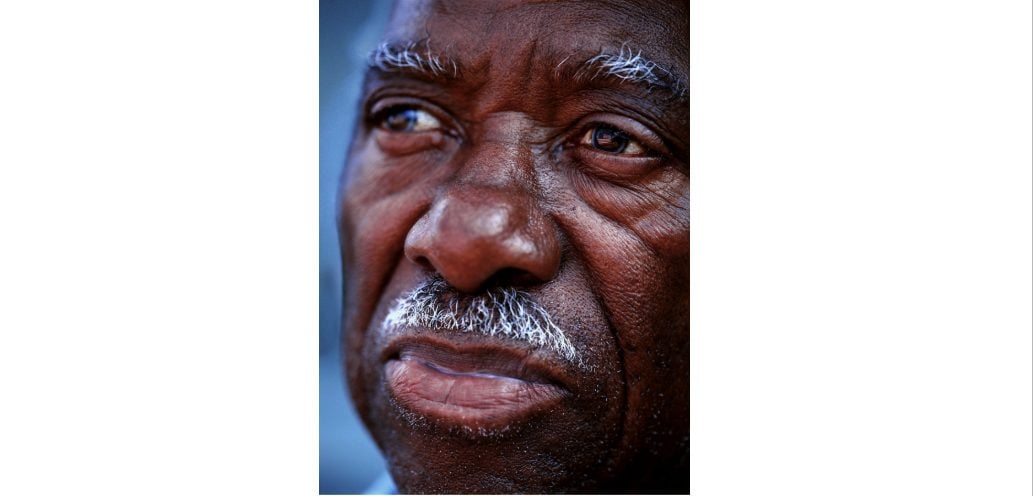
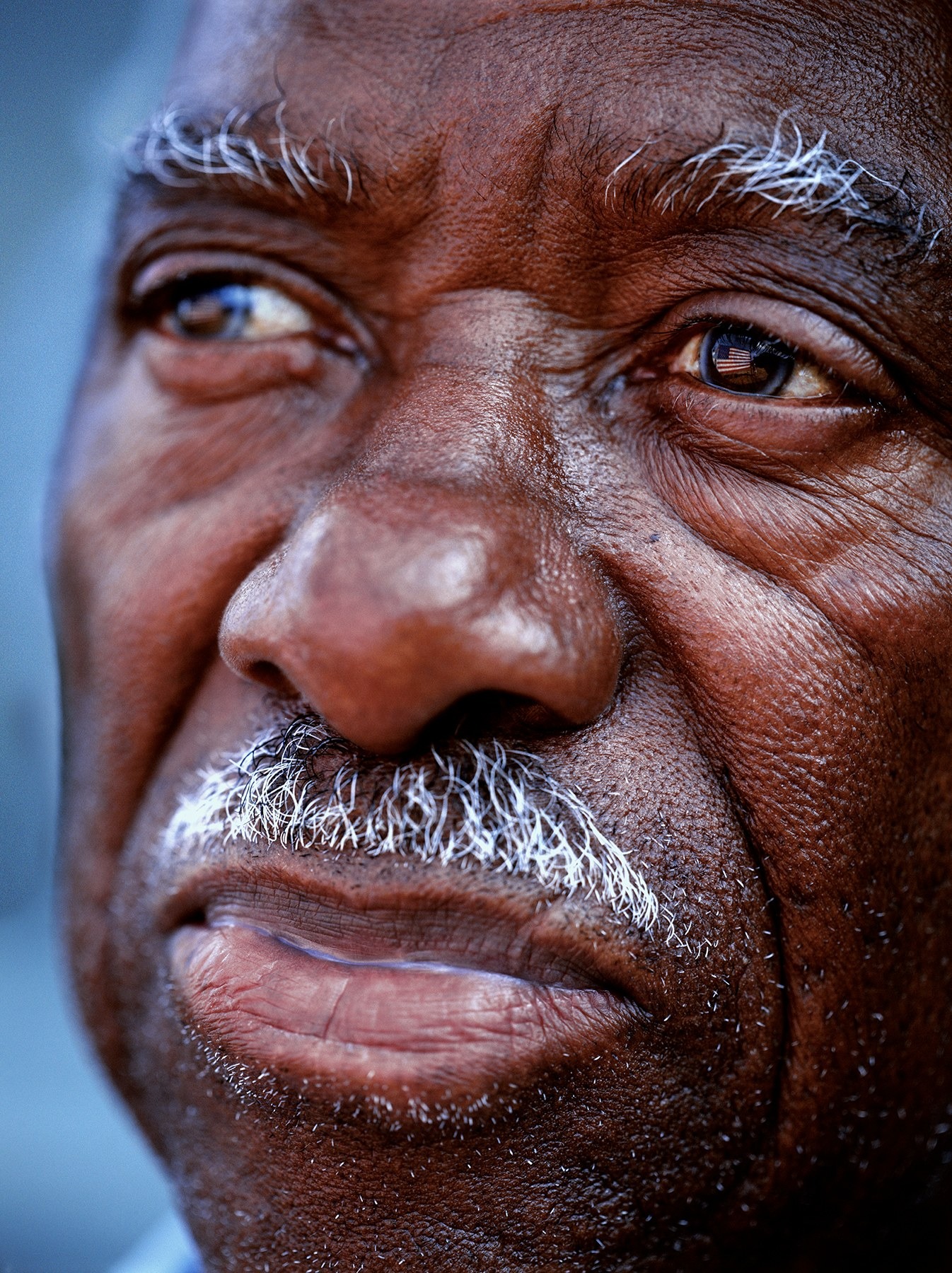
The portrait of Allie C. Peek is the clearest proof of Lesson 1 in the whole collection. Stephen came to Tuskegee, Alabama on Memorial Day with a plan: a group portrait of six Tuskegee Airmen in front of a giant American flag, with one of their historic planes landing behind it. It was a strong idea, and he made that picture.
Then it got hot. Over a hundred degrees, and the men were in the black turtlenecks Stephen had asked them to wear. He took Allie out to sit in the shade, and while they talked, Stephen noticed something.
“Suddenly I looked into his eye as he was speaking to me. And I could see the American flag was reflecting in his eye. And that, I realized that was the photograph… I said, could I ask you something, Allie? I want you to think about what that flag means to you. And in that moment, you could just, you could feel the emotion come up in his face, in his eyes.”
He could have stopped at the group shot.
Instead:
“I’m always present and I’m always looking and I’m always curious. And I’m trying in ways to tell a story that maybe hasn’t been told before.”
Notice what made that frame possible. Stephen had already done the planned work. Once he had the planned shot, Stephen kept looking. He sat in the shade with Allie and got to know him. That connection is what let him see the flag in Allie’s eye.
Lesson 3: Plan the trip, then stay open on the road
America in Detail was no casual road trip.
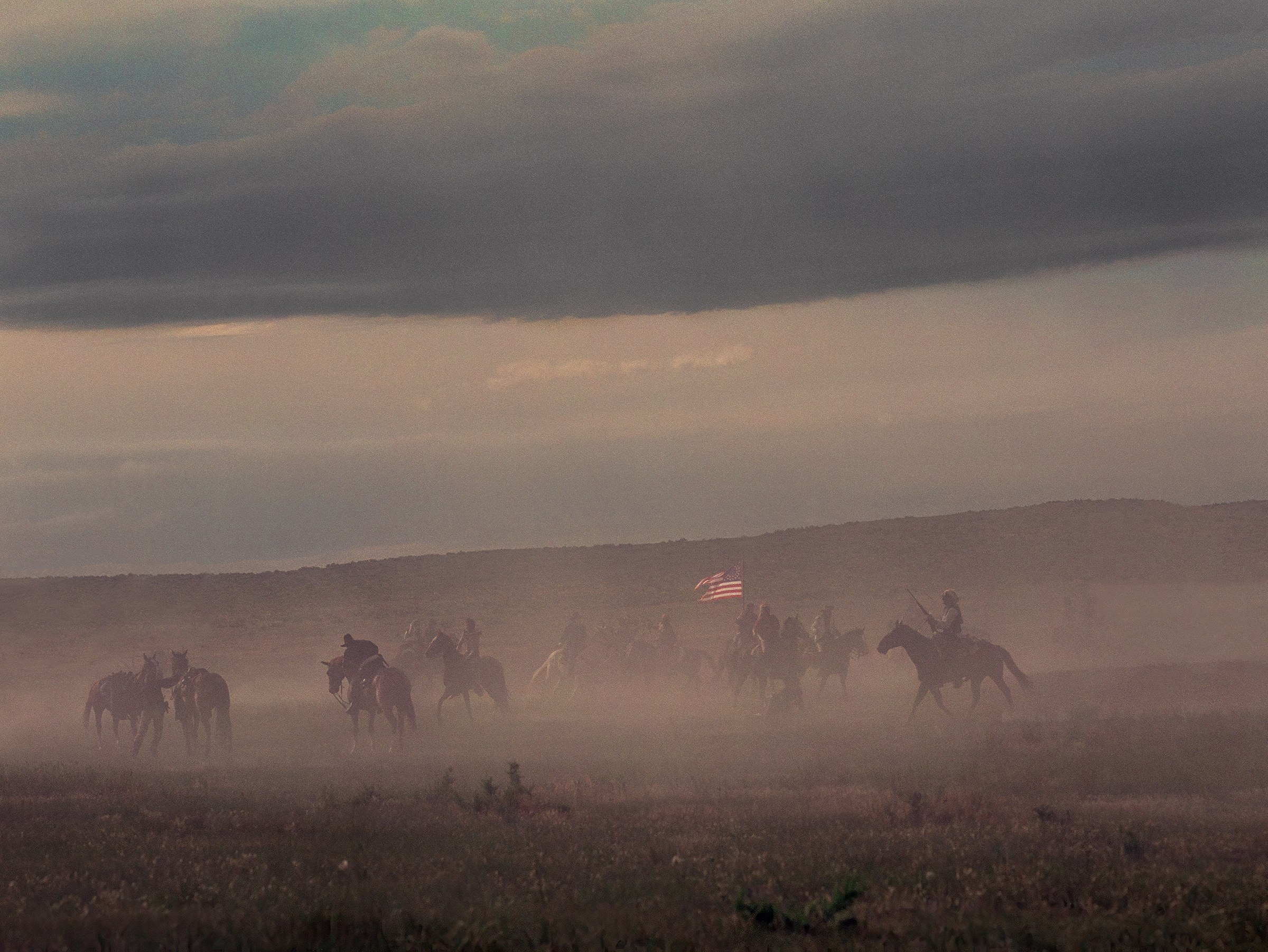
Fifty-two days straight without a single day off, more than 20,000 miles of driving, and a crew of five. Stephen and his team mapped “nodal points” across the country that together could paint a picture of America at the turn of the millennium. The route ran everywhere from a Custer’s Last Stand reenactment to the Field of Dreams.
And yet, much of the best material came from staying loose inside that plan. He read a Wall Street Journal story about Gary Greff, a man in Regent, North Dakota who was building giant sculptures from found objects along what he called the Enchanted Highway, to bring travelers back to a town the new superhighway had bypassed.
Stephen told his producer, “We got to go to Regent, North Dakota and see this guy.”
“It was very organic in a way. And at the same time, we had a general idea, but I never was locked into anything. And I think that’s the key thing.”
Plan the trip, but leave room for surprises. A newspaper story, a conversation or a detour might lead you to the best picture of the day.

Lesson 4: Learn to play jazz and at the symphony
Stephen shot the project two ways. Big, studied 4×5 frames with tremendous detail, and quick, spontaneous medium format pictures that drew on his roots as a street photographer.
He describes the two modes with a music analogy:
“Shooting off the cuff is like me doing jazz. It’s spontaneous. It’s like I never know where it’s going to go. I just move. And then when I do Day to Night or some of the other work… with the large format camera like this Epson series with the four by five, it’s more like a symphony. I’m very patient. It’s very studied. And I take my time.”
The Cotton Candy Boy is pure jazz.
On the Fourth of July in Garnavillo, Iowa, Stephen spotted a boy going to town on his cotton candy. He was using a 1950s Spiratone right-angle finder mounted on his medium format camera, a vintage gadget that let him aim one direction while appearing to look another.
The boy never knew his picture was being taken. (Stephen’s scout later tracked down the family for a release. They said yes.)
Most of us lean naturally toward one mode. Stephen’s lesson is to practice both, so you can switch when the moment calls for it.
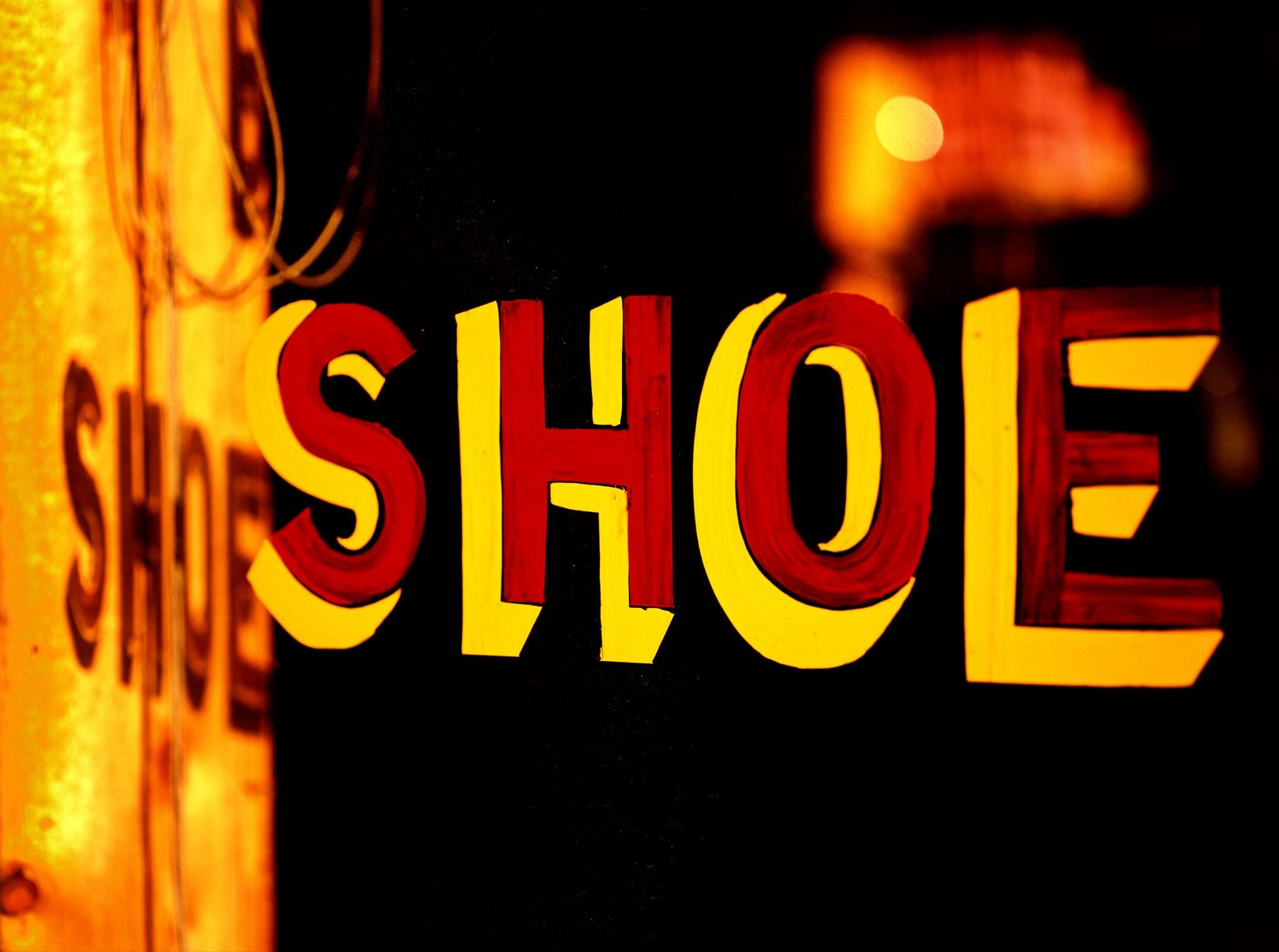
Lesson 5: Feed your eye with the masters
The Shoe Sign is one of Stephen’s quiet but graphic pictures. He made it at sunset in Cedartown, Georgia, when the low light threw the hand-painted letters onto the neighboring wall.
He calls it his homage to Walker Evans:
“I always loved the wonderful typography that he used to capture and photograph when he was photographed throughout the country… I was thinking about some of the great masters who had photographed America when I made this picture.”
He told me that painting and art history feed him too: “I go to museums a lot. That’s what feeds my soul. And so… the more time you put in to those areas, I think it comes through you visually.”
Curiosity needs fuel. The photographers, painters, and pictures you spend time with show up in what you notice out in the world.
Try this
On your next outing, before you raise the camera, say Stephen’s line to yourself: “Nobody’s paying you today.” Then ask the follow-up questions. What do I find interesting here? What am I curious about? Make your first five frames only of that, before you shoot anything you think you’re supposed to.
For extra credit, try the opposite of your usual mode. If you’re a jazz shooter, slow down and build one careful, studied frame. If you’re a symphony shooter, put the tripod away for an hour and just move.
November Show & Tell: Nobody’s Paying You Today
This month, we’re handing you Stephen’s question. Leave the client, the likes and the preconceived shot list at home. On the day: ask yourself what you find interesting and what you’re curious about, then follow it wherever it goes.
Stephen doesn’t walk in with the picture already in his head. “I go in very open,” he told us.” And then when I see it, that’s when my mind’s eye comes in.” That openness, he says, is where the magic comes from: “I stay open, I stay very positive. And then these amazing things maybe come into my orbit.”
Give yourself that same openness. Wander. Take the detour. Talk to the stranger. Let something catch you off guard, the way the flag in Allie Peek’s eye caught Stephen in the shade of a tree in Tuskegee.
Send us one or two images from November that came from pure curiosity, with a line or two about what pulled you in. Submissions are open through November 30 at [email protected]. Featured images may also appear on our YouTube channel.
Coming up
In Part 2, Stephen tells the story of the picture he almost never took, the rainy Iowa evening that every sensible person would have walked away from, and why “you’ve got to do the work” is the closest thing he has to a secret.
America in Detail, Discovering Its Life and Light was on view October 17 to 31, 2026 at JL Modern with Holden Luntz Gallery in Palm Beach, Florida, sponsored by Epson.
Join the discussion in the forum.
- Stephen Wilkes, official site
- Stephen Wilkes: An Epic Conversation with Kevin Raber & Jeff Schewe (Luminous Landscape)
- In Discussion: Stephen Wilkes, “Beyond the Horizon” (Holden Luntz Gallery)

Elevate Your Vision


Read this story and all the best stories on The Luminous Landscape
The author has made this story available to Luminous Landscape members only. Upgrade to get instant access to this story and other benefits available only to members.
Why choose us?
Luminous-Landscape is a membership site. Our website contains over 5300 articles on almost every topic, camera, lens and printer you can imagine. Our membership model is simple, just $2 a month ($24.00 USD a year). This $24 gains you access to a wealth of information including all our past and future video tutorials on such topics as Lightroom, Capture One, Printing, file management and dozens of interviews and travel videos.
- New Articles every few days
- All original content found nowhere else on the web
- No Pop Up Google Sense ads – Our advertisers are photo related
- Download/stream video to any device
- NEW videos monthly
- Top well-known photographer contributors
- Posts from industry leaders
- Speciality Photography Workshops
- Mobile device scalable
- Exclusive video interviews
- Special vendor offers for members
- Hands On Product reviews
- FREE – User Forum. One of the most read user forums on the internet
- Access to our community Buy and Sell pages; for members only.
You may also like