


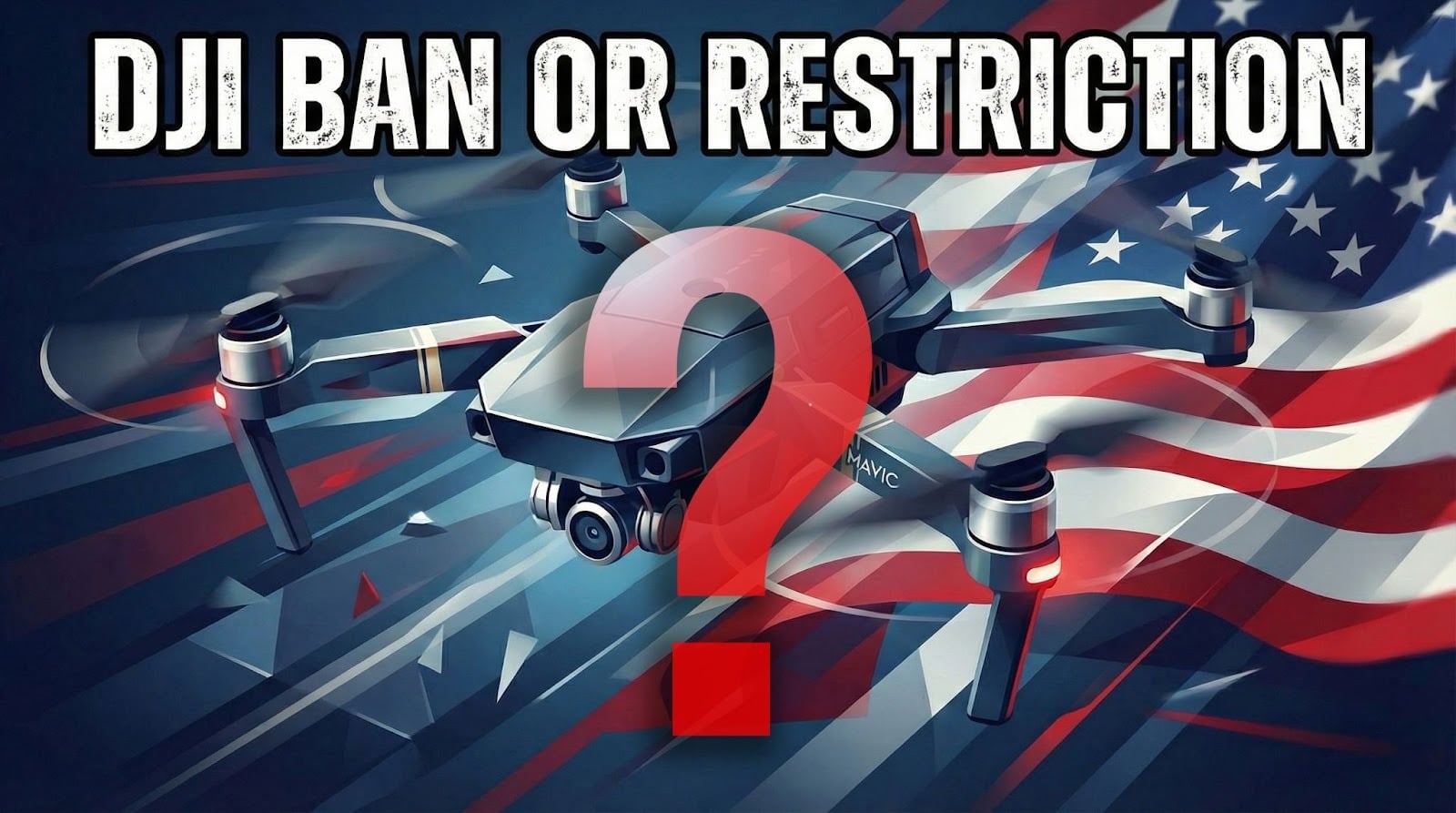


The December 23, 2025 deadline is less than three weeks away, and DJI – the company behind roughly 90% of consumer drones worldwide – faces an automatic regulatory ban in the United States. Not because any one has shown wrongdoing, but because there’s no political will to stop it.
Here’s everything you need to know, what you can do about it, and how to protect your gear and your work.
What’s Actually Happening
Under Section 1709 of the FY25 National Defense Authorization Act (NDAA), signed in December 2024, a U.S. national security agency must complete a formal security assessment of DJI by December 23, 2025. The agencies that are authorized to conduct this audit include the Department of Homeland Security, Department of Defense, FBI, NSA, and the Office of the Director of National Intelligence.
Here’s the deal: no agency has started the audit. DJI has repeatedly and publicly requested this review since at least March 2025, but as the company stated on their official blog, “the process has not begun.”
If no audit is completed by the deadline, DJI will be automatically added to the FCC’s “Covered List.” This would ban DJI from obtaining FCC equipment authorizations for any NEW products – blocking all new drones, gimbals, cameras, and any device with a radio transmitter from entering the U.S. market.
As Vic Moss, President of the Drone Service Providers Alliance, put it: “Don’t use the word ban anymore. The more accurate word is restriction.”
But make no mistake – the impact on photographers and videographers will be big.
The Political Landscape
The push for DJI restrictions has been led primarily by Representative Elise Stefanik (R-NY), who secured DJI restrictions in the House version of the NDAA. There IS pushback within her own party.
According to DroneXL’s reporting, the Senate Armed Services Committee opted against including the provision in their version. Senate Agriculture Chair John Boozman (R-AR) told Politico: “They are the primary drone maker in the United States at a reasonable price. This technology is being used more and more. That’s the crux of the problem.”
Senator John Hoeven (R-ND) echoed concerns about economic fallout: “There are real cost ramifications for commercial enterprises, not just farming. You’ve got the energy industry, where they’re tracking transmission lines, rescue and recovery, all these different other uses.”
DJI has spent nearly $3 million on federal lobbying this year, appealing to lawmakers from states and districts that rely on DJI drones for agricultural and law enforcement operations.
Financial Interests in Play
In November 2024, Donald Trump Jr. joined the advisory board of Unusual Machines Inc. (UMAC), a U.S. drone component manufacturer. According to SEC filings, he held 331,580 shares in the company. The company’s stock nearly tripled after the announcement.
Unusual Machines owns Fat Shark and Rotor Riot – brands specializing in FPV drone parts – and has been positioning itself as a Tier-1 supplier for the Pentagon to replace Chinese supply chains. The company has secured Pentagon contracts for drone motors and other components.
Upon joining the board, Trump Jr. stated: “It is also obvious that we must stop buying Chinese drones and Chinese drone parts. I love what Unusual Machines is doing to bring drone manufacturing jobs back to the USA.”
For drone users hoping the incoming administration might help soften restrictions or grant extensions, this arrangement suggests that nothing will be done. The political will to restrict DJI now has financial backing at the highest levels of the administration.
What Happens to Your Existing DJI Gear
The most important thing to understand: your current DJI drones will NOT stop working on December 23, 2025. This is not a “kill switch” scenario. DJI representatives have confirmed that drones purchased before the deadline remain operable pending future government action.
What Will Continue to Work
- All DJI drones purchased before December 23 remain legal to fly
- Recreational and Part 107 commercial pilots can continue operating their existing equipment
- Cloud tools like DJI Fly, Pilot 2, and Terra should remain functional
What Becomes Uncertain
- Firmware updates: Most likely available, but not guaranteed. No official statement confirms future update access. I’m updating all my DJI products.
- Spare parts and batteries: Increasingly difficult and expensive to source as import restrictions tighten. U.S. Customs has been holding or delaying DJI shipments under the Uyghur Forced Labor Prevention Act since mid-2024.
- Warranty and repairs: DJI Care Refresh may not be available for new purchases. Existing coverage should be honored, but replacement inventory is limited.
- Resale value: Expect significant depreciation, especially for older models without current firmware.
One additional concern: the FCC’s expanded authority (approved October 2025) now allows it to retroactively ban previously approved DJI devices on a case-by-case basis after a public comment period. This means even older DJI products could eventually face restrictions on sale or import.
Practical Steps for Photographers and Videographers
Your strategy depends on whether you’re a hobbyist or professional, but if you’re doing something you better act before December 23. If you have the funds…
Stockpile essential parts NOW:
- Extra batteries: These are high-wear items with strict shipping rules and chronic shortages
- Propellers and motors: Replacement parts will become difficult to source
- Controllers and charging hubs: Essential backup equipment
- Memory cards and cables: Standard accessories that may become scarce
Review and revise client contracts: Replace platform-specific language (e.g., “DJI drone”) with “UAV platform with equivalent capabilities” to protect yourself if you need to switch equipment.
Consider purchasing a backup drone if you rely on DJI for paid work. Third-party distributors still have limited stock of newer models like the Mini 5, but availability is rapidly diminishing.
A Personal Note
I recently made some decisions about my own gear. I picked up a DJI Avata 2 for specific flying situations – gaps, indoor work, that kind of specialized video FPV shooting. I was hoping to get an eventual Avata 3 when they come out, but thought I better get an Avata 2 for now. I also sold my Inspire 2 before the deadline. I thought, just simplify now – get what I can for it. It may go up or may lose all value. I will still have 3 DJI work horse drones. I will be holding off on upgrading to the Mavic 4 Pro as I have the Mavic 3 Pro Cine and the Inspire 3 which can cover my professional needs. But, I would suggest the DJI Mavic 4 Pro if you are willing to take a risk for an amazing platform with a 100MP camera. What I’ve seen has been wonderful, but most of my professional drone work is video and the Mavic 3 Pro Cine shoots in Pro Res Log which is most requested to match professional tv shows and commercials.
I encourage you to think strategically about your gear and your needs before more uncertainty sets in.
Non-DJI Alternatives Worth Considering
The alternatives landscape depends heavily on your budget and needs. Consumer options are limited compared to DJI’s ecosystem, but there are viable choices. We have not tested but these are what seem like possible options.
Budget-Friendly: Potensic Atom 2 ($350-$480)
- Sub-250g weight means no FAA registration required for recreational flight
- 4K video at 30fps with 3-axis gimbal
- 32-minute advertised flight time (real-world: 20-25 minutes)
- Visual tracking and waypoint modes included
- No obstacle avoidance – you’ll need to fly carefully
- Best for: Beginners, travel photography, casual aerial work
The Potensic sits in an interesting spot – it’s priced well below DJI’s comparable offerings while delivering capable performance. The footage looks a bit over-sharpened, and you won’t get the polish of DJI’s ecosystem, but for photographers looking to experiment with aerial work without a major investment, and avoiding the “DJI risk” it’s worth a look.
Serious Enthusiasts: Autel Evo Lite+ ($1,500-$1,850)
- 1-inch CMOS sensor with 20MP resolution and adjustable aperture (f/2.8-f/11)
- 6K video at 30fps – excellent detail for professional work
- 40-minute flight time (real-world: 30-35 minutes)
- Strong low-light performance thanks to the larger sensor
- Three-way obstacle detection (front, back, bottom)
- Best for: Serious photographers and semi-professional videographers who need image quality
The Autel competes directly with DJI’s Air series and offers some advantages – particularly that 40-minute flight time and variable aperture. It’s more expensive than comparable DJI models, but Autel faces the same NDAA provisions as DJI, so it’s worth noting this isn’t necessarily a “safer” long-term bet from a regulatory standpoint. Anecdotally, I’ve heard pilots have had flyaways, battery malfunctions, and that the customer service was poor.
The Reality Check
Let’s be honest: there’s no perfect DJI replacement at comparable price points. DJI’s dominance isn’t just marketing – they’ve invested heavily in image quality, flight stability, and user experience. The alternatives are catching up, but if you switch platforms, expect some compromises. It will be a little better than flying an old DJI Phantom.
For enterprise and government users, American-made options like Skydio exist, but prices start around $20,000 and they’re no longer available to regular consumers.
The Bigger Picture
DJI estimates their products support 450,000-460,000 jobs in the United States. They hold roughly 70% of the commercial drone sector, 90% of agricultural drones, and about 90% of law enforcement and firefighter drone operations.
A Michigan State University study published recently in Science found that agricultural drones are reshaping farming faster than almost any technology in history. DJI controls roughly 80% of agricultural spray drone sales in the U.S. American-made alternatives from companies like Hylio start at $20,000 for entry-level models and can reach $85,000 for advanced systems – compared to an $18,000 DJI Agras T50.
Florida’s experience with a state-level DJI ban is instructive. According to DroneXL’s investigation, the state grounded over $200 million worth of public safety drones, provided only $25 million for inferior replacements, and never published the security analysis that supposedly justified the action. Orlando Police testified that DJI had zero failures in five years while approved replacements failed five times in 18 months.
Whether you view this as necessary national security policy, a money grab, or protectionism dressed up in security language, the practical impact on photographers, filmmakers, farmers, and first responders is real. I’m no economist, but it stands to reason that prices in agriculture will be affected.
What Comes Next
The December 23 deadline appears like it will result in an automatic restriction through strategic bureaucratic inaction rather than evidence-based security findings.
While some senators have expressed opposition and there’s a theoretical possibility of a last-minute extension or audit, no action has materialized with less than 20 days remaining.
DJI has been calling for a reasonable extension of the deadline to make a genuine, fact-based review possible. They’ve made clear they’re open to dialogue with the Administration on additional measures to ensure data security.
If you want to make your voice heard, DJI has created a portal for users to contact lawmakers. Whether that will matter at this point is anyone’s guess.
The bottom line for photographers and videographers: your existing drones will continue to fly – for now.
The long-term viability of DJI equipment in the U.S. is now uncertain. Whether that means stockpiling parts, upgrading while you can, or beginning to explore alternatives depends on how central drone work is to your photography and how much uncertainty you’re comfortable with.
Take action now – not out of panic, but out of prudence. The clock is ticking, and December 23 will arrive whether or not Washington acts.
Let us know your thoughts on our forum or shoot us an email [email protected].
Resources
- The Complete DJI Ban Guide [Updated for 2025] – UAV Coach
- What’s Going On with DJI in the U.S.? – DJI Viewpoints
- GOP Senators Break With DJI Hawks As December Ban Deadline Looms – DroneXL
- Donald Trump Jr. Joins Unusual Machines as an Advisor – Accesswire
- Trump’s DOD Gives Massive Contract to Company With Ties to His Son – Yahoo News
- Donald Trump Jr. Joins Advisory Board to Boost U.S. Drone Manufacturing – Streetwise Reports


Elevate Your Vision


Read this story and all the best stories on The Luminous Landscape
The author has made this story available to Luminous Landscape members only. Upgrade to get instant access to this story and other benefits available only to members.
Why choose us?
Luminous-Landscape is a membership site. Our website contains over 5300 articles on almost every topic, camera, lens and printer you can imagine. Our membership model is simple, just $2 a month ($24.00 USD a year). This $24 gains you access to a wealth of information including all our past and future video tutorials on such topics as Lightroom, Capture One, Printing, file management and dozens of interviews and travel videos.
- New Articles every few days
- All original content found nowhere else on the web
- No Pop Up Google Sense ads – Our advertisers are photo related
- Download/stream video to any device
- NEW videos monthly
- Top well-known photographer contributors
- Posts from industry leaders
- Speciality Photography Workshops
- Mobile device scalable
- Exclusive video interviews
- Special vendor offers for members
- Hands On Product reviews
- FREE – User Forum. One of the most read user forums on the internet
- Access to our community Buy and Sell pages; for members only.
You may also like