


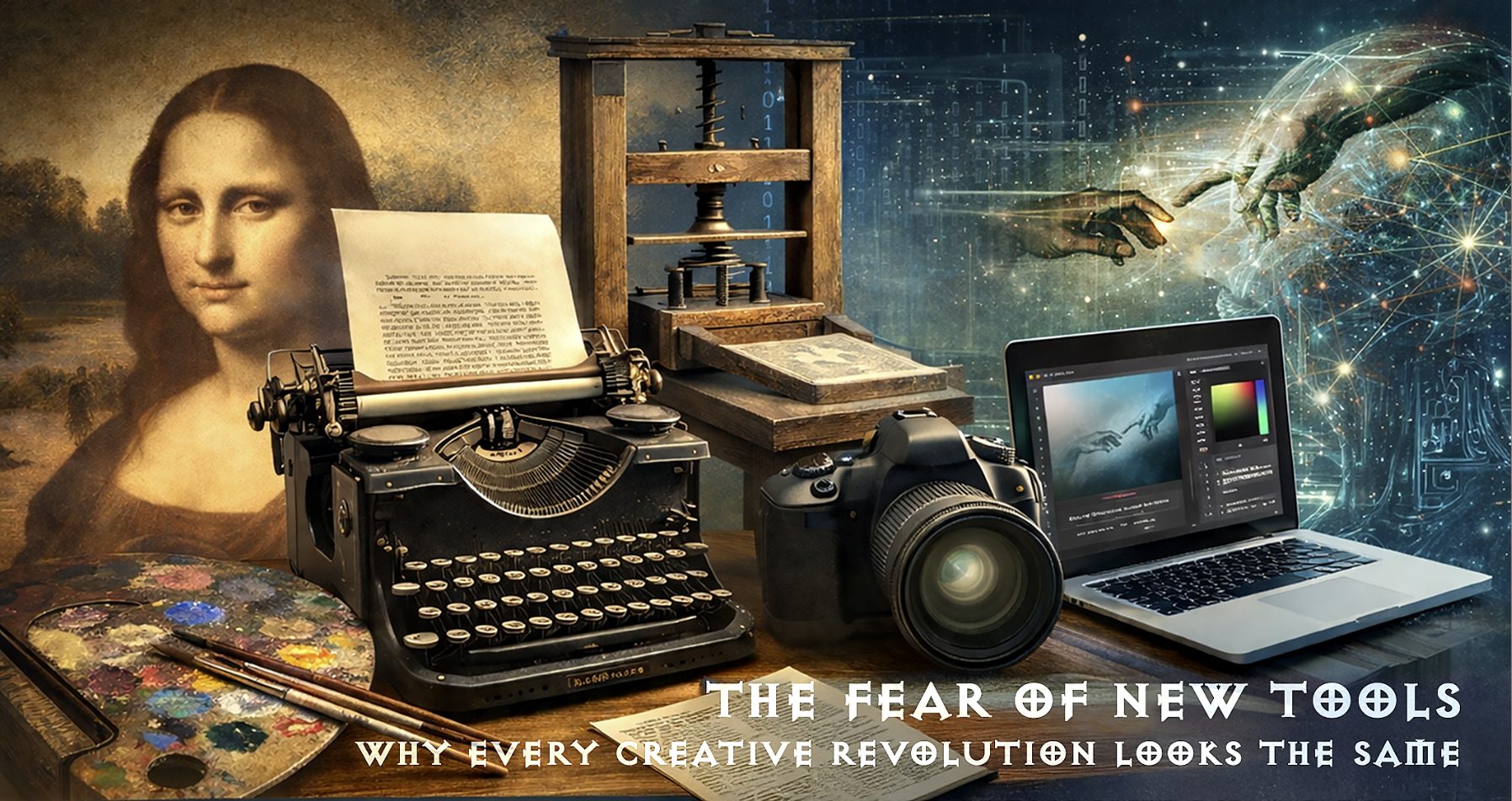


Since the beginning of recorded history, every meaningful technological innovation has been greeted by a familiar chorus: suspicion, resistance, and often outright hostility. The pattern is remarkably consistent. A small but loud group emerges to warn that the new tool will destroy livelihoods, degrade quality, and hollow out meaning. Rarely does this opposition stem from a clear understanding of the technology itself. More often, it is a reaction to something far more personal: disruption of habit, comfort, and identity.
When industry began adopting the steam engine perfected by James Watt, workers did not merely protest it is well documented that they destroyed machinery. The fear was framed as economic: machines would take jobs. In reality, the deeper threat was existential.
The steam engine forced people to change how they worked, how they learned, and how they understood their place in the world. Change is painful. Learning is uncomfortable. Tools that demand adaptation are often mistaken for enemies.
Today, as artificial intelligence enters creative fields—particularly photography—we are watching the same drama unfold, almost line for line.
When Artists Made Their Own Tools
To understand how hollow these arguments are, it helps to step back in time. Renaissance painters such as Michelangelo and Leonardo da Vinci did not walk into an art supply store or order pre-mixed pigments online. There was no Michaels, no Amazon, no internet. They sourced raw materials themselves—minerals dug from the earth, plant dyes, pigments traded across continents. Lapis lazuli traveled from Afghanistan to Italy, ground into powder for ultramarine blue.
Artists experimented endlessly with binders and oils: linseed, walnut, poppy seed, sunflower, even castor oil. Some dried well; others remained tacky for weeks. Some enhanced color; others dulled it. Brushes were handmade from pig bristles, rabbit hair, or sable. Canvas was often prepared by the artist—or purchased from merchants and finished by hand.
Was this labor intrinsic to art? Or was it simply the technological constraint of the era?
Writing Before Writing Was Easy
The same story unfolds in literature. Ancient texts—from the Bible to Roman manuscripts—were written entirely by hand. Authors were scribes. Pens were fashioned from bird feathers, cut and shaped with penknives. Paper, parchment, papyrus—each required skilled preparation. Writing was slow, expensive, and physically demanding.
Then came Johannes Gutenberg and the printing press. Suddenly, books could be reproduced mechanically. Did that make them less valuable? In a museum sense, perhaps—a handwritten codex is rarer today than an early printed book. But in literary terms? The value of the text itself did not diminish. Meaning was not diluted by multiplication.
Later, Remington gave us the typewriter. Writers typed manuscripts—still called manuscripts—using their ten fingers. No one seriously asked whether a novel typed on a Remington or an IBM Selectric was artistically inferior to one written by hand.
Then came the word processor. Formatting, spelling, revision—tasks that once consumed enormous time—became trivial. Writers could focus on ideas, structure, and voice. The word processor was not accused of killing literature. It was embraced as what it was: a productivity tool that served creativity.
Photography and the Old Question of Legitimacy
Photography itself once stood trial. Invented in the nineteenth century, it mechanized what painters had done for millennia: representing the visible world. Daguerre, Niépce, and the pioneers of glass plates and early film produced portraits in minutes—or hours, once setup and development were accounted for. Critics scoffed. Where was the skill? Where was the hand?
“All they do is push a button.”
And yet, pushing the button was never the art. Vision was.
When Kodak put Brownie cameras into millions of hands, most people produced snapshots destined for shoeboxes and family albums. But we remember Henri Cartier-Bresson and Weegee not because of the mechanism, but because of what they saw—and when they saw it. The debate over whether photography was art lasted decades. Eventually, photography won its place.
Photoshop: The Same Argument, Again
Then came Photoshop. Once more, the objections sounded familiar. Manipulation. Cheating. Artificiality.
Yet Photoshop differs from the darkroom only in efficiency. It is, quite literally, a word processor for images. Dodging and burning, contrast control, tonal adjustment—these were all standard darkroom practices. Ansel Adams spent countless hours shaping prints under enlargers. Photoshop makes those tools faster, more flexible, and more accessible.
It does not eliminate skill. It demands it.
Photoshop allows artists to focus on intention rather than mechanics. Lighting can be adjusted. Expression refined. Color interpreted. Meaning clarified. None of this happens automatically, and none of it guarantees artistic success. Mastery still requires time, patience, vision, and judgment.
The debate eventually settled. Today, even those who mutter “Was this photoshopped?” rarely question whether Photoshop invalidates photography as an art form. Curiously, the same people never ask whether a novel was written on a word processor.
Artificial Intelligence: The New Scapegoat
Now we arrive at artificial intelligence—the latest tool to provoke anxiety. Most critics have little understanding of what AI actually is. Fewer still grasp its role in creative work. AI is not an artist. It is not a mind. It is a productivity tool—no different in principle from the printing press, the typewriter, the word processor, or Photoshop.
Give a person with no talent a word processor, and no great literature will emerge. Give a person with no vision AI tools, and the result will be shallow and forgettable. In capable hands, however, AI can expand possibility. In incapable hands, it produces noise.
AI does not replace creativity. It reveals it.
Committees, Rules, and the Policing of Tools
It is both amusing and troubling to watch committees attempt to legislate creativity. There was a time—not long ago—when digital photography was excluded from competitions. Later, Photoshop use was grudgingly allowed, but only minimal cropping and tonal adjustments were permitted. Today, the same bodies debate how much AI is acceptable.
Some allow AI tools embedded in Photoshop but ban prompts. Others prohibit AI entirely. Some allow “judicious” use—but who defines judicious?
Judges are entitled to their preferences. They may dislike a work, score it poorly, or reject it outright. That is their role. What they are not entitled to do is dictate how an artist works or which tools are permissible.
Did anyone tell Jackson Pollock he could not drip paint? Did anyone forbid Caravaggio from using certain brushes? Was Picasso required to conform to established technique? Did anyone prevent Andres Serrano from placing a crucifix in a container of urine?
Art has never advanced by obeying tool restrictions.
An Optimistic Ending
I remain an optimist. History suggests that resistance fades, committees adapt, and art moves forward. The creative community—including judges and institutions—will eventually recognize what has always been true: tools do not create art. People do.
Technology does not diminish meaning. It changes the way meaning is made.
And every time, the argument sounds the same—until it doesn’t anymore.
Elevate Your Vision


Read this story and all the best stories on The Luminous Landscape
The author has made this story available to Luminous Landscape members only. Upgrade to get instant access to this story and other benefits available only to members.
Why choose us?
Luminous-Landscape is a membership site. Our website contains over 5300 articles on almost every topic, camera, lens and printer you can imagine. Our membership model is simple, just $2 a month ($24.00 USD a year). This $24 gains you access to a wealth of information including all our past and future video tutorials on such topics as Lightroom, Capture One, Printing, file management and dozens of interviews and travel videos.
- New Articles every few days
- All original content found nowhere else on the web
- No Pop Up Google Sense ads – Our advertisers are photo related
- Download/stream video to any device
- NEW videos monthly
- Top well-known photographer contributors
- Posts from industry leaders
- Speciality Photography Workshops
- Mobile device scalable
- Exclusive video interviews
- Special vendor offers for members
- Hands On Product reviews
- FREE – User Forum. One of the most read user forums on the internet
- Access to our community Buy and Sell pages; for members only.
You may also like