



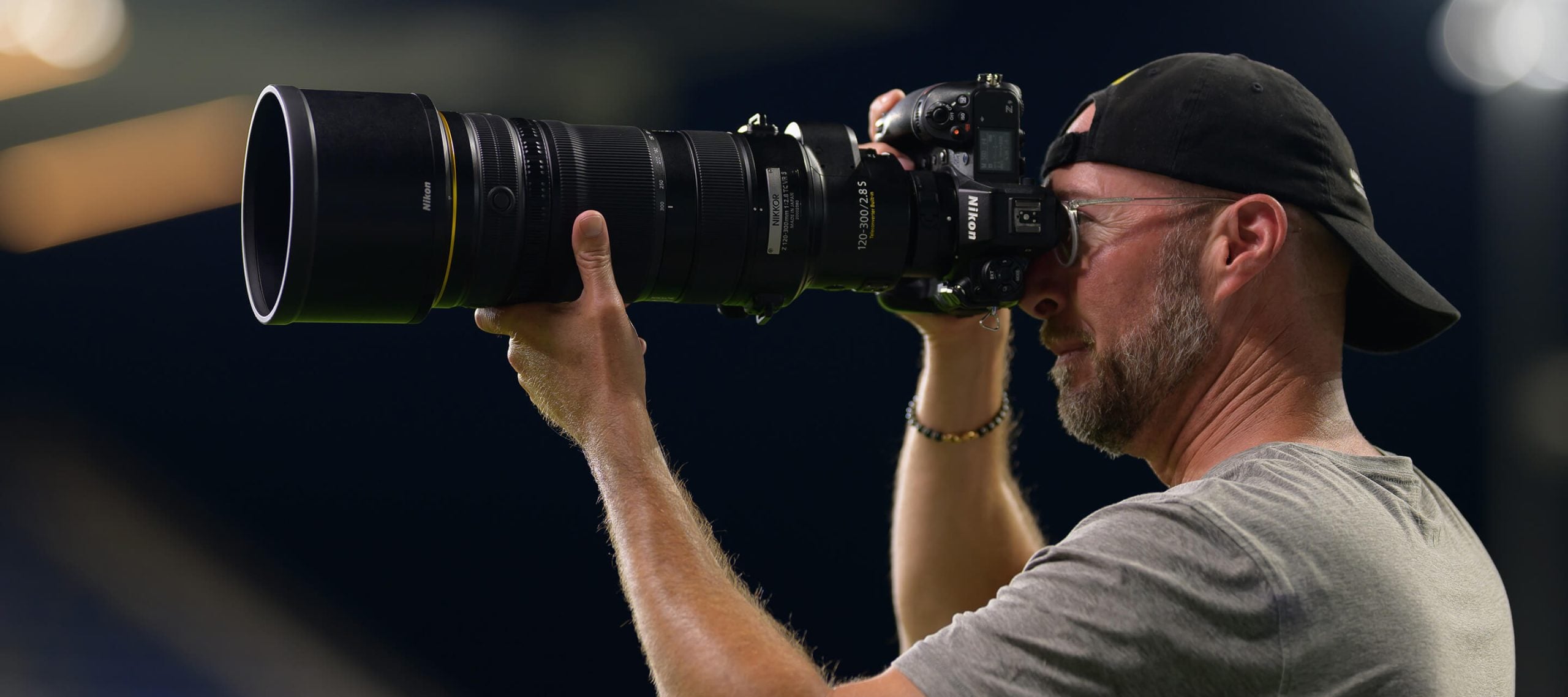


Nikon may have just built the sharpest telephoto zoom on the market. Early reviewers call the NIKKOR Z 120-300mm f/2.8 TC VR S a prime-quality optic, and Canon Rumors went as far as wondering if it’s the best zoom lens ever made. It’s also the first constant f/2.8 zoom with a teleconverter built right into the barrel.
It also costs $13,999.95 and weighs six pounds.
Nikon announced it on October 29, and it ships in mid-November. We’ve gone through the specs, the early field reports and the Canon comparison, so let’s look and see where it shines and where it asks you to compromise.
A Teleconverter at Your Fingertips
A teleconverter is a small optical unit that sits between lens and camera and multiplies focal length. It brings you closer with the same lens. A 1.4x converter turns 300mm into 420mm, and it costs you one stop of light (you need more light). Normally that means pausing, pulling your lens, putting on the converter and hoping the moment is still there.
Nikon built the converter inside the lens. With a brilliant flip of a switch near the mount and the 120-300mm f/2.8 becomes a 168-420mm f/4, with your eye still looking through the viewfinder.
Built-in converters have been around for over a decade. Canon’s EF 200-400mm f/4L did it in 2013, and Nikon’s AF-S 180-400mm f/4E followed in 2018. Nikon carried the idea into its Z 400mm f/2.8 and 600mm f/4 primes.
The new trick was fitting the teleconverter into an f/2.8 zoom.

The Specs:
- Focal range: 120-300mm at f/2.8, or 168-420mm at f/4 with the converter engaged
- Weight: 2,735g (6 lb), 515g lighter than the F-mount AF-S 120-300mm f/2.8E
- Length: 353.5mm, with internal zoom and focus – the length stays constant
- Stabilization: 6.5 stops with Synchro VR, where lens and in-body stabilization work together
- Autofocus: Silky Swift VCM, a voice coil motor borrowed from Nikon’s exotic primes
- Optics: 30 elements in 24 groups, including fluorite, SR, ED and Super ED glass, plus Meso Amorphous and ARNEO coatings
- Close focus: 0.98m at 120mm, with 0.25x maximum magnification using the converter
- Filters: 112mm front thread plus a 46mm rear slip-in holder
- Tripod foot: built-in Arca-Swiss dovetail, a first for a Nikon lens
- Price: $13,999.95, shipping mid-November 2026
The internal zoom means the lens stays the same length from 120mm to 300mm, so your balance point holds steady on a gimbal head. Though – not sure who’s putting this lens on a gimbal. More practically speaking less dust gets pulled into the barrel.
The new motor scans for focus about 60% faster at the wide end and 30% faster at the long end than the F-mount version, and Nikon says it matches or beats the Z 400mm f/2.8 TC.
The SR (short-wavelength refractive) element controls color fringing along high-contrast edges, the kind of fringing you see on white feathers against a dark forest. And that Arca-Swiss foot drops straight into most tripod and gimbal clamps with no extra plate. It’s a small thing but it makes shooting easier.

Nikon Versus the Canon RF 100-300mm f/2.8L
Canon shooters have had the RF 100-300mm f/2.8L since 2023.
- Price: Nikon $13,999.95, Canon $10,599 plus $589 for the RF 1.4x extender
- Weight: Nikon 2,735g, Canon 2,590g
- Wide end: Nikon 120mm, Canon 100mm
- Teleconverter: Nikon built in, Canon external
- Stabilization: Nikon 6.5 stops, Canon 5.5 stops (6 with coordinated IS)
- Close focus: Nikon 0.98m, Canon 1.8m
- Maximum magnification: Nikon 0.25x, Canon 0.16x
- Tripod foot: Nikon Arca-Swiss built in, Canon needs a plate


Image credit: Nikon (left), Canon (right)
The Tradeoffs
The Price
The F-mount AF-S 120-300mm f/2.8E launched at $9,500 in 2020. Six years later, this one costs about 47% more. That money buys the converter, better stabilization, closer focus and the Arca foot, and the online reaction has still been mostly sticker shock. This is a working-pro lens, priced for working pros.
The Weight
Six pounds is 515g lighter than the old version, and it’s still six pounds. Plan your support before your first big shoot.
The 168-300mm Overlap
Here’s a thing about this design. With the converter engaged, you’re shooting 168-420mm at f/4. Those 168-300mm focal lengths also exist at f/2.8 with the converter out. When a subject walks toward you, you’ll zoom wide, flip the converter off, or accept a stop less light. It’s a new thing to get used to, so practice it before the big moment arrives.
Reach
For small, distant birds, 420mm can run short. What’s exciting is that you can stack an external 2x on top of the internal converter for 840mm f/8. Autofocus consistency does dip a bit with each converter you add.
The Small Stuff
- 112mm front filters cost money. The 46mm rear slip-in holder solves most of that, and it takes Nikon’s C-PL460 polarizer.
- Nikon recommends screw-type clamps for the Arca foot and advises against lever clamps. (It’s heavy)
- The tripod collar rotates freely,
- Sealing covers dust and drips. You should bring a rain cover for a real downpour.

Who It’s For
- Working sports shooters in arenas, at courtside, on the touchline and in the pits
- Wildlife photographers working dim forests, dawn and dusk, or hides
- Pros who already own a 600mm f/4 TC and want a fast, flexible partner for it
- FTZ shooters running the AF-S 120-300mm f/2.8E who’ve waited years for a native version
- Event and portrait photographers with the budget, who’ll love the 0.25x close focus and smooth background blur
Most photographers will find a better, more value fit elsewhere.
- If you’d leave a converter on most of the time, the Z 400mm f/4.5 VR S gives similar reach and aperture for a fraction of the cost and size.
- For small, distant subjects, the Z 180-600mm or a 600mm prime gets you more reach per dollar.
- If you travel light, a 14-inch, six-pound lens may stay home more often than it rides along.

Flip the Switch
For the photographers it’s built for, this lens earns its price. One body, one lens, and a switch that turns a 300mm f/2.8 into a 420mm f/4 without missing a play.
For the rest of us, it shows where telephoto design is heading: lighter, sharper and built around how photographers move in the field.
Join the discussion in the forum.
Sources
- Nikon USA press release: NIKKOR Z 120-300mm f/2.8 TC VR S
- B&H: Nikon NIKKOR Z 120-300mm f/2.8 TC VR S product page
- PetaPixel PixelMeter: review roundup (Steve Perry, Jan Wegener and others)
- Fstoppers: Is Nikon’s $14,000 120-300mm f/2.8 Zoom Worth Its Size?
- Canon Rumors: Nikon Z 120-300mm f/2.8 TC versus Canon RF 100-300mm f/2.8L
- DPReview: Nikon’s $13,999 120-300mm F2.8 with a built-in teleconverter





Elevate Your Vision


Read this story and all the best stories on The Luminous Landscape
The author has made this story available to Luminous Landscape members only. Upgrade to get instant access to this story and other benefits available only to members.
Why choose us?
Luminous-Landscape is a membership site. Our website contains over 5300 articles on almost every topic, camera, lens and printer you can imagine. Our membership model is simple, just $2 a month ($24.00 USD a year). This $24 gains you access to a wealth of information including all our past and future video tutorials on such topics as Lightroom, Capture One, Printing, file management and dozens of interviews and travel videos.
- New Articles every few days
- All original content found nowhere else on the web
- No Pop Up Google Sense ads – Our advertisers are photo related
- Download/stream video to any device
- NEW videos monthly
- Top well-known photographer contributors
- Posts from industry leaders
- Speciality Photography Workshops
- Mobile device scalable
- Exclusive video interviews
- Special vendor offers for members
- Hands On Product reviews
- FREE – User Forum. One of the most read user forums on the internet
- Access to our community Buy and Sell pages; for members only.
You may also like