


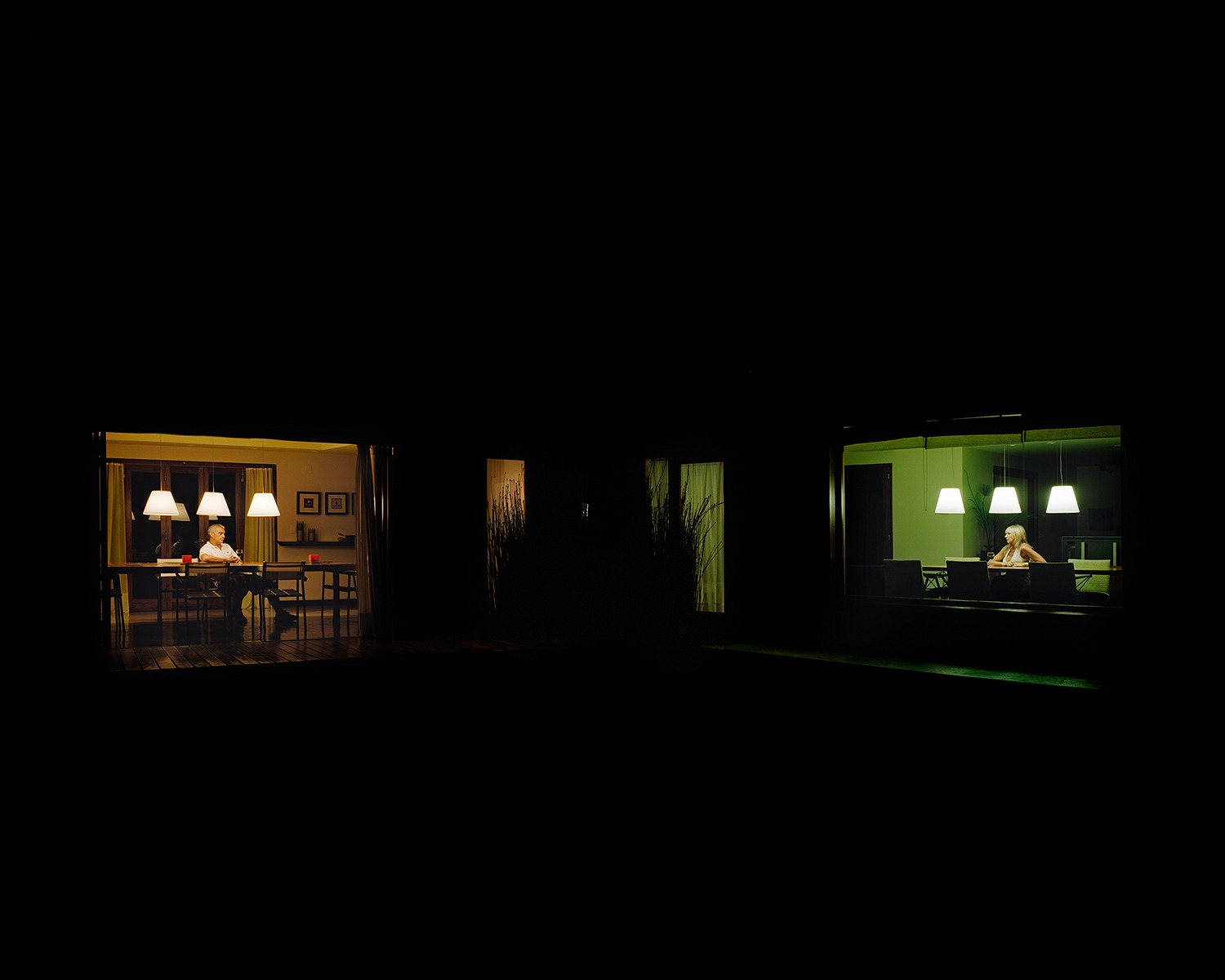


What happens in the space between two people who share a room but not a moment? How do we photograph the distance that exists even when bodies are close enough to touch?
These questions animate Archipelago, the debut photobook by Spanish-born, New York-based artist Yolanda del Amo. Published by Kehrer Verlag, this collection of approximately fifty large-format photographs represents a decade of work – from 2004 to 2014 – exploring human connection and its fragile opposite.
Understanding Staged Tableau Photography
Before we look at del Amo’s work, it helps to understand the tradition she’s working within. Staged tableau photography – sometimes called constructed photography – emerged in the late 1970s and early 1980s as artists began questioning photography’s relationship to truth and documentation.
For most of the twentieth century, photography was understood through Henri Cartier-Bresson’s concept of the “decisive moment” – that instant when a scene comes together in perfect clarity.
But what happens if that moment is made rather than found?
Artists like Cindy Sherman, Gregory Crewdson, Philip-Lorca diCorcia, and Jeff Wall pioneered this approach, meticulously constructing scenes to evoke specific atmospheres or emotions. Crewdson, perhaps the most cinematic of the group, employs full film crews and elaborate sets to create his haunting images of American suburbia. DiCorcia blurs documentary and staged work, using dramatic lighting that feels borrowed from cinema. Wall creates massive, painting-like visual stories that reference art history while commenting on contemporary life.
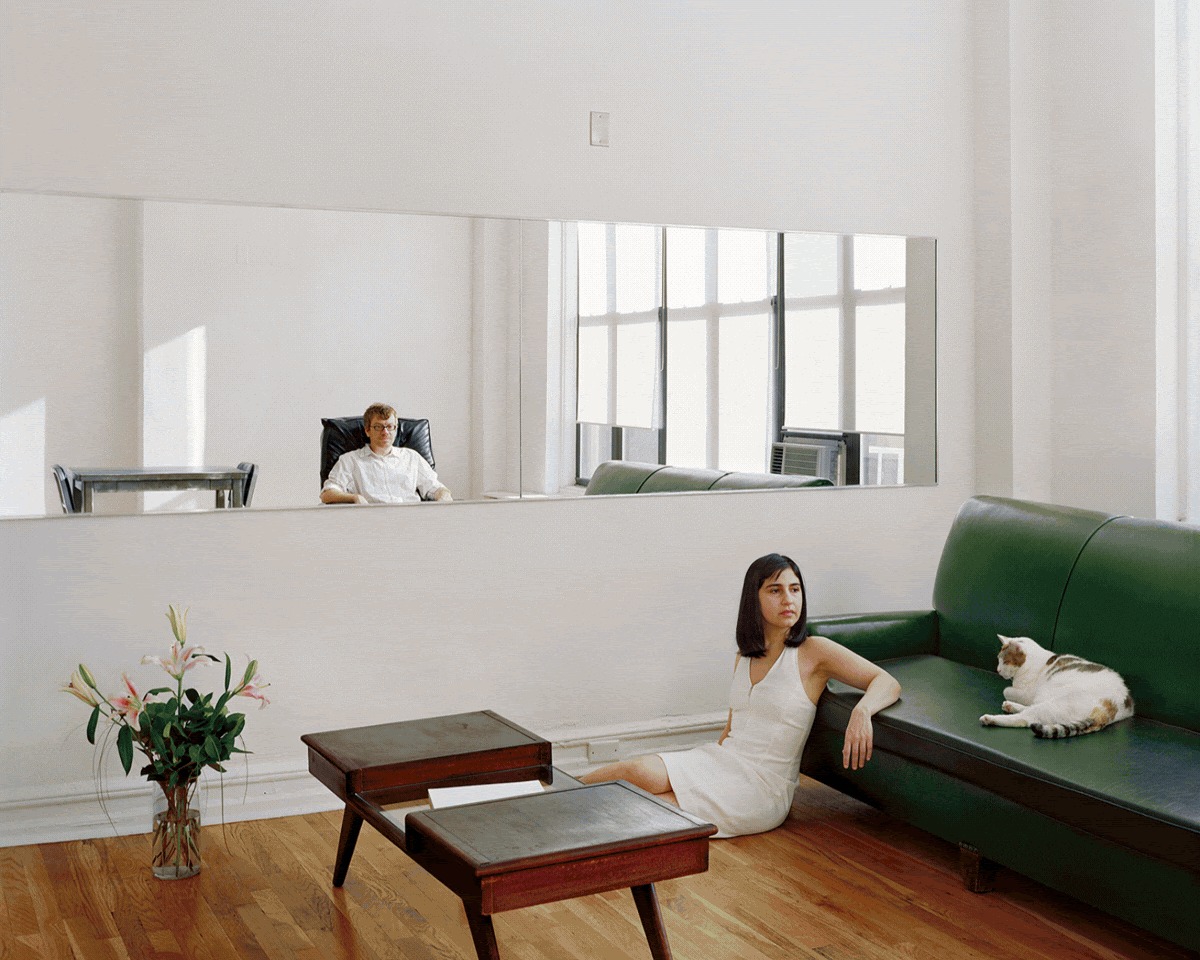
Del Amo shares DNA with these artists but she takes a different path. Where Crewdson builds elaborate sets from scratch, del Amo works in real spaces. She works in actual homes and locations that she discovers and then subtly modifies. Where his work often feels otherworldly and strange, hers remains grounded in the recognizable forms of domestic life.
The Pina Bausch Connection: When Dance Meets Photography
Del Amo cites German choreographer Pina Bausch as a primary influence, and understanding this connection makes sense when taking a look at Archipelago.
Bausch (1940-2009) pioneered Tanztheater – dance theater – a form that combined movement, spoken word, and theatrical elements that explore human emotion and relationships.
Bausch’s famous statement sums up her philosophy: “I am not so much interested in how people move but in what moves them.”
This was del Amo’s approach when translated to still photography. Her subjects are not professional actors but friends and family members. They are real people performing imagined relationships.
Like Bausch’s dancers, they embody emotional states through precise gesture and positioning. The result is somewhere between observation and invention, documentary and fiction.
Bausch was known for her use of repetition – the same gesture performed again and again until it revealed something deeper about human behavior.
Bausch believed that repressed memories could only be recovered by focusing carefully on the body’s conditioned responses. Del Amo translates this into single images that feel like they contain the weight of these repeated moments – the thousandth breakfast eaten in silence, the countless evenings spent looking in different directions.
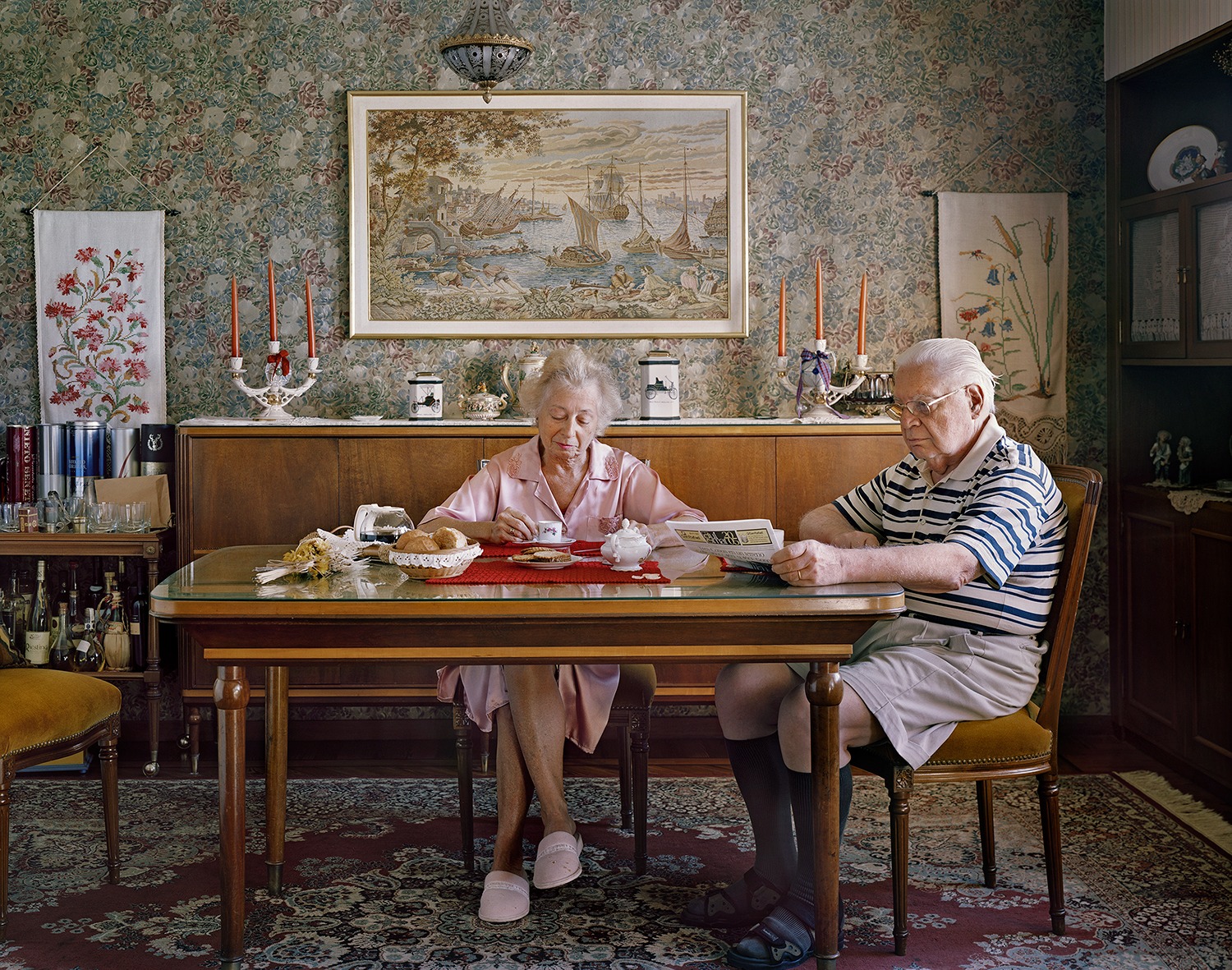
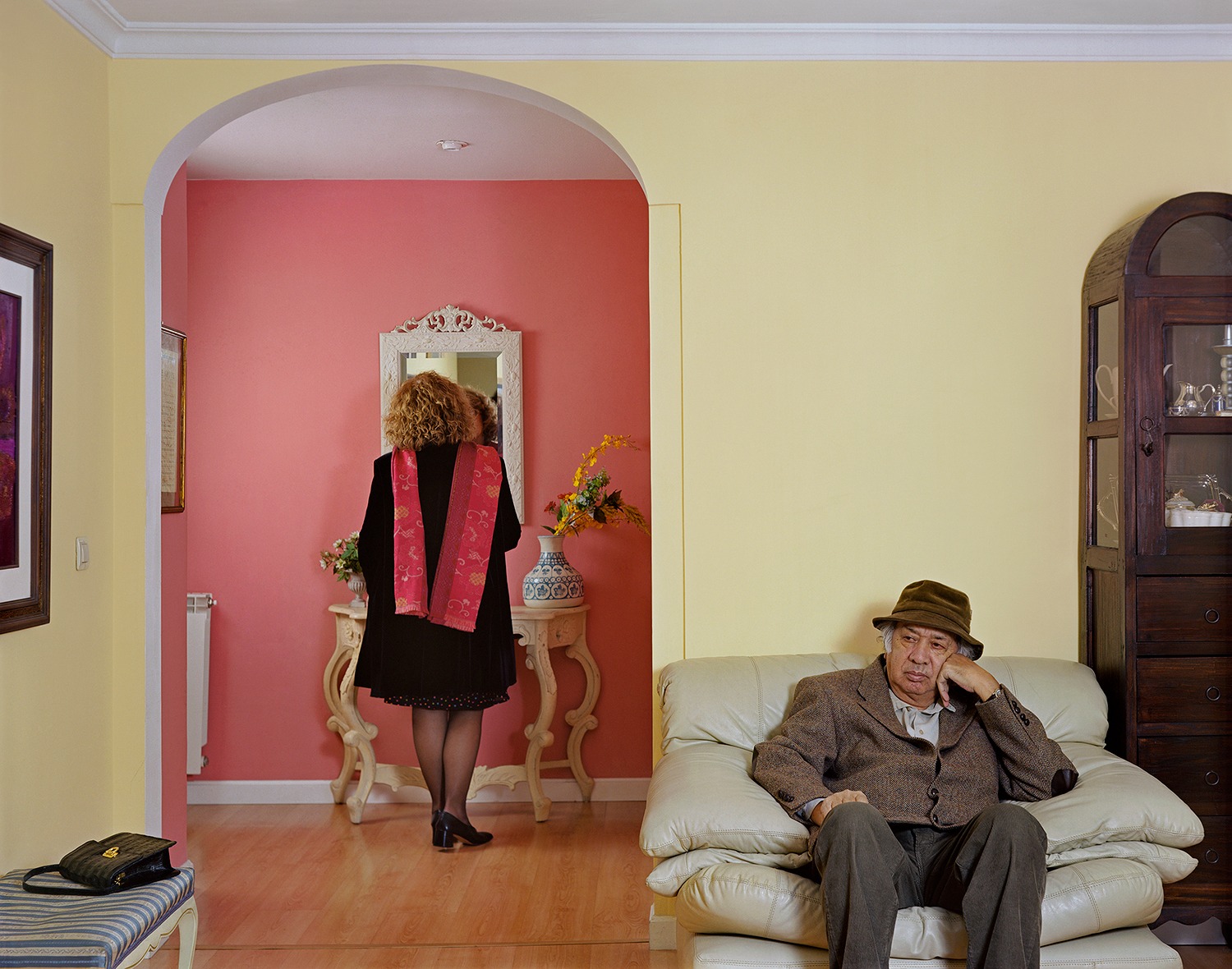
Bausch’s sets were visceral – stages covered in dirt, flooded living rooms, fields of carnations that became psychological extensions of her dancers’ emotional states. Del Amo works in a similar way: the lemon-yellow bedroom, the pink-walled alcove, the tropical mural behind a diner booth – these spaces contain her subjects and their emotional state.
The Technical Approach: Large Format and the Slow Gaze
Del Amo works with a large-format camera, a choice that shapes everything about her images. Large format demands slowness – each exposure is deliberate, expensive in time and attention. There’s no rapid-fire shooting, no hoping to capture the right moment from dozens of frames.
Each photograph must be thought out through before the shutter is pressed.
“Every time I shoot a photograph, I experience a great deal of excitement and adrenaline,” del Amo has said. “I never know exactly how the models or the setting will look through the camera. I try to be very present so I can make last-minute changes if necessary. My process is slow, and each one of my images has been in my head for a long time.”
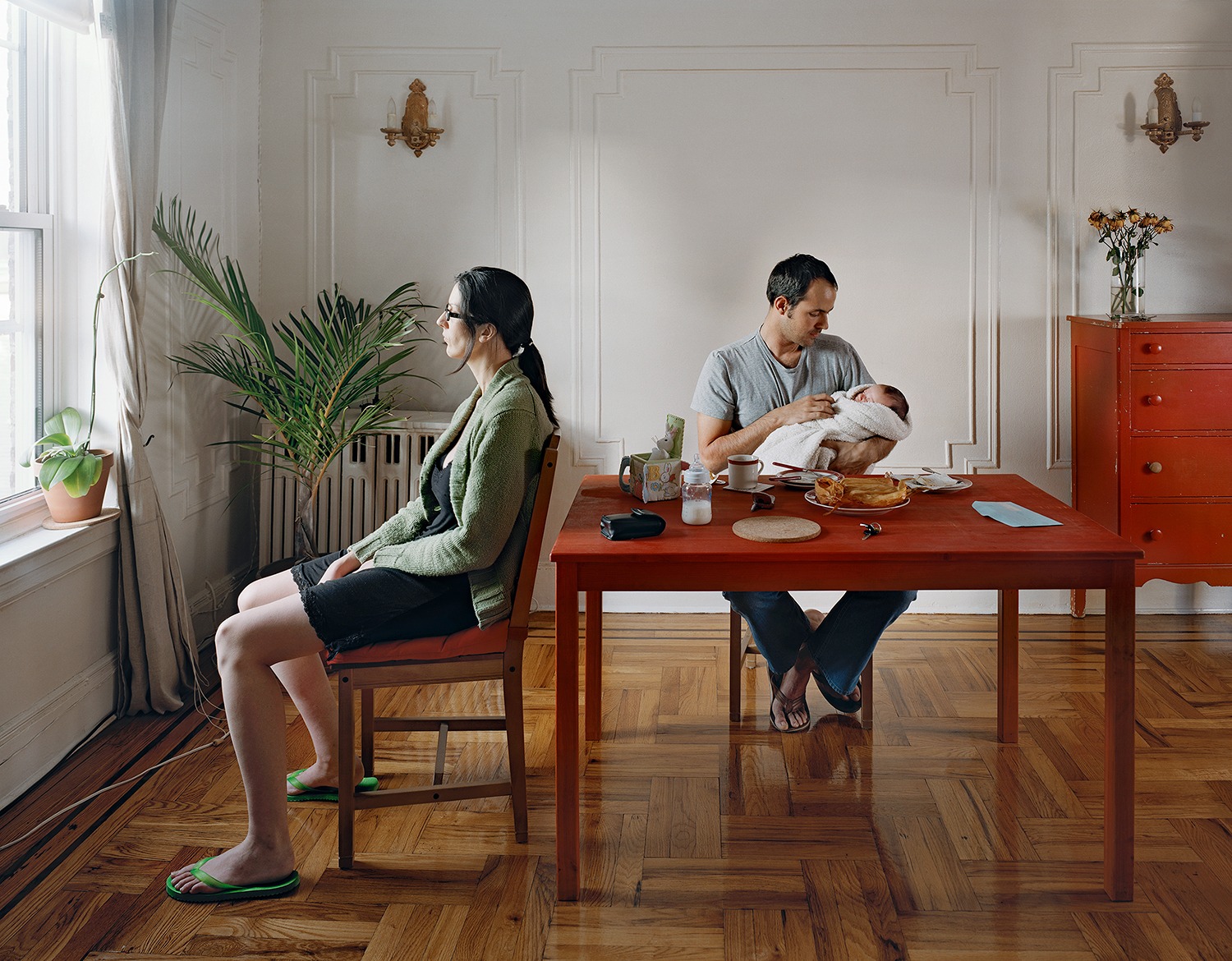
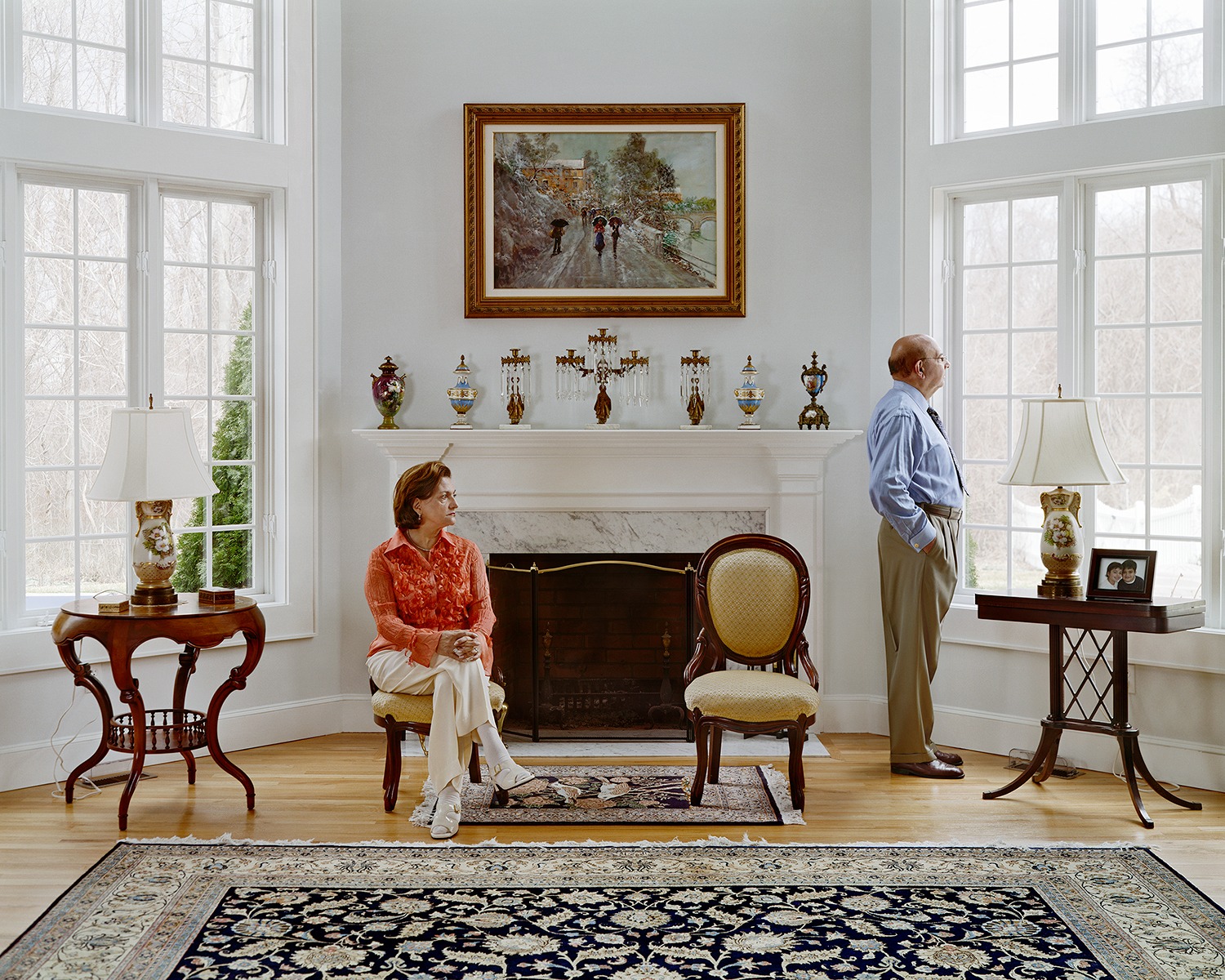
This slowness serves her subject matter perfectly. The emotional states she captures – the stasis between people, the suspended moments of disconnection – it has a contemplative quality that large format provides. These aren’t snapshots of relationships; they’re ongoing and sustained observations.
The large-format camera also produces images with extraordinary detail and presence when printed at scale – the book measures 27 x 29.5 cm, allowing viewers to enter these domestic spaces almost physically.
Color as Emotional Register
Photography critic Jean Dykstra, who contributes an essay to the book, notes how del Amo uses color to deepen emotional distance. The “emotional register of a lemon-yellow bedroom” or the “bright blue of an empty swimming pool” – these are psychological and emotional inducing visual choices.
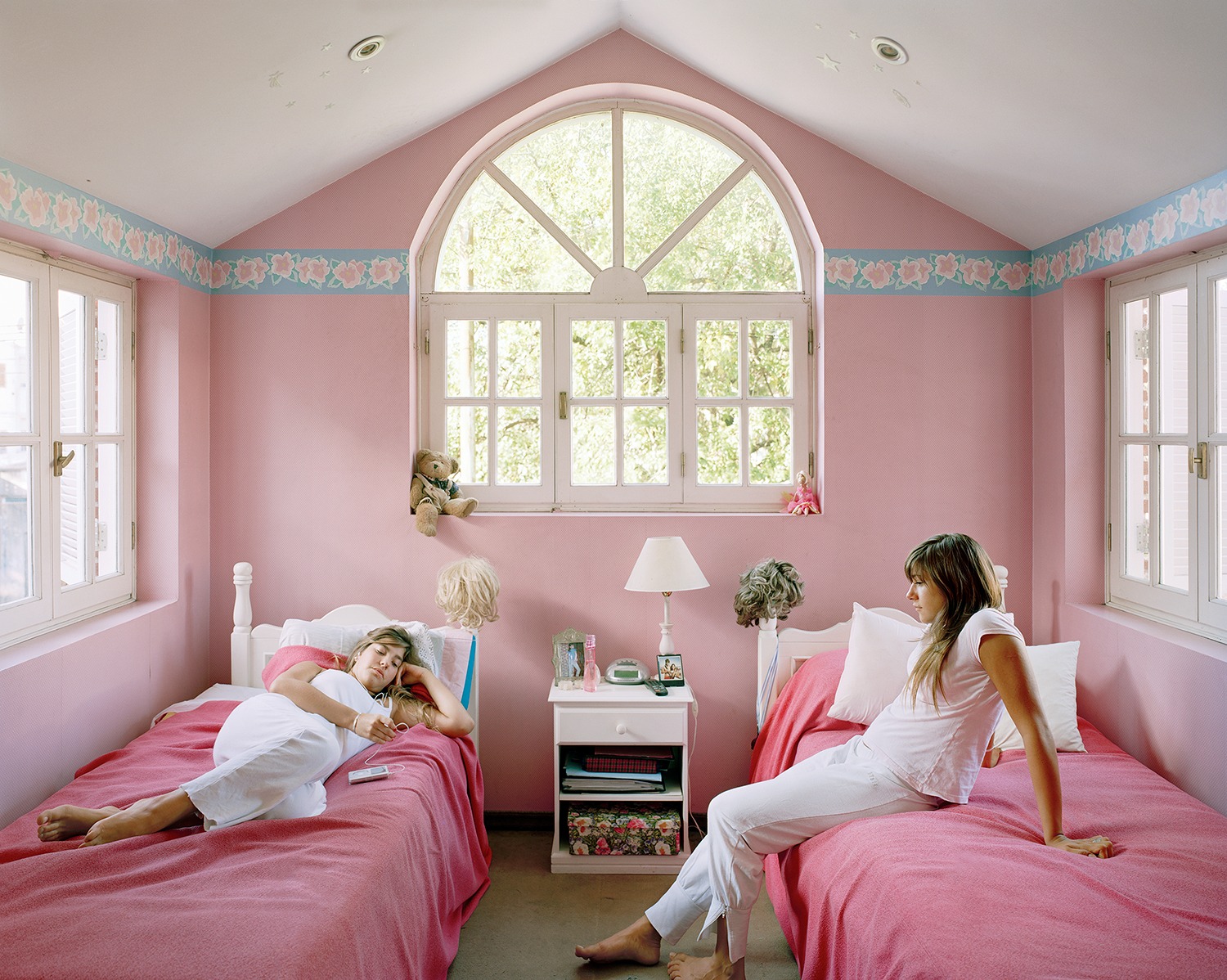
Look at the pink bedroom where two young women exist on parallel beds – one sleeping or turned away, one sitting awake, alert, watchful. The sweetness of the pink walls, the floral border, the childhood artifacts all create a kind of tension against the emotional distance between the figures.
The color speaks of intimacy; the composition speaks of separation.
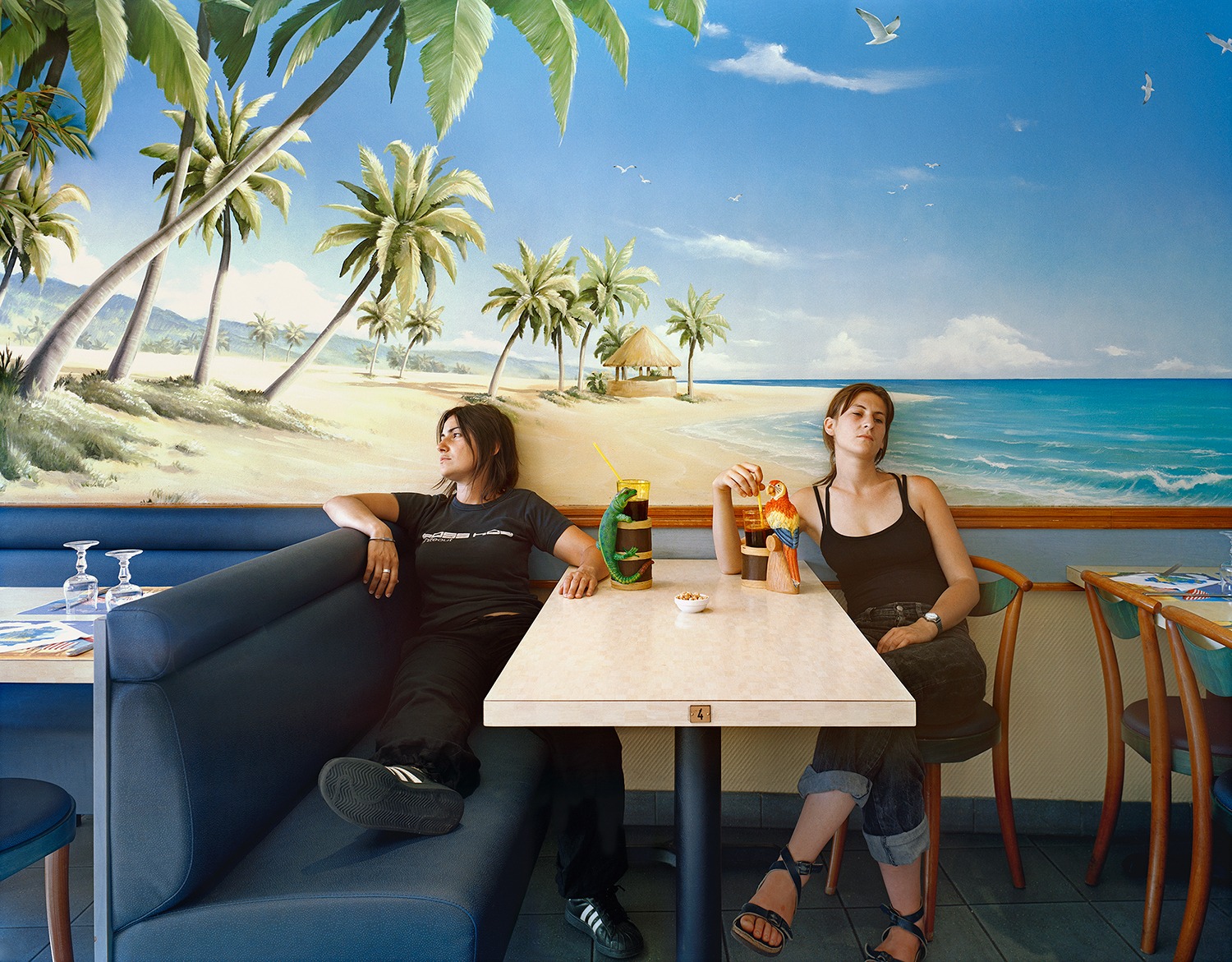
Or consider the couple photographed against a tropical beach mural in what appears to be a diner. The painted paradise behind them – palm trees, blue water, soaring birds – creates an almost painful contrast with their body language, each turned away, each occupying their own psychological island even as they share a booth and fun tropical drinks.
The Weight of What Remains Unsaid
“We are always performing roles in front of one another,” del Amo has observed. This is the heart of Archipelago. Her photographs show people caught between their social performances and their interior lives – what they project outward versus what is churning within them.
Photography critic Vicki Goldberg (1936-2025), in her essay “Islands in the Sea of Life,” describes del Amo as a “playwright, director, and stage manager” of her own photographic theater. She notes that del Amo was after “something slightly stranger than reality, that throws reality off.” The images show “the struggle to reconcile the needs for relation and for individuality.”
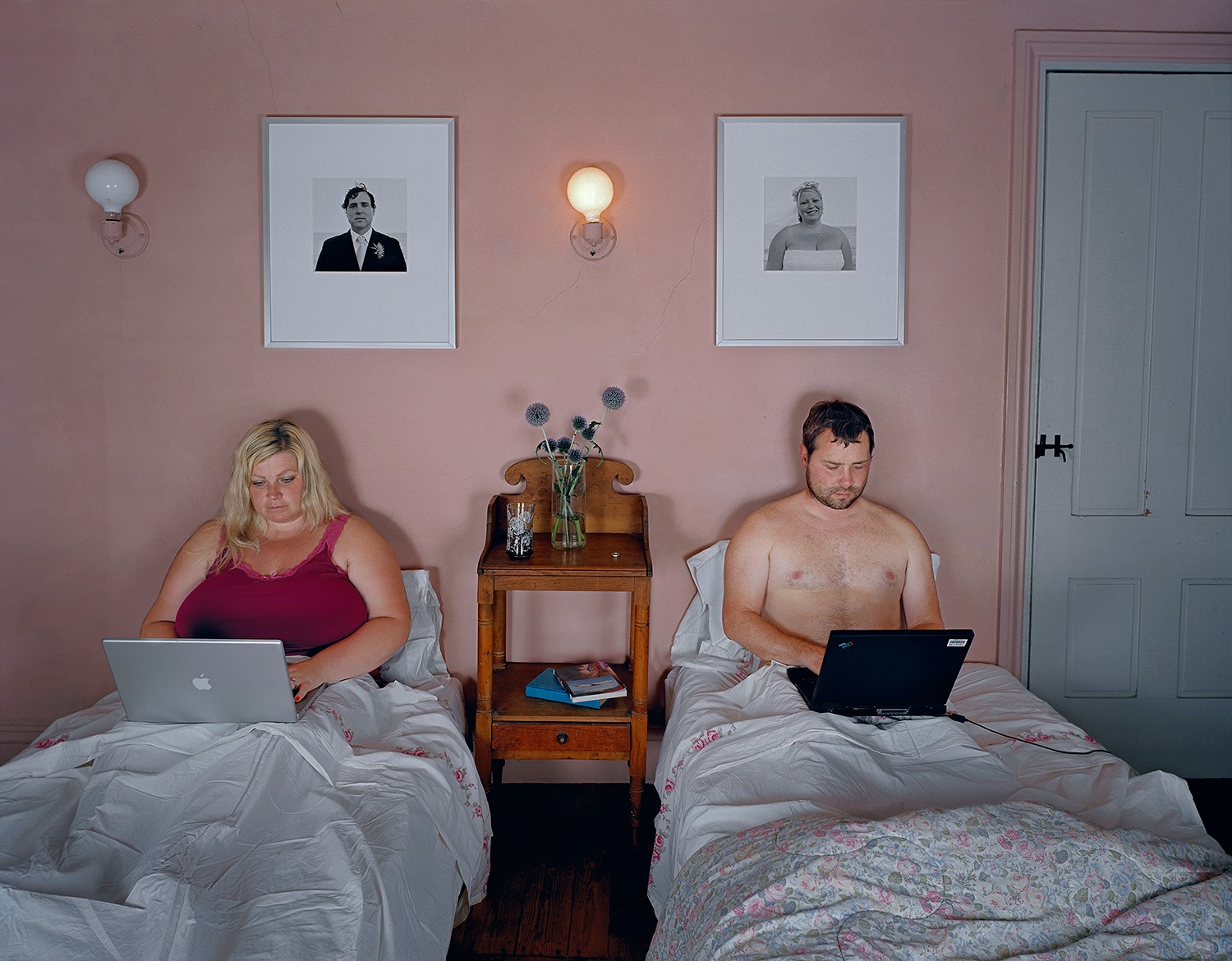
The silence that runs through these images carries tremendous weight. These are photographs of what isn’t being said – that unspoken tension in a marriage, the quiet distance between sisters, the exhaustion of new parenthood, the quiet solitude of decades together. Del Amo gives visual form to emotional states that many times don’t get represented.
Islands in the Same World
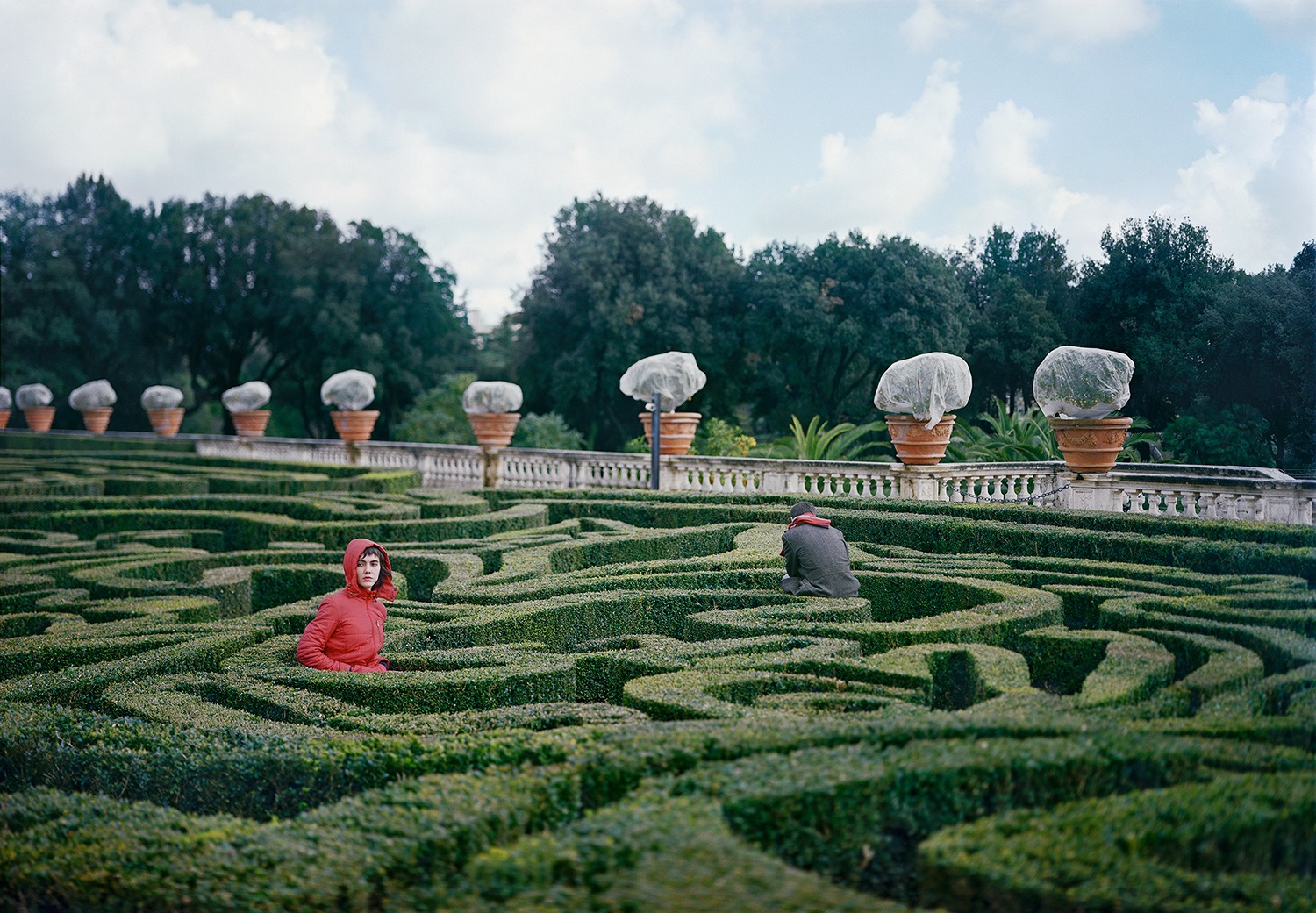
The title Archipelago provides the perfect metaphor. An archipelago is a chain of islands – separate landmasses that do are connected to the same geographical whole. Del Amo’s subjects are exactly this: isolated within shared spaces, connected by proximity but separated by interior distance.
“Using silence as a platform,” del Amo writes, “these photographs operate as a collection of ‘islands,’ separated by the loneliness of each one and linked by the intimate bond of belonging to the same world.”
From Corporate Life to Artistic Calling
Del Amo’s path to photography wasn’t direct. She worked in corporate management before discovering the medium, then lived what she describes as a “double life” – working a corporate job while nurturing her passion for photography.
“At the time I got started with photography, I was immersed in a corporate career,” she has recalled. “I fell in love with the medium and lived a double-life for a while. In order to look at my work, I sent the negatives to a lab to be developed and locked myself in the office restroom to look at the results.”
Eventually, the drive became too strong to ignore. She pursued formal training, earning an MFA from the Rhode Island School of Design, and committed fully to her artistic practice. Her work has since been exhibited internationally and supported by institutions including the Jerome Foundation, the New York State Council on the Arts, and the Spanish Ministry of Culture.
Her father, a writer, filmmaker, and playwright, provided early exposure to storytelling. “I grew up in an environment that revolved around telling stories,” she notes. “I enjoy the control and process of creating a narrative myself. I condense a story in one image and leave it up to the viewer to fill in the rest.”

The Question of Truth in Staged Photography
Some might ask: if the images are staged, are they true?
“Due to the indexical character of photography, every photograph captures a moment of the world, regardless of whether the photographer is capturing a moment or inventing one,” she explains.
“I like to think beyond the categories of documentary versus staged photography, and I consider every photographic image an interpretation of the world created with light.”
Her photographs “oscillate between reality and fiction.” She’s inspired by real locations and real stories, so the images are “born out of reality.” Yet they also represent a “departure from reality as it is because she’s interested in the tension between the exterior and interior lives – “what is projected to the outside versus what is going on inside of people’s minds.”
By acknowledging construction, del Amo achieves something documentary photography often misses: the truth that every photograph is a choice, a frame, an interpretation. Her staged images tell the truth about staging itself – about how we all perform for each other, how every relationship involves a kind of theater.
What Photography Can Express
For those of us who work with cameras, Archipelago offers a reminder of what our medium can achieve. Photography records what exists in front of the lens – it can also express interior states, emotional truths and the invisible islands of human relationships.
When asked what photography has taught her about herself, del Amo offers an honest answer: “It has confirmed my obsessive character and my tendency to gravitate towards similar themes.”
Ten years on a single project, exploring the same territory of connection and solitude is a commitment to an artistic vision.
These photographs invite us to look more carefully at the spaces we share with others and what goes unspoken in the rooms we call home.
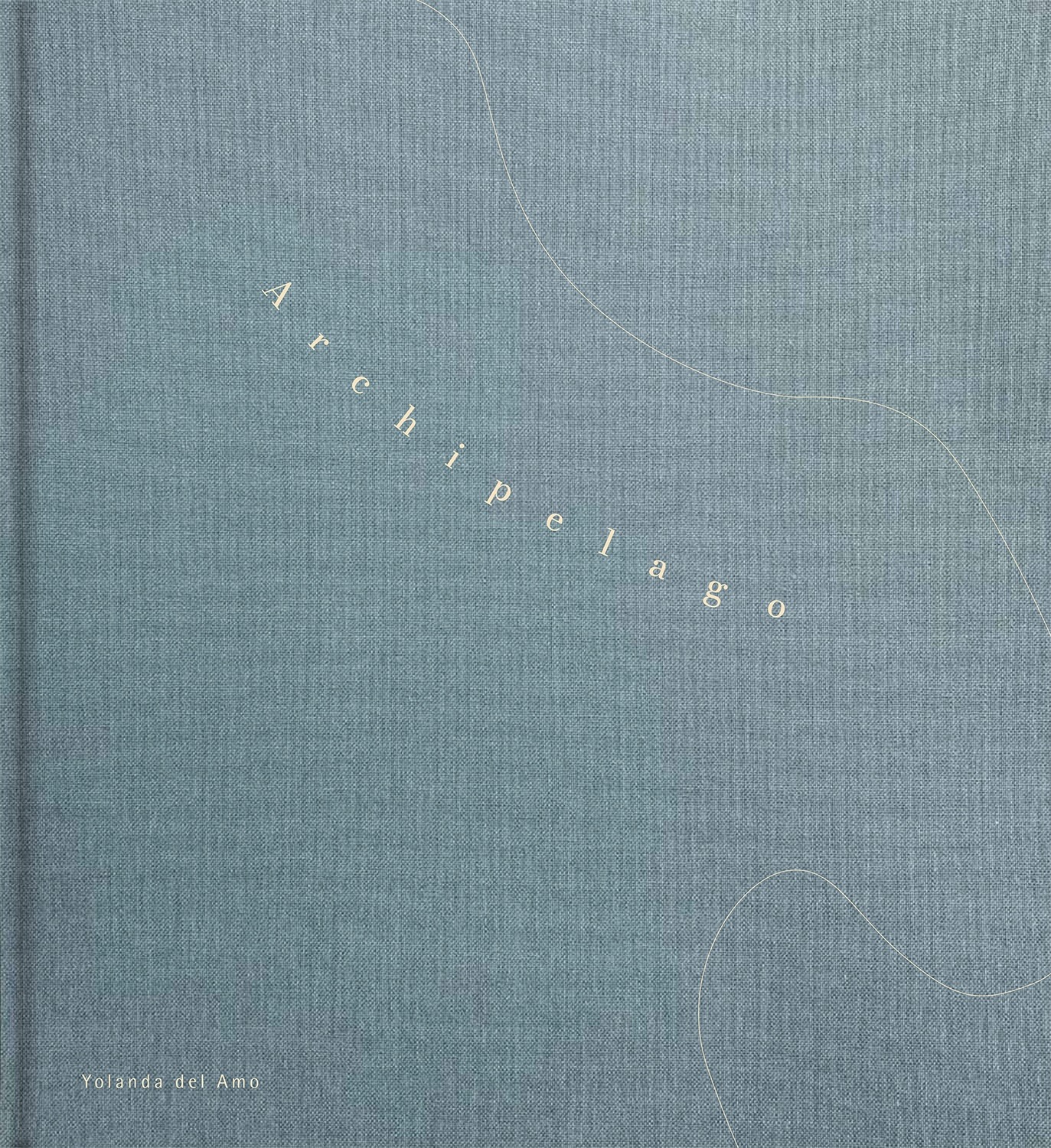
Archipelago by Yolanda del Amo Published by Kehrer Verlag Essays by Vicki Goldberg and Jean Dykstra Cloth hardcover, 128 pages, 47 color illustrations 10.6 x 11.6 inches ISBN 978-3-96900-228-5 Available January 2026 (Europe) / September 2026 (US)
Purchase: https://www.kehrerverlag.com/en/yolanda-del-amo-archipelago-978-3-96900-228-5
Artist website: https://www.yolandadelamo.com


Elevate Your Vision


Read this story and all the best stories on The Luminous Landscape
The author has made this story available to Luminous Landscape members only. Upgrade to get instant access to this story and other benefits available only to members.
Why choose us?
Luminous-Landscape is a membership site. Our website contains over 5300 articles on almost every topic, camera, lens and printer you can imagine. Our membership model is simple, just $2 a month ($24.00 USD a year). This $24 gains you access to a wealth of information including all our past and future video tutorials on such topics as Lightroom, Capture One, Printing, file management and dozens of interviews and travel videos.
- New Articles every few days
- All original content found nowhere else on the web
- No Pop Up Google Sense ads – Our advertisers are photo related
- Download/stream video to any device
- NEW videos monthly
- Top well-known photographer contributors
- Posts from industry leaders
- Speciality Photography Workshops
- Mobile device scalable
- Exclusive video interviews
- Special vendor offers for members
- Hands On Product reviews
- FREE – User Forum. One of the most read user forums on the internet
- Access to our community Buy and Sell pages; for members only.
You may also like