






A reader named Tilo recently wrote to The Luminous Landscape about our yearly membership banner. He led with this well played ZINGER:
“$24 a year, that’s less than $2 a month… Ah, yes, you’re photographers, not mathematicians.”
Well played sir. Indeed – we ARE photographers.
And in jest, I thought I’d write back that we observe the International Fixed Calendar of 13 months here at The Luminous Landscape. As I remembered a history class long ago where we discussed the proposal to have 13 months in a year.
On my journey to come up with the perfect snarky reply to Tilo, it led me to an icon in photography history. George Eastman. Yes, that George Eastman.

It turns out there was a Kodak calendar, and it really did have 13 months, and the man who pushed the plan was George Eastman himself.
The Calendar With an Extra Month
In the early 1900s, a British railway accountant named Moses B. Cotsworth got fed up with how uneven the Gregorian calendar was for tracking business performance. His fix: the International Fixed Calendar, 13 months of exactly 28 days each, every month a perfect 4 weeks.
They slotted the new month in between June and July and called it “Sol,” – named that because it was timed so the summer solstice landed right in the middle of it.
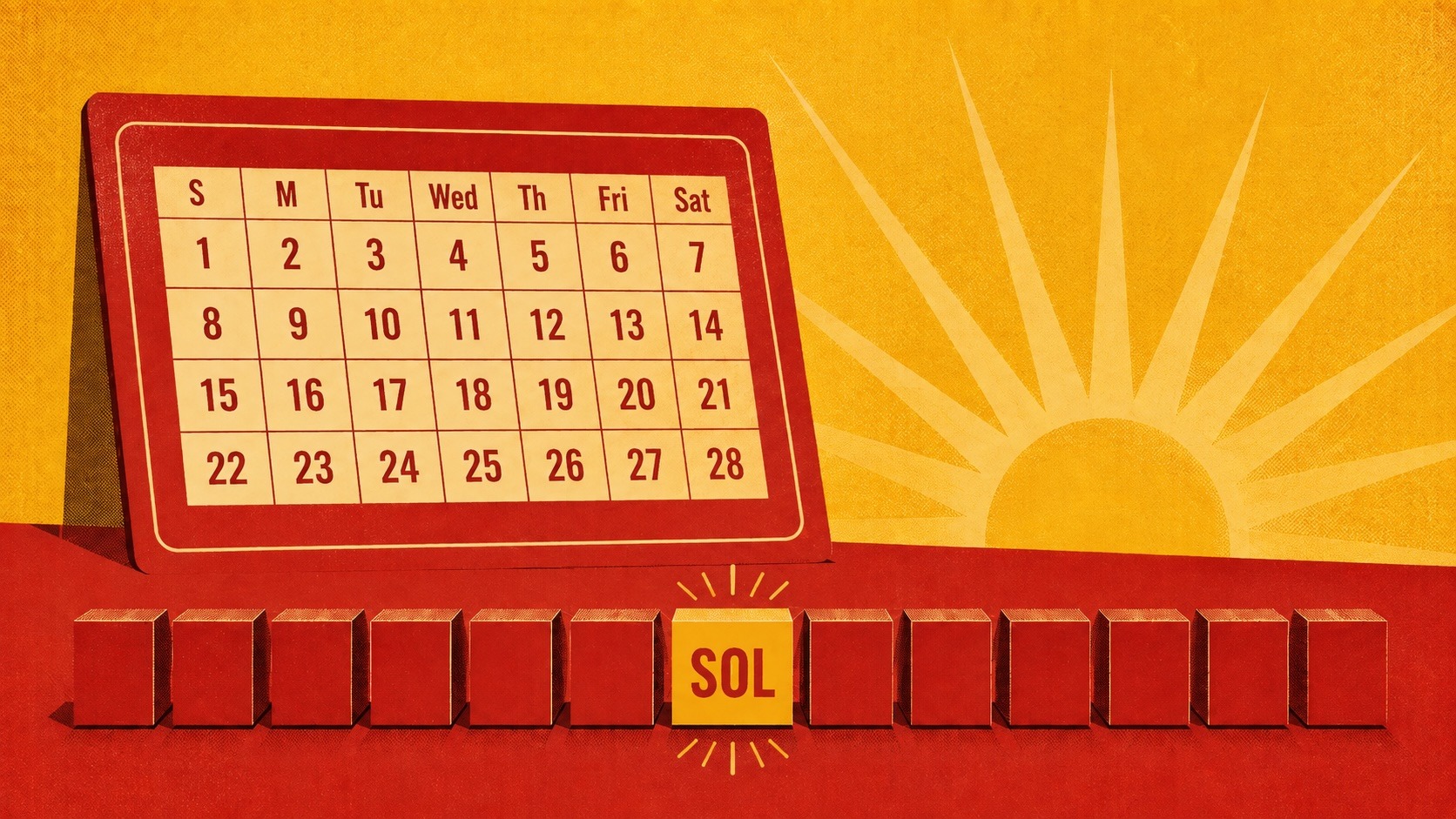
Since every month had the same 4 weeks, the 1st of the month always fell on the same day of the week, every month, every year. No more guessing whether the 15th was a Tuesday or a Thursday.
The leftover day (or two, in leap years) didn’t belong to any week at all. Kodak workers called it “Year Day,” which was a single calendar-free day tacked on at the end of the year just to make the math work.
Eastman Loved the Idea
Cotsworth’s idea landed on George Eastman’s desk around 1924, and Eastman soon became its loudest champion.
In 1928 he ordered Kodak to run its entire internal operation on the 13-month system: payroll, production reports, management statements, all of it.
Kodak stayed on that calendar until 1989. Sixty-one years of 13-month accounting.
Employees carried pocket calendars printed with the 13-month grid. Boardrooms had wall charts built around it.
Kodak even housed the U.S. office of the International Fixed Calendar League right inside its Rochester headquarters, using company resources to push the idea of Sol.
What Was He Thinking?
Well, this had nothing to do with photography. Eastman’s obsession was efficiency.
In a 1929 New York Times piece, he argued that modern industry had learned to conserve every resource except time, and that the standard 12-month calendar was, in his words, “a waste of time” compared to the 13-month plan.
He complained that with the old system, “nobody is ever sure until he has looked it up whether the first of the month falls in the beginning or the end of the week.”
Think about it from a factory owner’s perspective.
Uneven months make it difficult to compare February’s output to March’s output, or this year’s third quarter to last year’s. Give every month the same 4 weeks and then your production numbers, payroll cycles, and sales comparisons all line up cleanly, year after year.
Eastman called it a way to see the business “with mathematical accuracy.” Curators at the George Eastman Museum today describe his motivation the same way: it kept things running efficiently and kept records clean.
Why It Never Left Rochester
Eastman worked hard to give the world some SOL. He funded research, printed and distributed calendars by the thousands, and personally lobbied the League of Nations to consider the 13-month system as a global standard.
For a while it actually had a real shot, it was one of the finalists when the League narrowed down years of calendar reform proposals.
Then it hit a wall. Religious communities, especially Jewish and Seventh-day Adventist groups, had some push-back. Any calendar with a “blank day” outside the normal week structure breaks the continuous 7-day cycle, which means the Sabbath would drift to a different weekday depending on the year. That’s a big problem for observant communities. The League listened, and the international push for the 13-month calendar stalled out for good.
Kodak kept running its internal system anyway, long after the rest of the world moved on. But running one calendar inside the building and coordinating a different calendar with everyone else in the world – got harder every year.
By 1989, the friction finally outweighed the tidiness, and Kodak let it go.
So, Tilo About That Math
Eastman was obsessed with efficiency and as a manufacturer he was trying to make his books, his production lines, and his payroll clean, comparable, and predictable. The 13-month calendar was his plan. You see…we too are obsessed with efficiency and dedicated to carrying on photographic history.
The Luminous Landscape IS on Kodak’s 13-month calendar.
And mathematically, $24 a Kodak year IS less than two dollars a month. At those prices, it just make sense to: Become a LuLa Member
Tilo, thank you for a good zinger, and for finishing with: “Seriously, love your site and photos.”
Alas, we are photographers and not mathematicians.
And to be clear you can Support Luminous Landscape any time of the year – all 13 months.





Elevate Your Vision


You may also like