“Photography, at its best, is not the art of capturing what is there, but the art of revealing what is not visible at a casual glance.” – Paul Bock
The Architecture of Intention: How interhemispheric communication transforms a simple record of light into a deliberate visual statement.
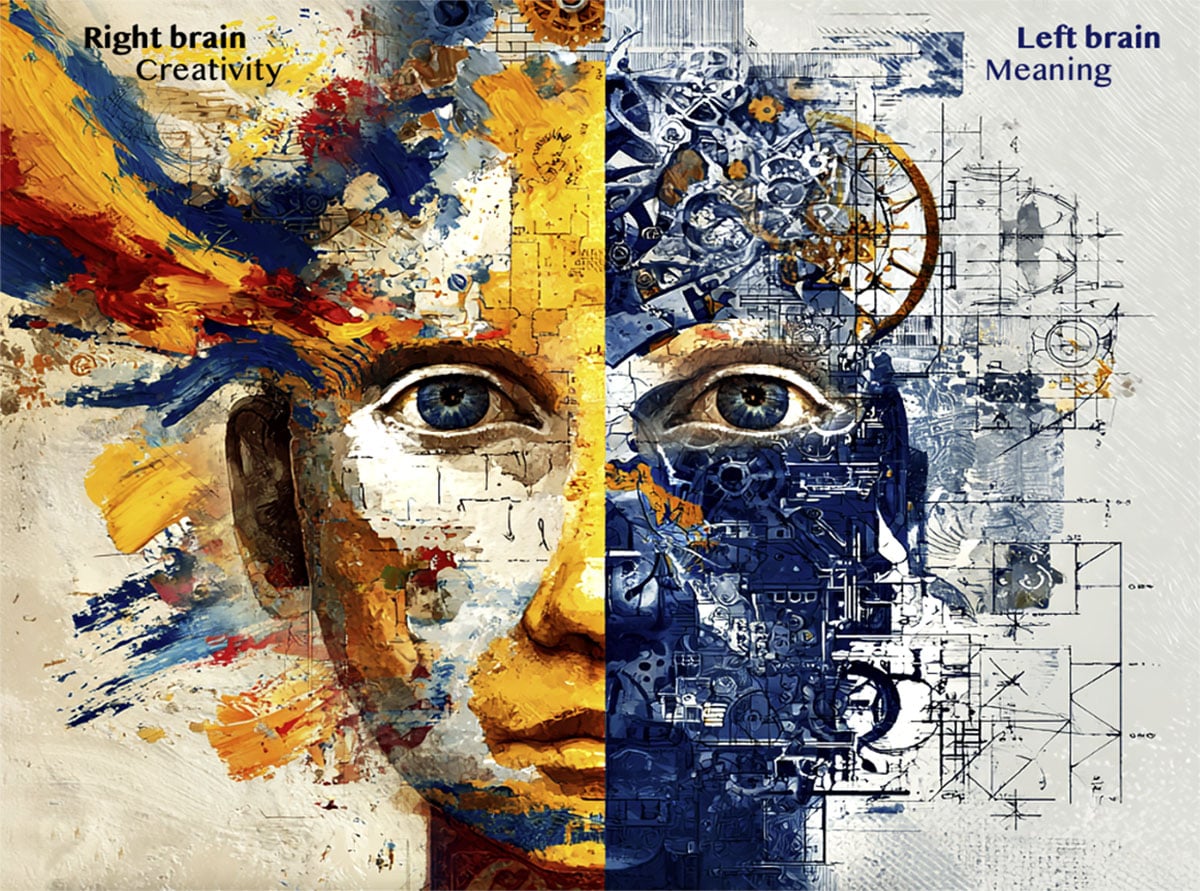
There is a lot of talk about photographic equipment, cameras, lenses, chip resolutions, tripods, you name it, but we never, well, almost never talk about a major piece of “equipment”, although all of us own one: our brains.
The mark of a good photographer is less what they hold in their hand, it is more what they hold in their head. Our brains are fascinating equipment and having two halves of them make it a major component of our photographic creativity.
The left hemisphere, associated with logic, facts, language, order, and control, while the right hemisphere, tied to imagination, intuition, creativity, emotion and symbolism, are often described as separate worlds. Yet, they do not exist in isolation. They are two halves of a unified whole, connected by the corpus callosum, a bundle of nearly 200 million nerve fibers that allows and facilitates constant communication. The left and right hemispheres communicate continuously through the corpus callosum, a massive neural bridge that integrates precision with intuition, structure with meaning.
This left-right communication and cooperation is not automatic or fixed; it can be consciously trained and strengthened, through activities that integrate logic with imagination, such as music, drawing, writing, problem solving, and of course, photography. When this interhemispheric dialogue becomes refined, creative communication deepens, the technique becomes expressive, and expression becomes deliberate and intentional.
Creativity is not the privilege of the artist or the engineer, but the natural inheritance of every human being. To live fully, we must not only recognize the bond between our two halves but transform it into a dynamic partnership that guides us toward truth, beauty, and innovation.
The left hemisphere tends to specialize in logic, structure, sequencing, and technical control, while the right is more attuned to emotion, intuition, spatial awareness, and symbolism.
Creativity—especially in photography—emerges most strongly when these two modes are tightly integrated.
During the act of photographing, the corpus callosum enables the technical eye of the left brain (exposure, focus, geometry, timing) to work seamlessly with the poetic eye of the right brain (mood, meaning, tension, story).
When this bridge is active and fluid, the photographer does not merely record what is in front of the lens, but transforms perception into intention, turning light, form, and gesture into a coherent visual statement that carries meaning, not just information.
Every person has two hemispheres. The connection exists by nature, but the bond must be cultivated by choice. To unlock creativity:
We acknowledge both sides: we do not suppress imagination for the sake of logic, nor ignore reality in the pursuit of beauty. We exercise both: we train our analytical skills but also nurture imagination and artistic expression. We integrate consciously: we use imagination to inform decisions and use logic to bring visions to life.
Purpose emerges when our whole brain—right and left—works together.
A meaningful photograph is never just a record of what stood before the lens. It is the trace of a moment in which the world and the photographer met with intention.
Meaning arises when the image carries something beyond appearance—when it reveals a quiet structure, an emotional truth, or a thought that cannot be spoken but can be seen. In a meaningful photograph, the visible world becomes a language. Light, distance, gesture, and form are shaped into something that resonates in the viewer: recognition, memory, longing, silence.
The image does not shout; it invites. It holds enough clarity to guide the eye and enough mystery to awaken imagination.
Every photograph carries a fragment of the photographer’s inner life. We do not photograph only the world; we photograph our way of being in it. A meaningful image becomes a bridge between the outer landscape and the inner landscape, between the moment experienced and the meaning discovered.
Photography, at its best, is not the art of capturing what is there, but the art of revealing what is not visible at a casual glance.
Meaning reveals more than the eye normally sees.
Not through trickery, but through the photographer’s way of looking:
– a gesture people usually overlook
– a subtle relationship between shapes and light
– an emotional truth in a face
– a fleeting moment that contains a larger story
Photography gives meaning when it discovers something, not when it confirms the obvious.
As an engineer, my training demanded precision: calculations grounded in physics, adherence to building codes, regulations, and respect for the immutable laws of nature. At the same time, as a writer and photographer, my artistic side flourished through international photo exhibitions that required intuition, aesthetic sensibility, and creative daring.
What unites these pursuits is not a conflict of left and right brain but their bond—a partnership that fuels innovation, creativity and expression.
Interestingly, most of the people use mostly only one side of their brain. We all know engineers and accountants, who know their numbers to the perfection, but have no sense of humor, and probably never bothered to read a poem. We also know talented artists, who do not know how to balance a check book or how to manage their own finances.
Photographers see the world differently; we see it in full color, and we distinguish shades of gray; and when we decide to photograph a scene, we see more than what is in front of us. We discover the hidden meanings of things or situations; we find connections which are visible only by the full use of both sides of our brains.
Everything I have shared so far—the dialogue between logic and imagination, the harmony of the left and right brain—finds its truest expression not only in words, but in images. Therefore, I invite you to join me in a visual journey through some of my photographs that represent this bond—where structure meets poetry, and where reason embraces wonder and where the unseen becomes meaning.
Global Case Studies: From the “silent scream” of the Antelope Canyon to the geometric social inversions found in the streets of Lisbon and the ideological tensions of Istanbul’s Taksim Square.
1. Silent Scream (Upper Antelope Canyon, Arizona)
Deep inside the Upper Antelope “Slot” Canyon, the sunlight scatters through the narrow „slot” opening and bathes the canyon walls in a spectrum not visible anywhere else. The bright yellows and whites are the direct reflection of sunlight, the many hues of red are the color of the sandstone, and the purples are the reflection of the blue sky on the red rock.
By choosing an intimate, close-up framing rather than showing the canyon floor, the lens reveals a “silent” expression reminiscent of Munch’s The Scream.
2. The Shoeshine Boy (Lisbon, Portugal)
The left brain anchors this moment in geometry—the sharp diagonals of the paving stones and the precise framing of two figures in space. But the right brain interprets the soul: a quiet inversion of traditional social expectations. The camera allowed me to freeze the frame, but introspection allowed me to see the meaning—a silent dialogue on the shifting nature of status, dignity, and the human condition.
3. The Dragon Gate (Los Angeles, California)
This high-contrast night scene serves as a study in interhemispheric interaction, bridging architecture and spirit. The “Left-Brain” captures the tiered, Neoclassical geometry of City Hall, while the “Right-Brain” finds a philosophical entry in the golden dragons—guardians representing a balance of harmony and wisdom.
4. Taksim Square (Istanbul, Turkey)
A documentation of “Realpolitik” and the dual identity of a nation. The grounded, secular Republic Monument (1928) represents Atatürk’s legacy, while the soaring minarets of the Taksim Mosque (2021) represent the resurgence of public religious expression. They occupy the same frame in a delicate, often strained coexistence.
5. The Zipper of Oculus (New York, New York)
A fusion of 21st-century engineering and the spiritual awe of medieval cathedrals: Designed by Santiago Calatrava, the central skylight (the “Zipper”) is precision-aligned with the sun’s angles on September 11. At the exact moment of the 9/11 attacks, a “Wedge of Light” illuminates the floor, transforming a transit hub into a cosmic memorial.
6. The Fate of Europe? (Cologne, Germany)
Using the camera as a witness to seismic demographic and cultural shifts through architectural change. This image documents the transition from the historic Cologne Cathedral though the relatively new Bundestag (Parliament) in Berlin to the modern Central Mosque. It reflects a landscape where hundreds of churches have closed as hundreds of mosques have risen, marking a shift in the continent’s cultural soul.
7. Harvard Glacier (Prince William Sound, Alaska)
Capturing a moment of absolute equilibrium between force and fragility. The immense frozen mass, scored by dark moraine lines, presses forward into mirror-still water. It stands as a “Left-Brain” study in weight and geological time and a “Right-Brain” premonition of environmental change.
8. Twenty Years Later (Yellowstone National Park)
A narrative of endurance and the “Right-Brain” affirmation of life following catastrophe. Two decades after the devastating fires of 1988, the scars are still visible, yet the frame is filled with the joy of new forest growth. It is a testament to the strength and determination of Nature to repair itself.
9. Pilgrimage at Lake Tuz (Central Anatolia, Turkey)
A surreal landscape where natural beauty meets magical belief. Lake Tuz, a hypersaline salt lake, creates mirror-like reflections that challenge spatial perception. Here, visitors flock to a “Wishing Tree,” seeking to connect with out-worldly beauty through a simple rag or plastic bag.
10. Red on Li River
Ambiguity invites the viewer to participate. Not confusion, but depth—space for the viewer’s imagination, interpretation, and memory. Meaning grows when the viewer finishes what the photographer began.
11. Breaking the Sound Barrier
The ultimate meeting of high-precision engineering and ephemeral, poetic beauty. At Mach 1, localized pressure drops create a “fleeting sculpture of cloud and steel”. The “Left-Brain” understands the physics of condensation; the “Right-Brain” sees a beautiful cone-shaped vapor cloud.
12. The Dance (Upper Antelope Canyon, Arizona)
The first image of this article was the “Silent Scream”, an image taken in the Antelope Canyon, Arizona. Concluding this interhemispheric journey, where ambiguity invites viewer participation is another image from the Antelope Canyon, where sunlight scatters through the narrow opening, creating an orgy of color. Is it a rock formation, a kiss frozen in time, or a graceful dancer with flowing hair? Meaning grows when the viewer finishes what the photographer began.
Follow his work and ongoing reflections at:
Elevate Your Vision
Join our community of passionate photographers.
Access our extensive knowledge archive.
Master the art of landscape and beyond.
By submitting this form, you are consenting to receive marketing emails from: The Luminous Landscape Inc. https://luminous-landscape.com. You can revoke your consent to receive emails at any time by using the SafeUnsubscribe® link, found at the bottom of every email. Emails are serviced by Constant Contact.
Read this story and all the best stories on The Luminous Landscape
The author has made this story available to Luminous Landscape members only. Upgrade to get instant access to this story and other benefits available only to members.
Why choose us?
Luminous-Landscape is a membership site. Our website contains over 5300 articles on almost every topic, camera, lens and printer you can imagine. Our membership model is simple, just $2 a month ($24.00 USD a year). This $24 gains you access to a wealth of information including all our past and future video tutorials on such topics as Lightroom, Capture One, Printing, file management and dozens of interviews and travel videos.
New Articles every few days
All original content found nowhere else on the web
No Pop Up Google Sense ads – Our advertisers are photo related
Download/stream video to any device
NEW videos monthly
Top well-known photographer contributors
Posts from industry leaders
Speciality Photography Workshops
Mobile device scalable
Exclusive video interviews
Special vendor offers for members
Hands On Product reviews
FREE – User Forum. One of the most read user forums on the internet
Access to our community Buy and Sell pages; for members only.
Paul Bock, PE, HonCPE, ACPE, is a Professional Engineer, author and internationally exhibited photographer whose work explores the synergy between technical precision and emotional meaning.
Over several decades, Paul’s photography has been recognized in numerous international solo exhibitions, earning awards and distinctions for his artistic ability to transform raw information into a coherent visual statement. His collection, “Secrets of the Stone,” was featured at the First International Photo Festival in Shenzhen and is now part of the permanent exhibit at the Shunde Art Museum in Guangdong, China.
Paul is an international juror, and since 2013 is the vice president of the US Branch of the EuroFotoArt Association. He is a frequent presenter, teaching photographers how to integrate the "technical eye" of logic with the "poetic eye" of story and other subjects. Through his lens, he seeks to connect the outer landscape and the inner world of the photographer, revealing that purpose emerges when the left and right brain cooperate creatively.
Paul is an expert in investing in Closed End Funds and had written two books on the subject: “Let Your Money Work for You - The Wonderful World of CEFs” and “Dividends Rule”, both available on amazon.com.
Follow his work and ongoing reflections at:
www.paulbockphoto.com | thebockblog.com | amazon.com/s?k=bock+cef
Be in the Know: Get the Exclusive LuLa Newsletter Sent to Your Inbox!
Get access to exclusive articles, behind-the-scenes content, and become a valued member of our photography team! Subscribe now to elevate your photography experience.