


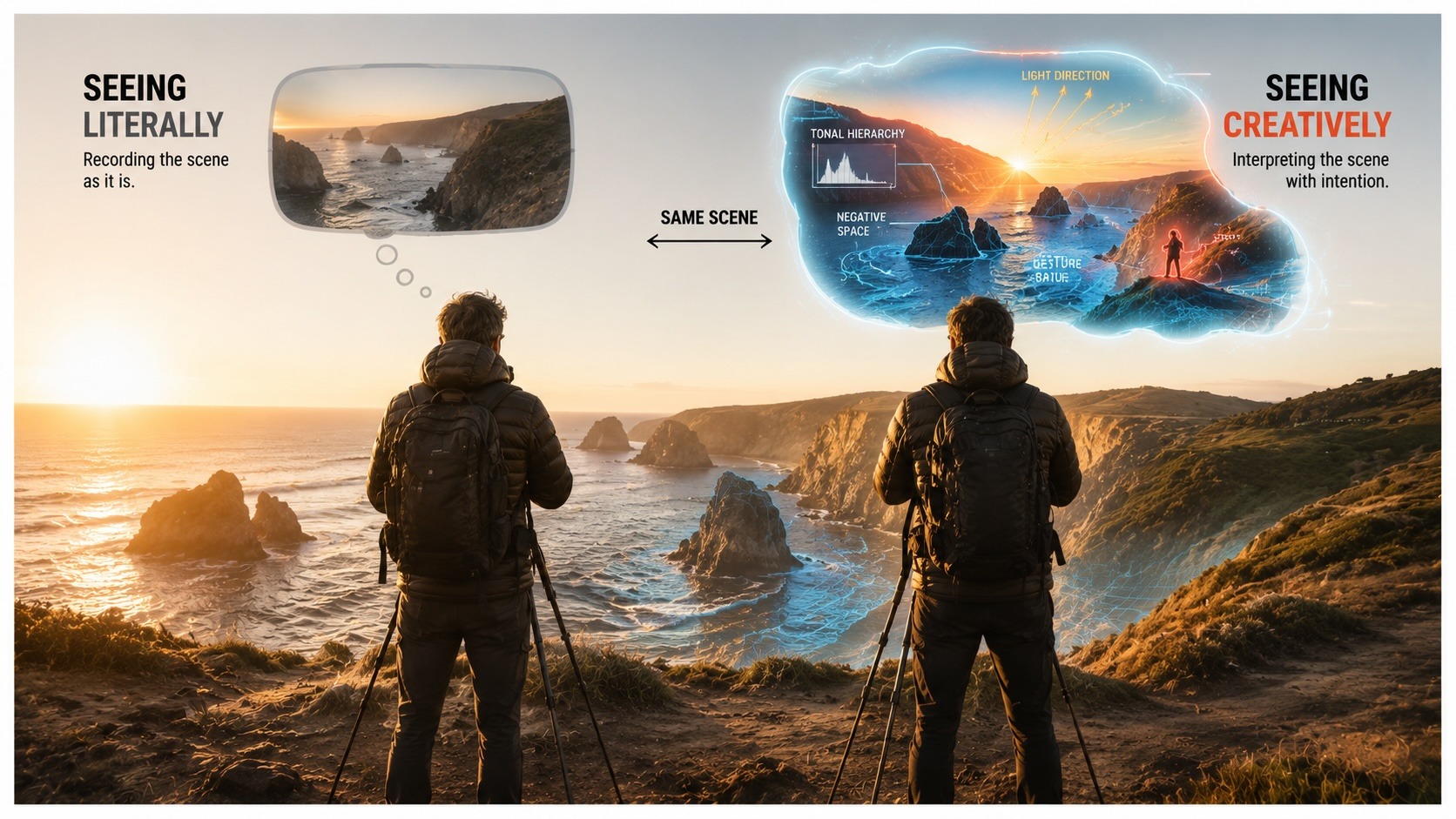


Two photographers with the same camera setup are standing in the same location. Same light. Same scene. One comes away with a competent record of what was there. The other comes away with something extraordinary.
Their prescriptions might be identical. Their equipment is the same. The difference is in how they see – and seeing, at the level that matters for photography, is a skill built in the brain, not the eye.
This is the article about that.
Acuity and Awareness Are Different Things
Acuity is what an eye chart measures. It’s the optical resolving power of your cornea and lens, expressed as a ratio. 20/20 means you can read at 20 feet what a reference eye reads at 20 feet. It tells you the optics are working.
Awareness is something else. It’s what your brain selects, attends to, and registers consciously from the onslaught of visual information the eye delivers every second. The eye sends roughly 10 million bits of data per second toward the brain. The brain processes a fraction of that consciously – and which fraction it selects is determined by attention, expectation, expertise, and habit.
You can have perfect acuity and sometimes miss what’s in front of you.
You can have compromised acuity and see more than almost anyone in the room.
Here’s the photographer’s project – that underneath all the camera gear and technique – we expand what we consciously perceive. It’s a training project.
Gorillas in the Midst
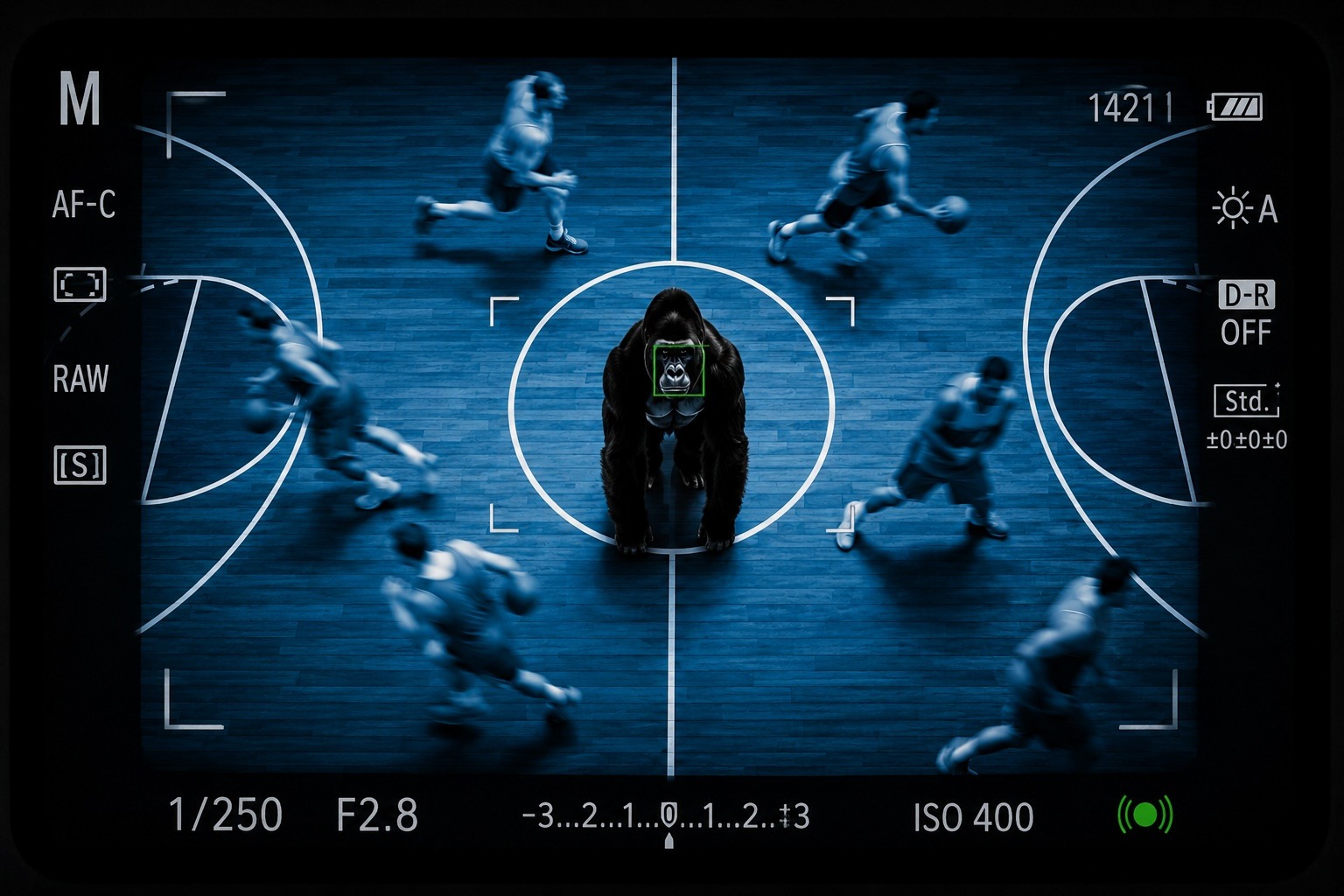
In 1999, psychologists Daniel Simons and Christopher Chabris ran an experiment that changed how scientists think about vision. They showed people a short video of two teams passing basketballs and asked them to count the passes made by one team.
Afterward, they asked: did you notice anything unusual?
Forty-six percent of observers had missed a person in a gorilla suit walking through the middle of the scene, stopping to beat their chest, and walking out. The gorilla was on screen for nine seconds.
This is inattentional blindness – the failure to perceive something fully visible because attention is directed elsewhere. And it’s universal. It happens to everyone, in every context, including photography. We sometimes don’t see what we see.
When you’re managing exposure, tracking focus, anticipating the moment – your attention narrows. The gorilla walks through your frame. You press the shutter and never see it.
Photographers who catch those moments have trained their attention to stay broad under pressure. That’s a specific, learnable skill. How do we see the gorilla?
How Experts See
Eye-tracking research on photographers and visual artists reveals something: experts move through a scene differently.
Novices tend to fixate on salient points – the brightest area, the most obvious subject, the center of the frame. Their saccades are reactive, drawn by whatever demands attention first.
Experts use global scanning patterns. Their eyes move through a scene in structured paths that build a spatial map of the whole frame – edges, negative space, tonal relationships, movement at the periphery – before settling into detail. They see the composition before they see the subject.
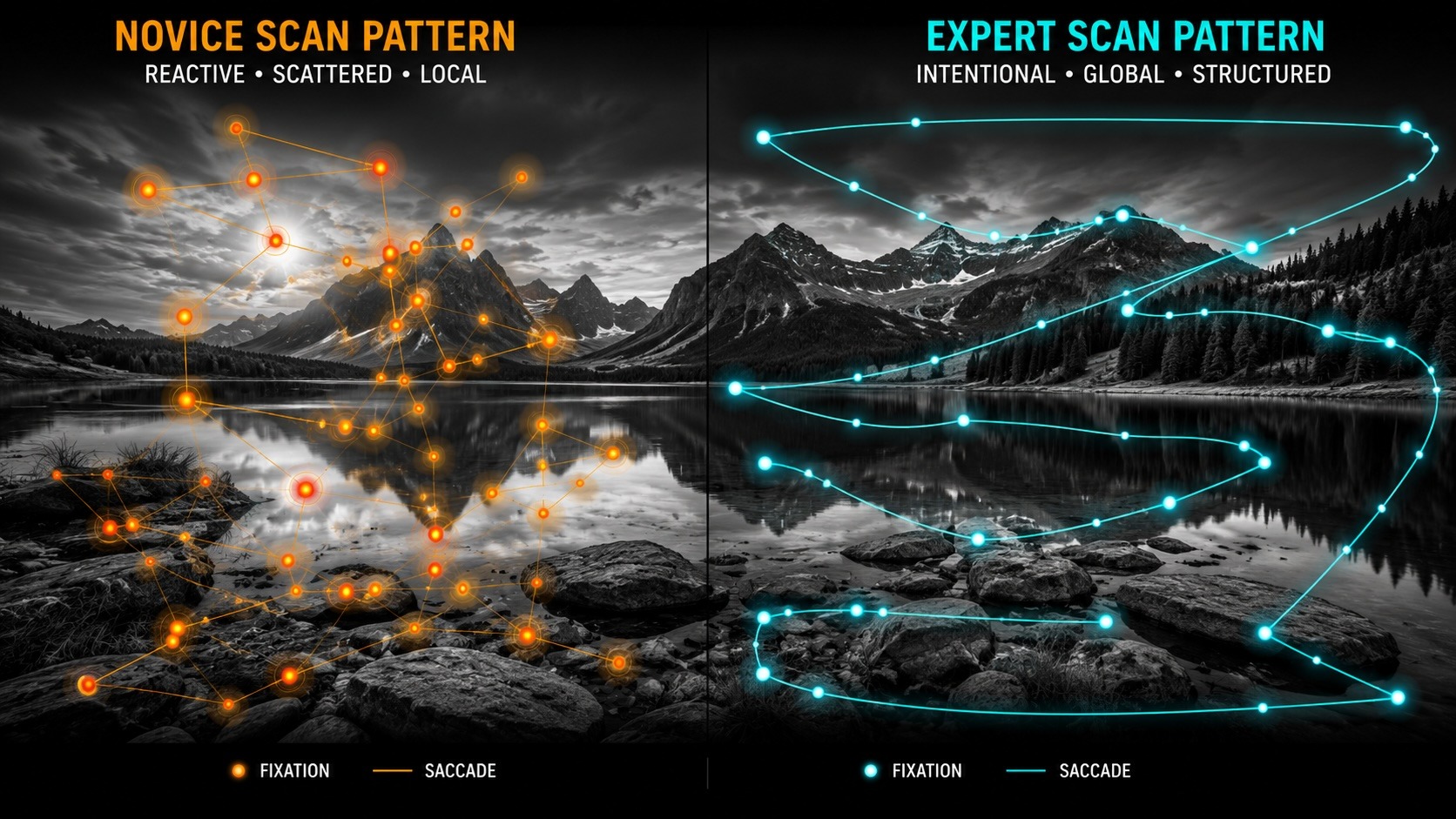
This pattern develops with practice. The visual system learns what to look for, and those features begin to pop out automatically. A landscape photographer may start noticing light direction before they notice the landscape itself. A street photographer’s peripheral awareness catches a gesture before conscious attention arrives.
Expertise also does something counterintuitive: it can narrow attention in specific domains. In another gorilla study, it was shown expert fingerprint analysts were more likely than novices to miss an embedded gorilla image while examining a fingerprint – because expertise means efficient filtering of the irrelevant.
The lesson for photographers: train global awareness deliberately, alongside your technical skills. Expertise in one domain can create blind spots in another.
The Brain Builds the Image
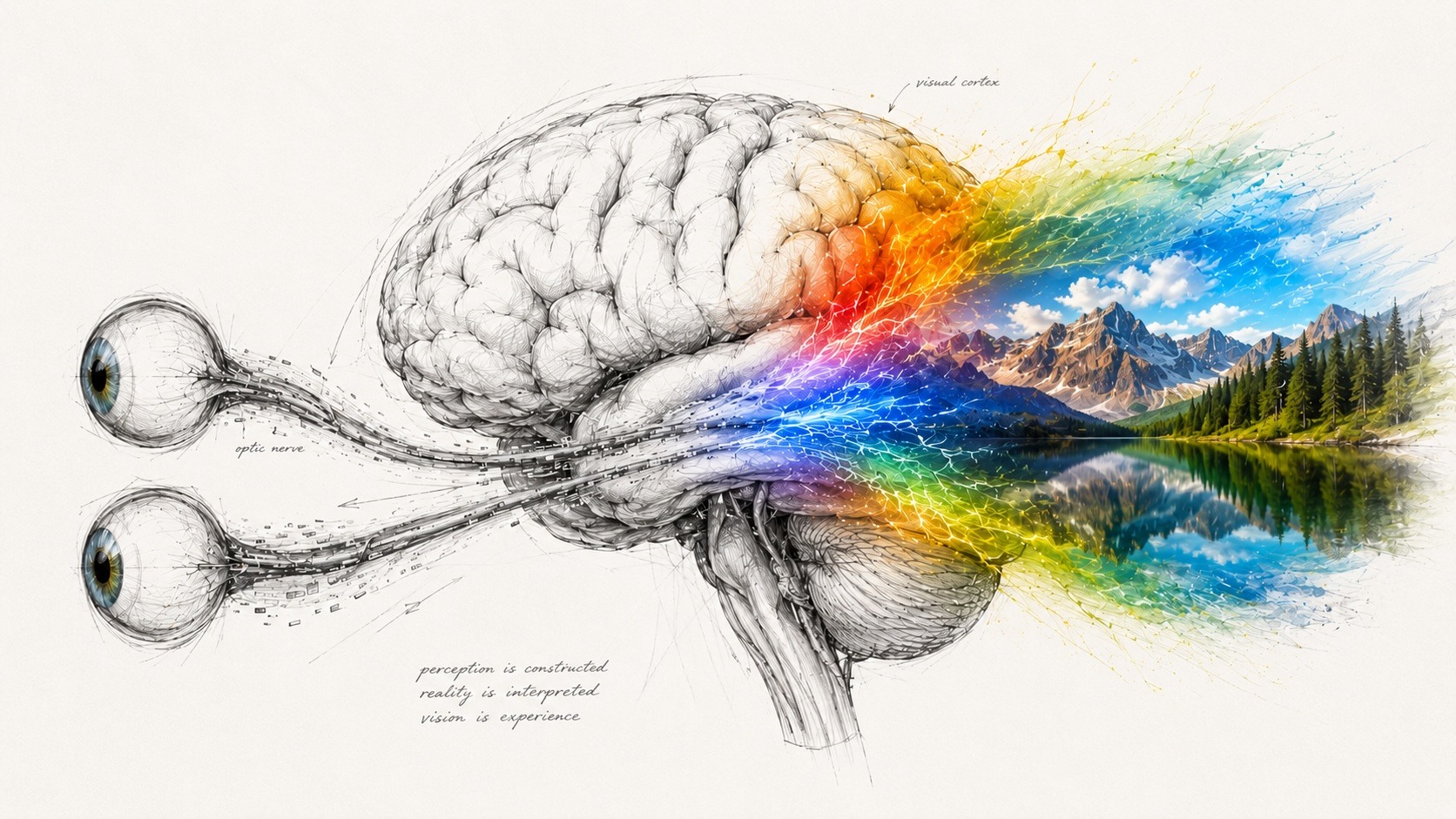
Color, depth, motion, sharpness – none of these are properties of light.
They’re actually constructions the brain assembles from raw photoreceptor signals.
Color is an inference. The brain compares the ratio of signals across three cone populations and assigns a color experience. Two surfaces with completely different spectral reflectances can appear identical under different lighting conditions – a phenomenon called metamerism.
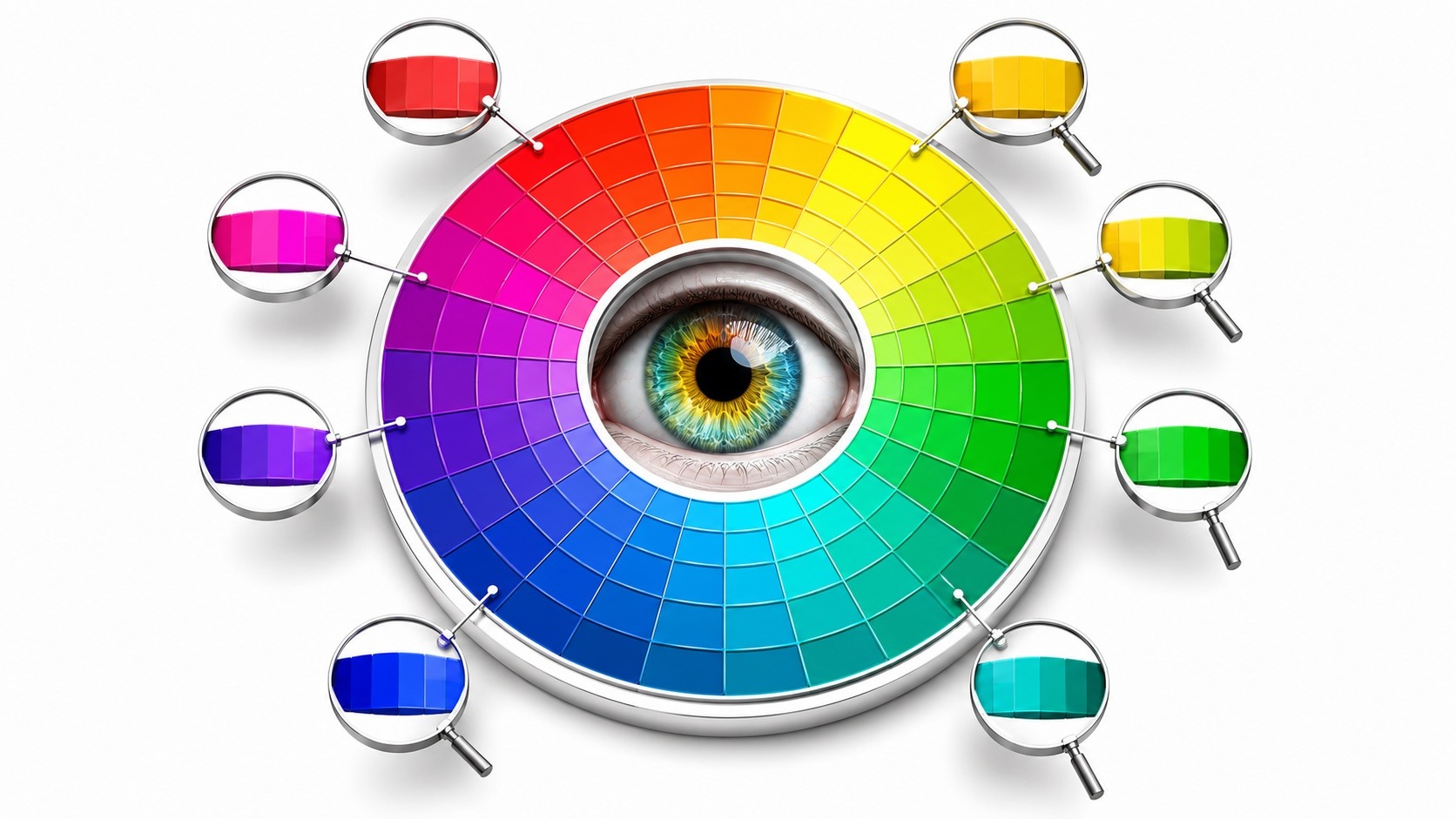
Your visual system adapts so thoroughly to ambient color temperature that you perceive a white wall as white under tungsten, fluorescent, and daylight, even though the spectral content of the reflected light differs dramatically in each case.
This is why color calibration matters for editing. A tired visual system drifting under the influence of ambient room light will make different color decisions than a rested one working under a properly controlled environment. The brain is making the edit as much as the hands are.
Depth is a construction from multiple cues – binocular disparity, perspective, relative size, atmospheric haze, motion parallax. The brain synthesizes these into a three-dimensional experience from two flat retinal images.
Photographers learn to read depth cues so fluently they can represent three-dimensional space convincingly on a flat surface – not because their eyes are different, but because their brains have learned to decompose what most people perceive as a unified experience.
Peripheral Vision and the Composition Instinct
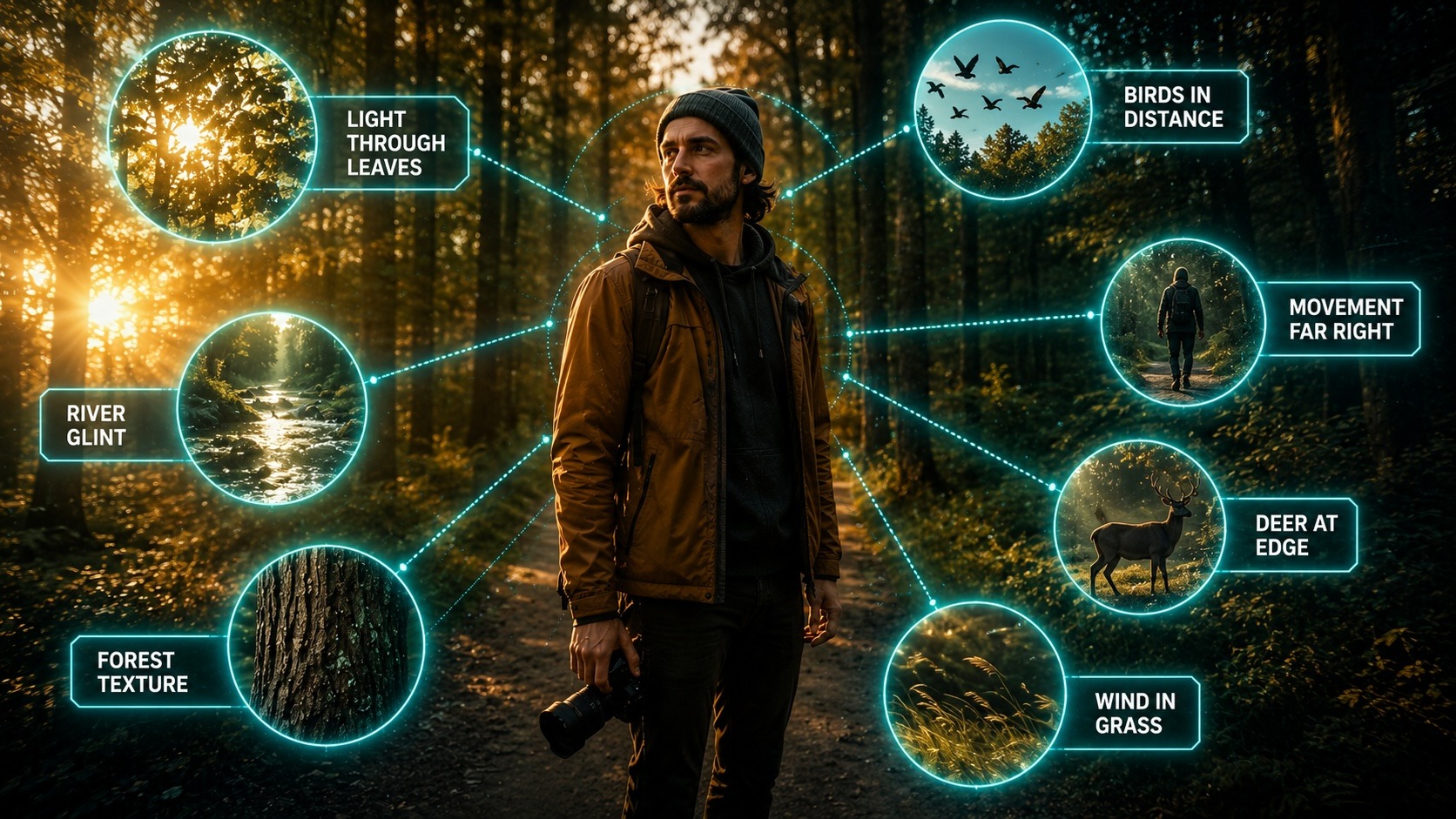
The peripheral retina delivers low-resolution, motion-sensitive, gist-level information. It can’t resolve fine detail. What it does – and does it well – is capture the spatial layout of a scene in a single fixation.
Before your eyes move, before a single saccade fires, your peripheral vision has already sketched the composition. The brain uses that sketch to decide where to look next.
Photographers who develop strong peripheral awareness are, in effect, pre-visualizing before they consciously frame.
Training peripheral attention is a practice of deliberate noticing. Fix your gaze on a point and, without moving your eyes, expand your awareness outward to the edges of your field. Notice the shapes, the movement, the tonal masses at the margins.
Do this regularly – on the street, in the field, in ordinary moments – and the peripheral sketch your brain generates becomes richer and more compositionally useful.
The motion sensitivity of peripheral vision is ancient hardware. Your eye is wired to detect movement at the edges and fire a reflexive saccade toward it. Photographers working with unpredictable subjects – wildlife, children, street – learn to trust that peripheral flash. It arrives before conscious thought. Let’s follow it.
Color Perception: Training the Brain’s Parser
The photoreceptors themselves are fixed. Three cone types, their spectral sensitivities determined at birth. What we train is the brain’s categorization and labeling of color – the parsing system that turns raw wavelength ratios into named, remembered, and discriminated hues. “What color is this?”
Research shows that color discrimination thresholds genuinely drop with practice – you get better at distinguishing very similar colors the more you train. The gains are specific to the trained hues and require sustained, focused effort.
More practically, artists and photographers develop finer color vocabulary. They learn to name subtle hue shifts, to see temperature differences that read as neutral to an untrained eye, to distinguish a magenta cast from a red one at the level where it matters in an edit. This vocabulary is learned. It builds with exposure, attention, and practice.
Ways to build it:
- Work with physical color references. Paint chip matching, color swatch sorting, the Farnsworth-Munsell 100 Hue test. Physical color forces finer discrimination than screen-based work alone.
- Practice naming color temperature in natural light – not in Kelvin, but in relationships. This light is warmer than that shadow. The highlight has a green cast the shadow doesn’t.
- Calibrate and profile your monitor. A properly calibrated display gives you a consistent reference point. So your color vocabulary builds on reliable ground.
- Review images in consistent, controlled light. Ambient room color shifts your perception of every image on screen.
Mindfulness and the Trained Eye
Attention is the backbone of photography. Every decision – what to include, when to press the shutter, where to place the horizon, where to put the focus – all of this an attention decision. And attention, the research shows clearly, responds to training.
A landmark study at a three-month meditation retreat found that intensive attention training measurably improved visual discrimination and reduced the vigilance decrement – the drop-off in perceptual accuracy that comes with time on task.
In plain terms: trained attention stays sharp longer. The practiced meditator makes better visual judgments in hour three of a shoot than the untrained eye does.
Shorter practices work too. A 2025 preregistered study found that 30 days of 10-15 minutes of daily mindfulness practice improved saccadic reaction times and goal-directed attentional control. The eyes moved more accurately toward intended targets and resisted distraction better.
Mindfulness trains the same attention you use waiting for light to break, scanning for the gesture, holding steady in a scene that hasn’t opened up yet. That patient, open state – the one that produces incredible photographs – is trainable.
Fifteen minutes of sustained attention daily builds the same faculty. Sit with your breath. Watch a single visual field. Listen to the sounds around you. Try and do it daily. The effects are said to compound.
Observational Drawing: Seeing Without the Shutter
Drawing forces something photography can defer: sustained, structured looking.
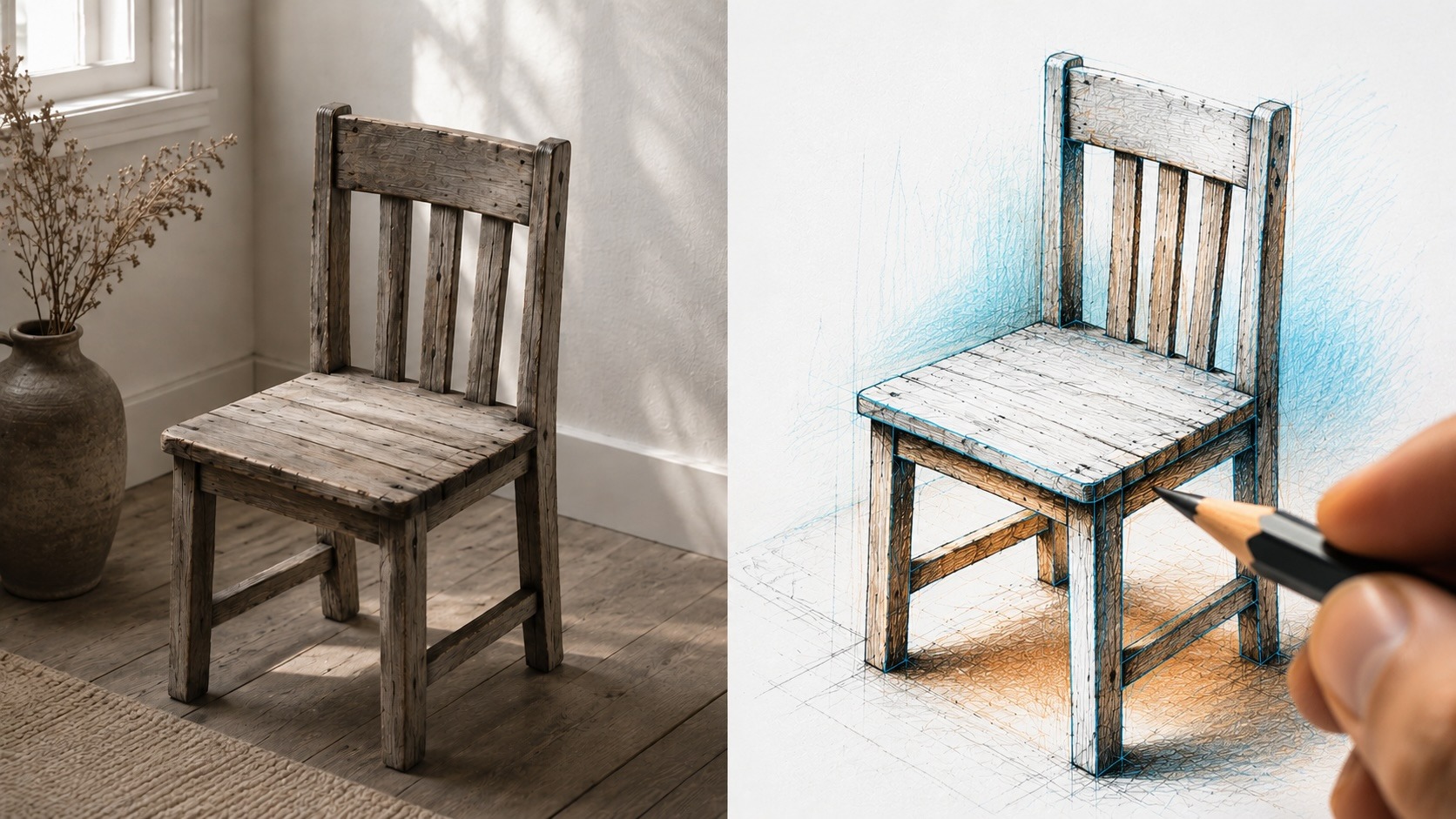
When you draw from observation, you can’t approximate. The eye has to follow the actual edge, measure the actual angle, compare the actual tonal relationship. The brain’s shortcut systems – the ones that substitute a symbol for a face, a generic shape for a hand – get overridden by the demand for accuracy. You start to see what’s actually there rather than what you expect to be there.
Eye-tracking research shows that people learning to draw develop more efficient, globally organized scanning patterns – the same patterns seen in expert photographers. The visual working memory improves. The ability to hold a spatial relationship in mind while looking at another part of a scene strengthens.
The benefit comes from the practice of looking, not the quality of the result. (It doesn’t matter how it looks!) Spend 20 minutes drawing something in front of you – your camera, a chair, the plant, a window, a face. Draw slowly. Take your time. The practice reorganizes how your visual system approaches a scene.
Many photographers who draw – report a shift in how they see through the viewfinder. Compositions feel more deliberate. The relationship between positive and negative space becomes easier to read. Light and shadow separate more clearly.
This is the visual cortex, reorganized by sustained observational practice.
Being Present in the Scene
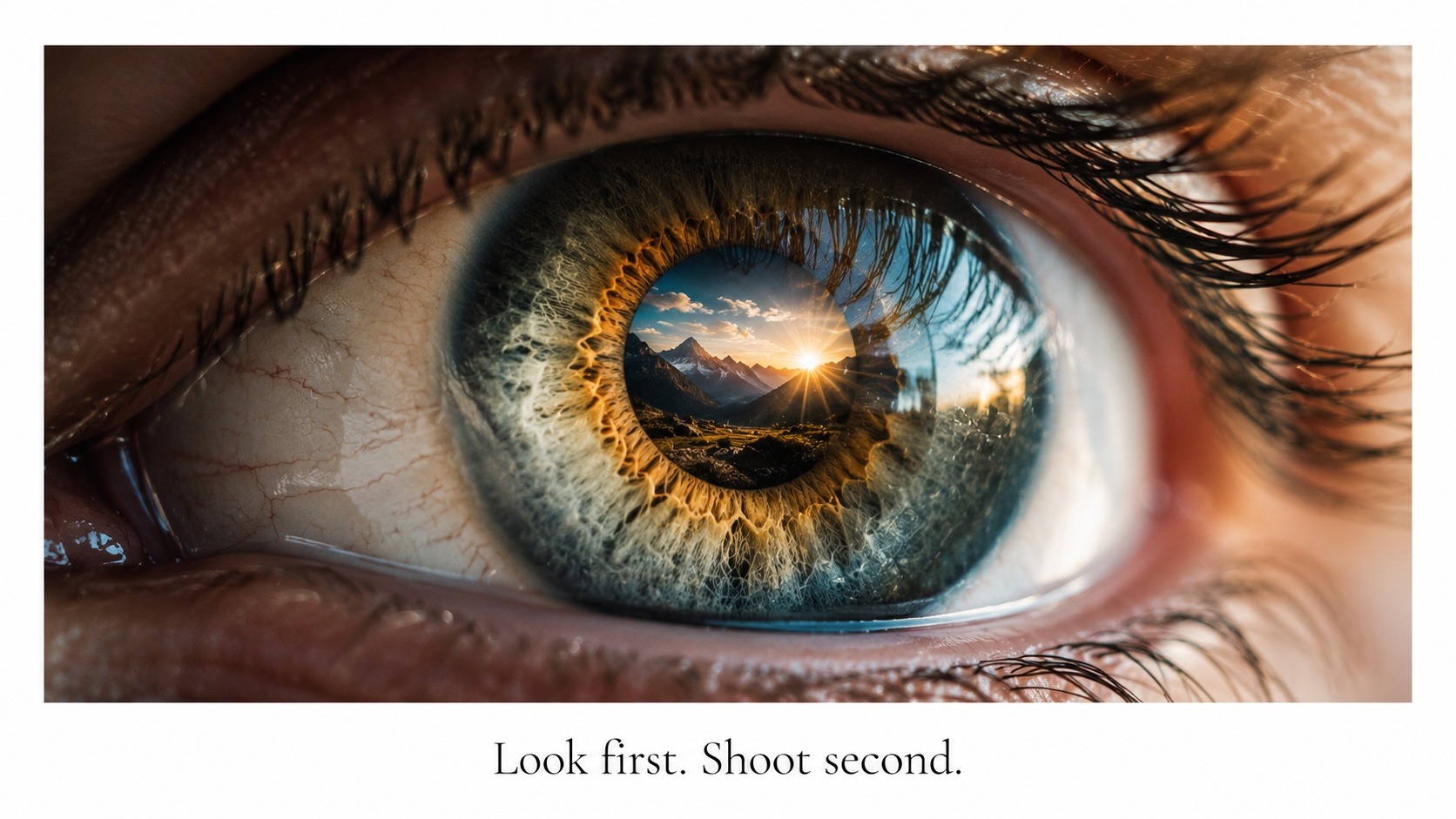
There’s a quality of attention that separates a photograph from a record. Photographers talk about it in different ways – presence, flow, being in the moment. Neuroscience has a less poetic name for “being in the flow”: open monitoring, a state of broad, non-reactive awareness in which attention is distributed rather than narrowed.
In this state, the peripheral flash registers. The unexpected gesture catches. The light breaking through at the edge of the frame pulls the eye before the brain has fully processed why. Photographs made from this state often surprise even the photographer who made them.
Open monitoring is the opposite of task focus. Task focus narrows attention to the objective – the exposure, the focus point, the anticipated moment. Both states are useful and both are necessary. The real skill is moving fluidly between them.
Practice: spend time in scenes without the camera. Stand in the location you’re going to photograph and simply look. Look with your whole visual field. Let the scene come to you rather than reaching for it. Notice what draws your eye and notice what you’d otherwise miss. Then pick up the camera.
The images that come from this kind of presence are different. Sometimes photographers feel the difference the moment they review them.
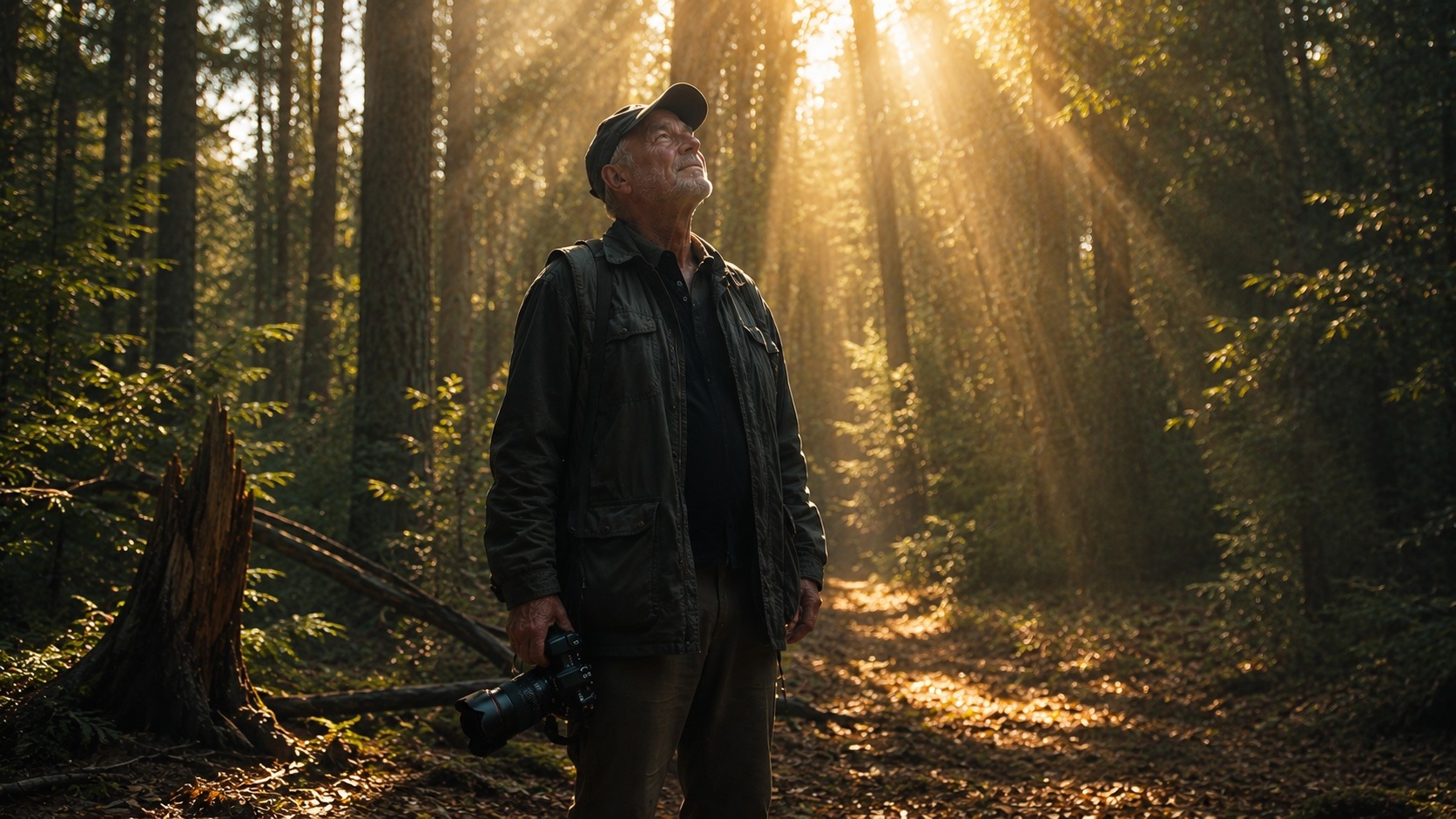
A Practice for Seeing
These are habits to try and build over time. We should get more “in the flow” if we try.
- Daily attention practice. Fifteen minutes. Sustained, non-reactive attention to something present. Build the faculty that photography runs on.
- Observational drawing. Twenty minutes, a few times a week. Draw from life. Look more than you mark.
- Peripheral expansion. In ordinary moments – waiting, walking, sitting – fix your gaze and expand awareness to the edges of your field. Notice what’s there.
- Color naming. Practice naming what you see in natural light. Temperature, cast, relationship. Build the vocabulary.
- Pre-shoot presence. Arrive early. Leave the camera down. Let the scene build in your peripheral sketch before you start composing.
- Post-shoot review with fresh eyes. The image you made in your full presence often reveals itself more clearly the next morning.
We as photographers should keep developing our awareness and stay curious. The world keeps offering us more to see.
If you have any tips or ideas to help others become more aware or help all of us photographers to see better – please send a message to [email protected]
Sources and References:
Inattentional Blindness
- Simons DJ, Chabris CF. “Gorillas in our midst: sustained inattentional blindness for dynamic events.” Perception, 1999. https://www.ncbi.nlm.nih.gov/pmc/articles/PMC3964612/ (search PubMed: Simons Chabris gorilla inattentional blindness 1999)
- The Invisible Gorilla – official site with background and research links http://www.theinvisiblegorilla.com/
Expert Visual Scanning & Artist Eye Tracking
- Vision: The Most Important Skill in Photo Editing – PetaPixel https://petapixel.com/2024/04/07/vision-the-most-important-skill-in-photo-editing/
- Tackling the Frustrating Problems of the Photographer’s Eye – Fstoppers https://fstoppers.com/education/tackling-frustrating-problems-photographers-eye-626227
- 12 Key Photography Skills – Imagely https://www.imagely.com/photographer-skills/
Perceptual Learning (Gabor Patch / GlassesOff)
- Polat U, et al. “Training the brain to overcome the effect of aging on the human eye.” Scientific Reports, 2012. https://www.nature.com/articles/srep00278
- Does Gabor Patch Training Work for Presbyopia? – GetVisionary https://getvisionary.app/gabor-patch-presbyopia-research
Color Perception & Discrimination Training
- Özgen E, Davies IRL. “Acquisition of categorical color perception: a perceptual learning approach.” Journal of Experimental Psychology: General, 2002. Search PubMed: Özgen Davies categorical color perception 2002
- Farnsworth-Munsell 100 Hue Test – X-Rite
https://www.xrite.com/fm-100-hue-test
Peripheral Vision & UFOV Training
- Ball K, et al. “Effects of Cognitive Training Interventions With Older Adults.” JAMA, 2002. (The ACTIVE Trial) https://pubmed.ncbi.nlm.nih.gov/12425704/
- Edwards JD, et al. “Speed of processing training results in lower risk of dementia.” Alzheimer’s & Dementia, 2017. https://pubmed.ncbi.nlm.nih.gov/29201994/
- Sports Vision Training – Southwest Family Eye Health Center https://www.swfamilyeye.com/sports-vision-training/
- What Is Sports Vision Training? – Mohawk Eyecare https://www.mohawkeyecare.com/what-is-sports-vision-training-could-it-improve-your-game/
Mindfulness & Attention Training
- MacLean KA, et al. “Intensive Meditation Training Improves Perceptual Discrimination and Sustained Attention.” Psychological Science, 2010. Search PubMed: MacLean intensive meditation perceptual discrimination 2010
- Lutz A, et al. Attention regulation and monitoring in meditation. Trends in Cognitive Sciences, 2008. https://pubmed.ncbi.nlm.nih.gov/18329323/
Observational Drawing & Visual Processing
- Edwards B. Drawing on the Right Side of the Brain. Tarcher/Penguin. (Foundational text on observational drawing and visual perception) https://www.drawright.com
Sports Vision & Far Transfer (Skeptical Review)
- Fransen J. “Perceptual-cognitive training in sport.” Sports Medicine, 2024. Search PubMed: Fransen perceptual cognitive training sport far transfer 2024
All web URLs verified at time of research. Academic papers listed with PubMed search guidance where direct URLs require institutional access.




Elevate Your Vision


Read this story and all the best stories on The Luminous Landscape
The author has made this story available to Luminous Landscape members only. Upgrade to get instant access to this story and other benefits available only to members.
Why choose us?
Luminous-Landscape is a membership site. Our website contains over 5300 articles on almost every topic, camera, lens and printer you can imagine. Our membership model is simple, just $2 a month ($24.00 USD a year). This $24 gains you access to a wealth of information including all our past and future video tutorials on such topics as Lightroom, Capture One, Printing, file management and dozens of interviews and travel videos.
- New Articles every few days
- All original content found nowhere else on the web
- No Pop Up Google Sense ads – Our advertisers are photo related
- Download/stream video to any device
- NEW videos monthly
- Top well-known photographer contributors
- Posts from industry leaders
- Speciality Photography Workshops
- Mobile device scalable
- Exclusive video interviews
- Special vendor offers for members
- Hands On Product reviews
- FREE – User Forum. One of the most read user forums on the internet
- Access to our community Buy and Sell pages; for members only.
You may also like