





Text and images by Paul Bock, PFIAP, 2026
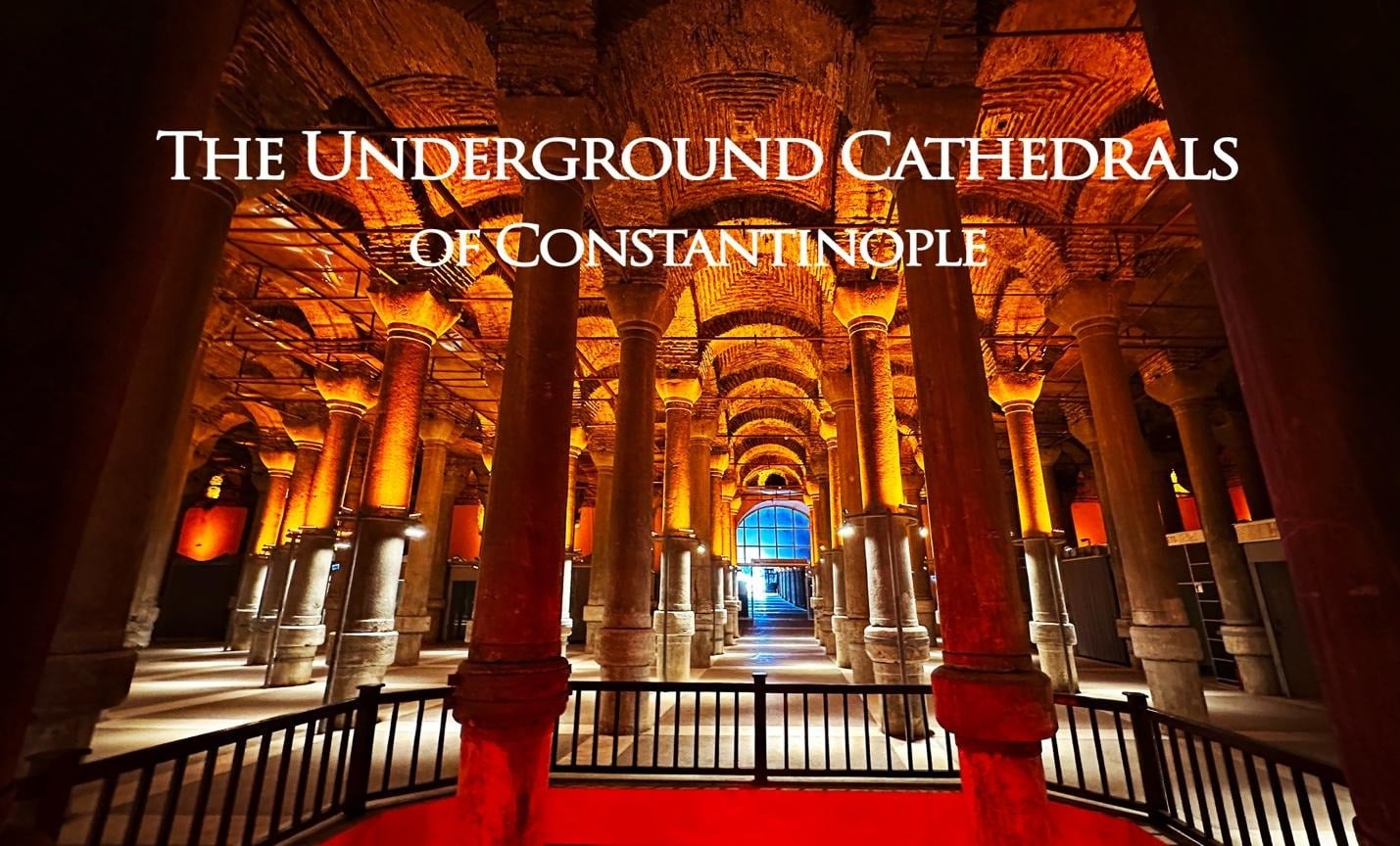
Beneath the crowded streets of Istanbul, below the noise, traffic, commerce, and restless movement of the modern city, lies another world: silent, submerged in memory, and sustained by stone. The great underground cisterns of Byzantine Constantinople remain among the most remarkable monuments of late antique engineering. Conceived not as decoration but as infrastructure, they nevertheless possess the gravity and beauty of sacred architecture. They are works of utility elevated into grandeur.
The Basilica Cistern, Yerebatan Sarnıcı, is the largest and most celebrated of these subterranean reservoirs. Located in the historic Sultanahmet district, across from Hagia Sophia, it was built in the sixth century during the reign of Emperor Justinian I, when Constantinople stood as one of the greatest capitals of the world. Hidden beneath the surface, the cistern once collected and stored vast quantities of water to serve the imperial palace and the surrounding urban district. In purpose it was practical; in conception it was monumental.
Its dimensions alone inspire respect. Approximately 450 by 210 feet in plan and about 30 feet in height, it could hold roughly 2.8 million cubic feet of water. Its roof is borne by 336 marble columns arranged in disciplined ranks, 12 rows of 28 columns each, rising from the dark water with an almost liturgical order. The walls, massive and thick, testify to a civilization that understood permanence not as an abstraction but as a technical obligation. Here, architecture was expected to endure, and engineering was exercised with confidence, precision, and scale.
A short walk away stands the Cistern of Philoxenos, known as Binbirdirek Sarnıcı. Smaller, but no less impressive in concept, it forms a companion work to the Basilica Cistern. Its 224 marble columns, arranged in 14 rows of 16, support another immense underground chamber once capable of storing approximately 1.4 million cubic feet of water. Built in the fifth or sixth century and supplied by a different line of water, it confirms that these works were not isolated feats, but parts of a sophisticated hydraulic system serving a growing imperial metropolis. The thick walls, towering supports, and mathematical regularity of the plan reveal an age in which civic necessity, state power, and technical skill were inseparable.
To visit these cisterns today is to encounter the intelligence of Byzantium in one of its purest forms. The empire is often remembered through theology, mosaics, court ceremony, and military history. Yet the cisterns remind us that civilizations are sustained not only by belief and ambition, but by water, logistics, and construction. These underground chambers are monuments to rulers who understood that the life of a great city depends on invisible systems no less than on visible splendor. They are also tributes to unnamed engineers, surveyors, masons, and laborers whose knowledge transformed geometry, stone, and hydraulic necessity into enduring form.
In their present restored state, the cisterns have acquired a second life. Carefully orchestrated lighting reveals the rhythm of arches, vaults, and columns, while reflections on shallow water multiply the architecture into an almost dreamlike visual field. Contemporary sculptures placed within these ancient spaces create a dialogue across centuries: modern objects inhabiting structures designed when Constantinople was still the center of an empire. Yet the historical presence remains dominant. The darkness, the coolness, the repetition of the columns, and the sense of hidden immensity all preserve the authority of the original conception.
Photographing such spaces presents a special challenge. Light is dim, contrast is extreme, and the scale is difficult to render without distortion or loss of atmosphere. That these images were made handheld with an iPhone 12 Pro Max is therefore more than a technical footnote. It demonstrates how far computational photography has advanced. What once would have required tripods, long exposures, and specialized equipment can now, under difficult conditions, be rendered with remarkable fidelity, tonal range, and color separation by a device that fits in the hand. These photographs are not merely records of ancient structures; they are also evidence of a contemporary imaging technology capable of honoring them with surprising seriousness.
This is what gives the project its double significance. On one level, the images are an homage to the Byzantine rulers and engineers who conceived and built exceptional structures to sustain the life of Constantinople. On another, they are a testimony to the quiet sophistication of the image-making systems embedded in modern smartphones. The encounter is striking: sixth-century hydraulic architecture seen through twenty-first-century computational vision. Stone, water, empire, mathematics, light, and algorithm meet in a single frame.
The cisterns of Istanbul are often described as mysterious, and indeed they possess mystery. But their deeper meaning is not mystery alone. It is discipline. It is foresight. It is the capacity of a civilization to think beyond the visible surface of daily life and to construct, beneath it, systems of extraordinary resilience. Even emptied of their original function, these underground reservoirs still speak of order, endurance, and intelligence. They remain among the most eloquent surviving witnesses to Byzantium’s practical genius.
To walk among their columns is to stand inside the memory of an empire. To photograph them is to acknowledge that beauty can arise from utility, that engineering can become architecture, and that the hidden foundations of a civilization may outlast its crowns, armies, and ceremonies. Beneath modern Istanbul, the cisterns still stand: silent, immense, and luminous in the dark.
Blue Flame in the Basilica
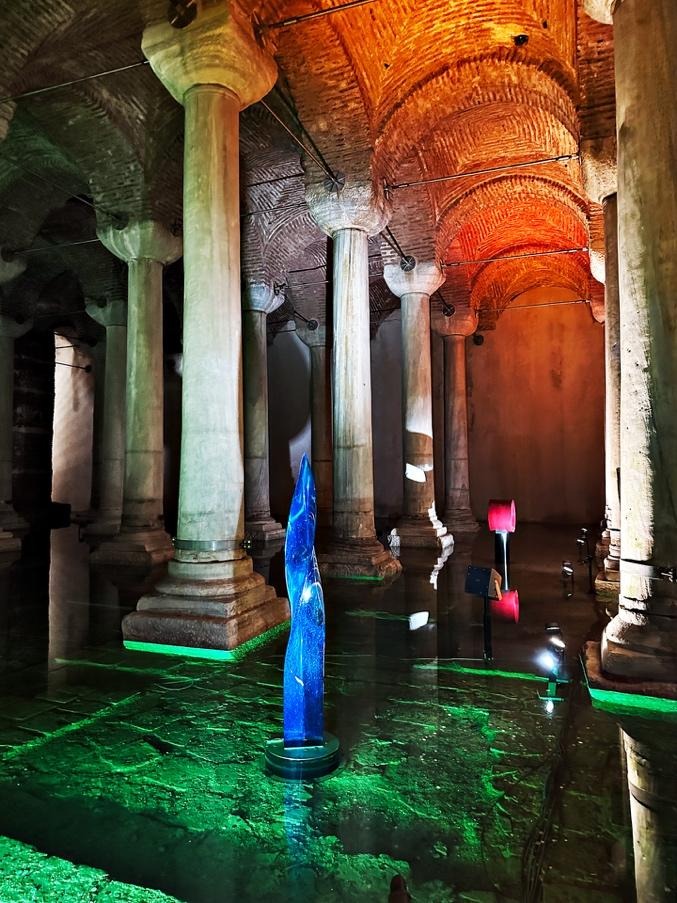
A slender blue sculpture rises from the shallow water like a frozen flame, set against the immense gravity of Byzantine columns and brick vaults. The image works through contrast: ancient masonry versus modern abstraction, warm amber vaults versus electric blue glass, permanence versus apparition. The sculpture seems almost weightless, but the architecture behind it speaks of mass, endurance, and engineering discipline. The photograph shows how the cistern has acquired a second life, where history is not erased, but reinterpreted through light, reflection, and contemporary intervention.
Forest of Columns
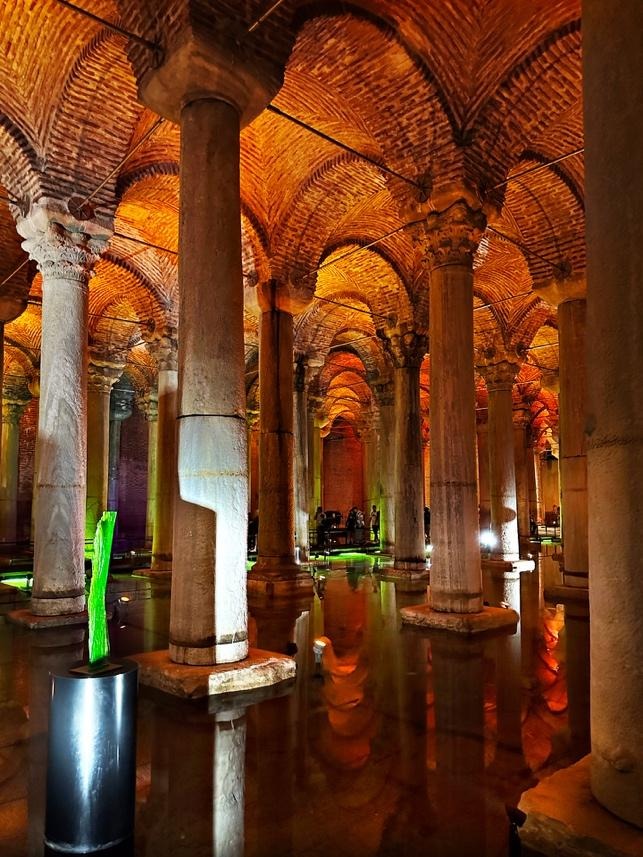
Here the cistern appears less as a chamber than as a vast submerged forest of stone. The green sculpture in the foreground echoes the green reflections in the water, creating a visual bridge between object and environment. The receding ranks of columns and arches give the image great depth and rhythm, while the orange illumination above transforms the ceiling into an almost living canopy. This is one of the strongest expressions of the cistern as an architecture of repetition: rational, ordered, almost infinite.
Jellyfish in the Underworld
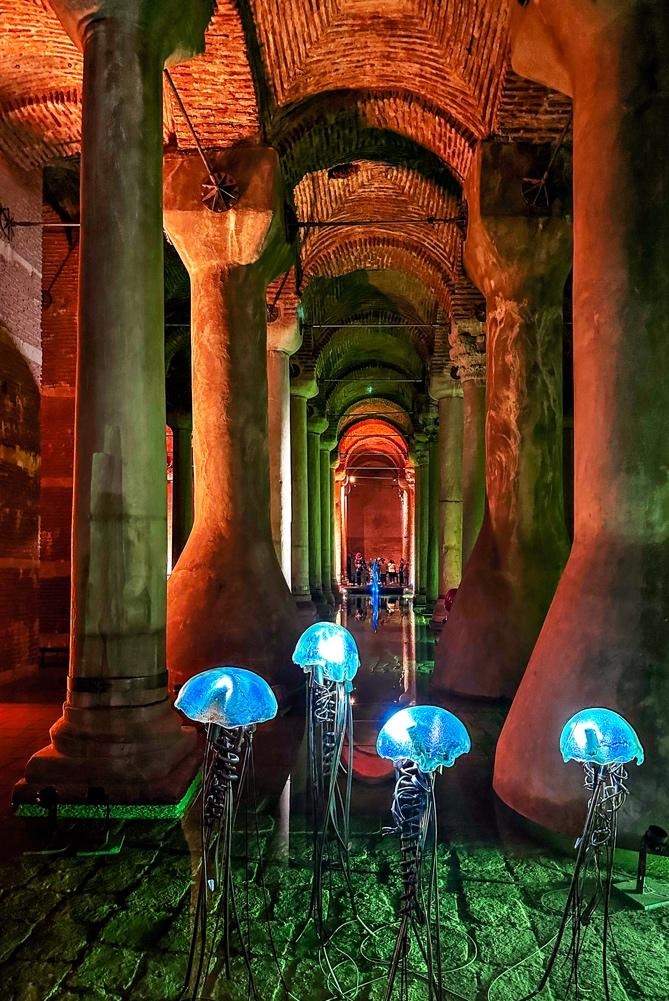
This image is one of the most surreal in the series. The glowing blue jellyfish-like sculptures appear to float inside a space that already feels half-real, half-mythic. The long row of columns creates a ceremonial perspective toward the distance, while the luminous sculptures animate the foreground with a strange aquatic life. The ancient cistern becomes, for a moment, not just a reservoir, but an underworld inhabited by visions.
Imperial Axis
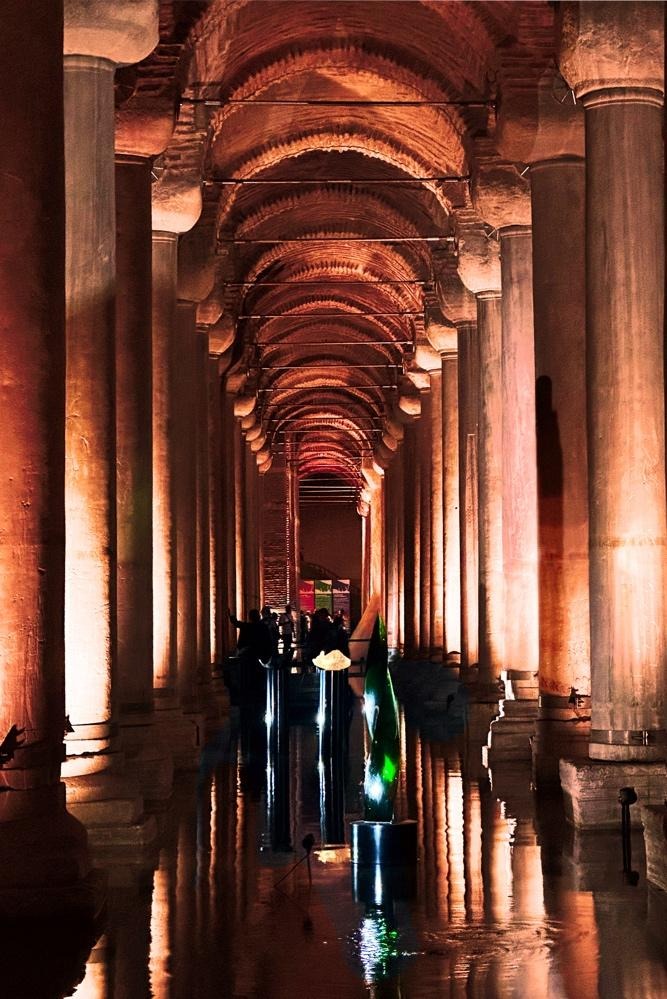
This is one of the clearest statements of the cistern’s geometry. The central aisle draws the eye deep into the image, emphasizing symmetry, order, and the immense serial discipline of the structure. The reflected arches double the architecture, giving the impression that the space continues below as much as above. The modern sculptures punctuate the scene without overwhelming it. The photograph communicates something essential about Byzantine engineering: not merely the ability to build large, but the ability to organize space with mathematical authority.
Silver Form Beneath the Vaults
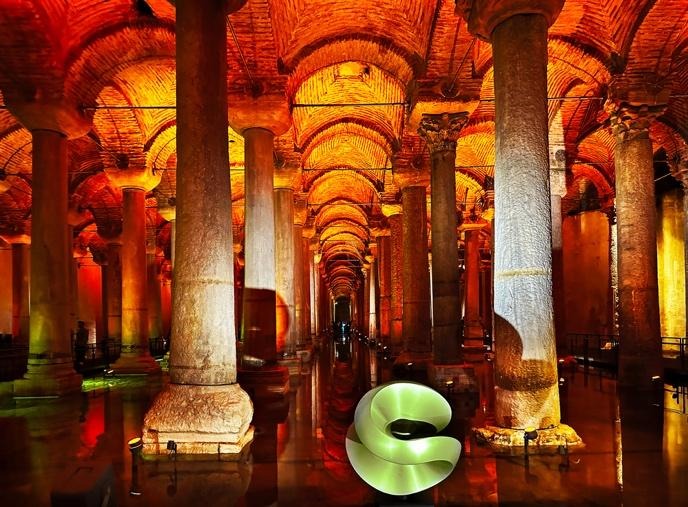
The silver-green sculpture in the foreground introduces a smooth, modern, almost aerodynamic form into a world of brick, stone, and water. Its polished surface and spiral openness contrast beautifully with the dense, repetitive masonry of the cistern. Yet the sculpture does not feel alien here; rather, it seems to absorb and reflect the surrounding order. The glowing arches above and their mirrored counterparts below make this image especially rich in tonal and spatial resonance. It is a conversation between modern abstraction and ancient structural logic.
Medusa and the Child
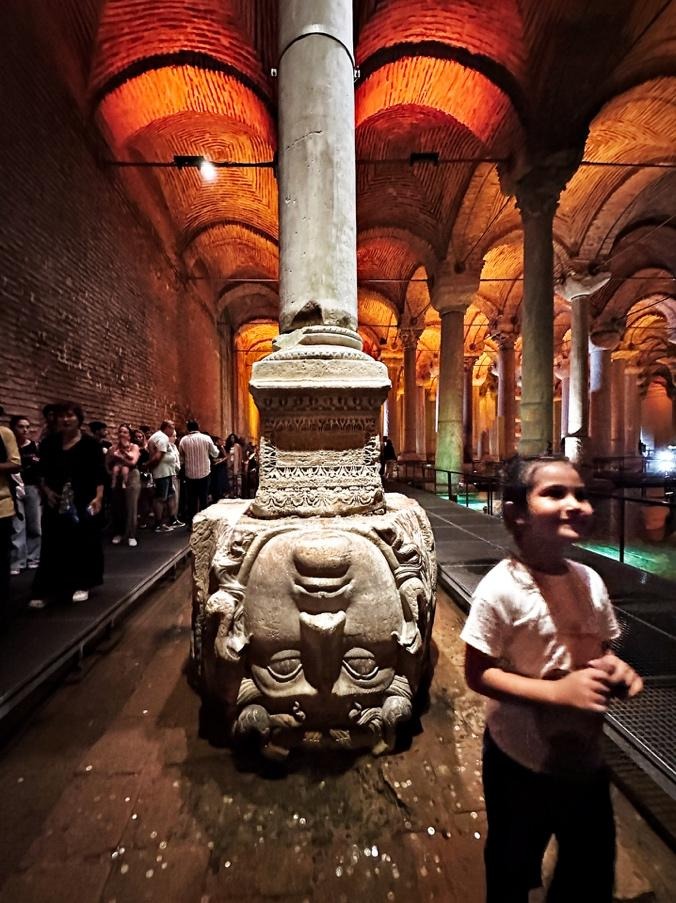
This image introduces a human note, and with it, scale, movement, and tenderness. The famous Medusa head at the base of the column is one of the iconic elements of the Basilica Cistern, but the passing child transforms the scene from pure monument into lived experience. The blurred figure suggests spontaneity and time passing, while the ancient carved head remains immobile, enigmatic, and severe. The juxtaposition is powerful: myth and tourism, antiquity and present life, the fixed and the fleeting. The photograph reminds us that monuments survive not in isolation, but through repeated encounters with the living.
The Shadow of Medusa
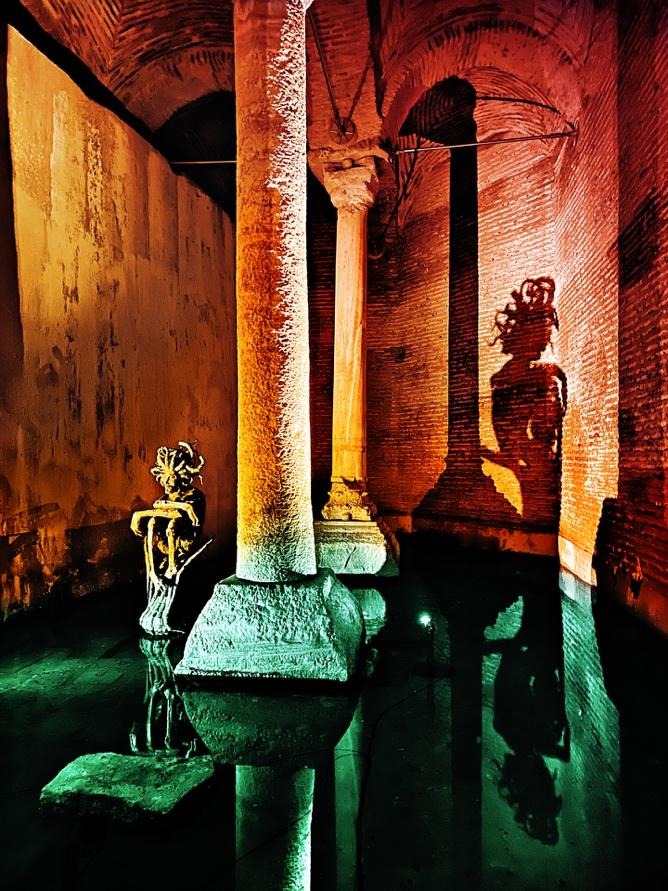
This is one of the most dramatic and theatrical images in the series. The sculptural figure and its oversized shadow projected onto the brick wall create a double presence, almost like an apparition. The green-lit water below and the orange wall behind intensify the image’s sense of myth and unreality. The column in the center divides the composition and adds structural stability to a scene otherwise dominated by shadow and illusion. The photograph suggests that in these underground chambers, light itself becomes a storyteller, turning sculpture into legend.
White Spiral in the Cistern
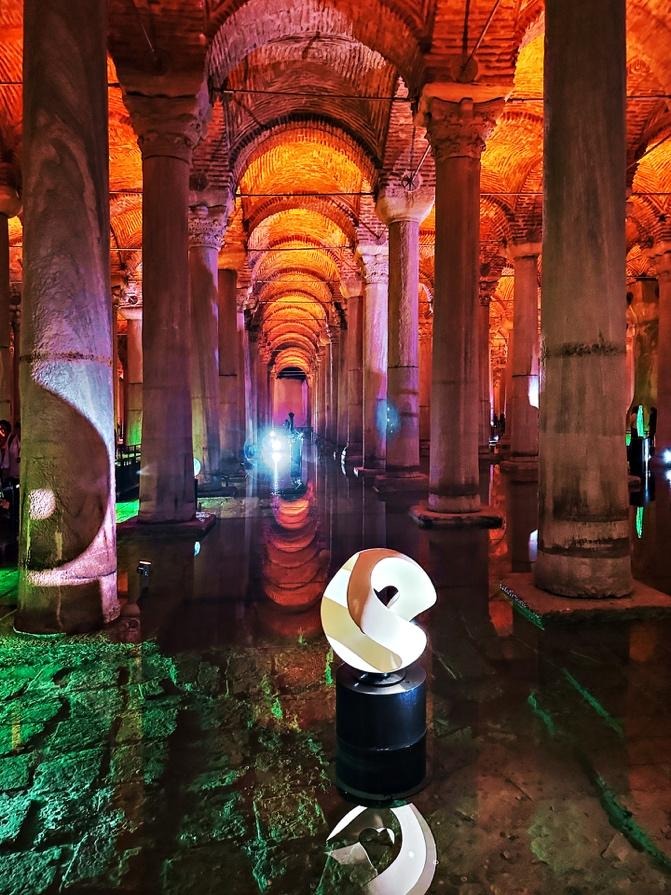
The white sculpture stands like a distilled modern emblem against one of the most spacious views of the Basilica Cistern. Its pale, smooth form contrasts with the rough texture of the columns and ancient brick vaults, yet it is perfectly placed within the axial order of the space. The bright source of light in the distance pulls the eye through the center of the composition, while the reflections below soften the heaviness of the architecture. This image is a statement about continuity: the cistern remains ancient, but not frozen; it still receives new forms and new meanings.
Binbirdirek: Hall of Amber Columns
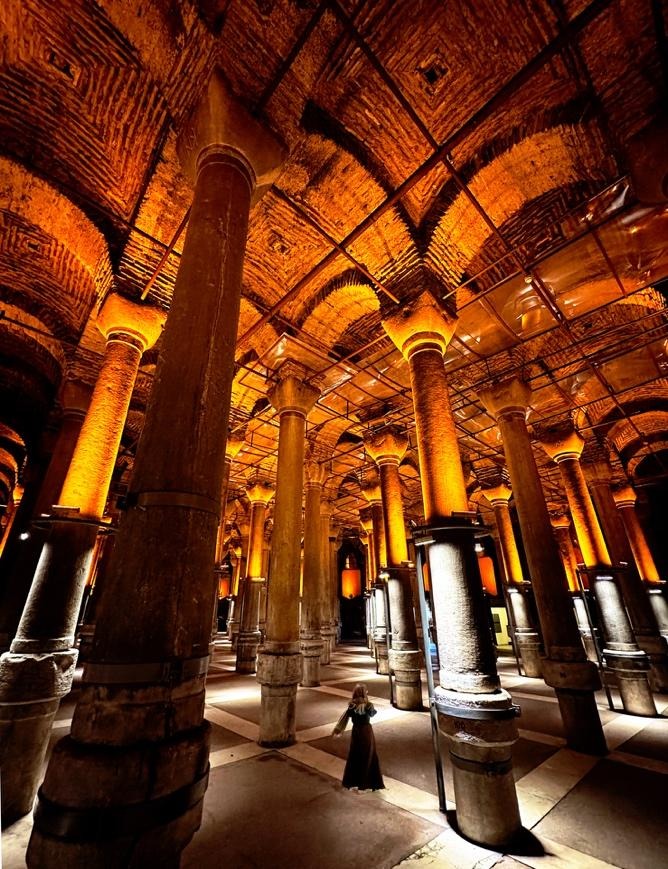
This image introduces the Cistern of Philoxenos with great dignity. Unlike the watery reflectivity and theatrical installations of the Basilica Cistern, this space feels drier, calmer, more architectural in the pure sense. The amber lighting lifts the columns and vaults into stately prominence, while the solitary human figure provides scale and a note of contemplation. The photograph reveals Binbirdirek as less dramatic perhaps, but no less impressive: a vast subterranean hall whose beauty lies in order, mass, and rhythm rather than spectacle.
Light at the End of Byzantium
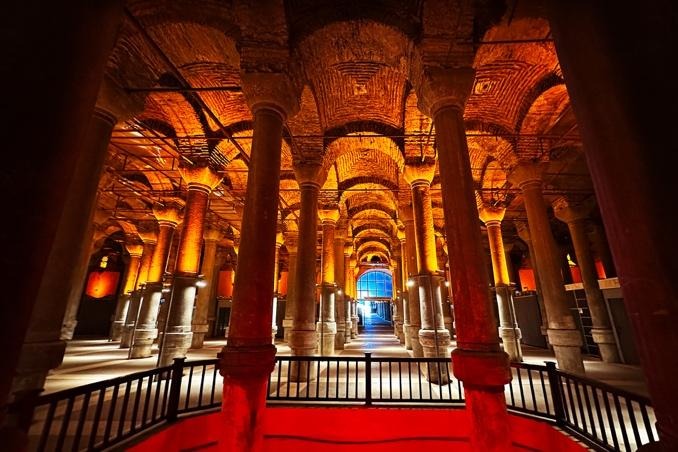
The red-lit foreground and the luminous opening in the distance create a strong emotional movement from darkness toward light, from enclosure toward release. The rows of columns emphasize the structural logic of the cistern, while the distant exit reconnects the underground monument to the living city above. The composition carries symbolic weight: it feels like emergence from memory, or a passage through the hidden foundations of history back into the present world. It is both architectural and metaphorical, making it a fitting closing image for the essay.
These cisterns remind us that great civilizations are sustained not only by armies, palaces, and monuments, but by invisible systems of water, planning, and construction. Even emptied of their original purpose, the underground reservoirs of Istanbul remain eloquent witnesses to Byzantine intelligence and endurance. Seen through the lens of a contemporary smartphone, they also reveal an unexpected meeting of eras: sixth-century engineering rendered by twenty-first-century computational vision. Stone, water, light, and memory continue to speak beneath the city.
A Note on the Process
The images within this collection were produced using a streamlined digital workflow. Each photograph was taken hand-held with an iPhone 12 Pro Max, relying entirely on available light. Shooting in the HEIC format maximized data retention while minimizing noise, and bypassing the use of a tripod or flash, I was able to maintain agility in the field. The files were imported to a Mac Studio, analyzed and rated in Adobe Bridge and processed through Adobe Camera Raw and Photoshop to preserve the tonal integrity of the subjects.




Elevate Your Vision


Read this story and all the best stories on The Luminous Landscape
The author has made this story available to Luminous Landscape members only. Upgrade to get instant access to this story and other benefits available only to members.
Why choose us?
Luminous-Landscape is a membership site. Our website contains over 5300 articles on almost every topic, camera, lens and printer you can imagine. Our membership model is simple, just $2 a month ($24.00 USD a year). This $24 gains you access to a wealth of information including all our past and future video tutorials on such topics as Lightroom, Capture One, Printing, file management and dozens of interviews and travel videos.
- New Articles every few days
- All original content found nowhere else on the web
- No Pop Up Google Sense ads – Our advertisers are photo related
- Download/stream video to any device
- NEW videos monthly
- Top well-known photographer contributors
- Posts from industry leaders
- Speciality Photography Workshops
- Mobile device scalable
- Exclusive video interviews
- Special vendor offers for members
- Hands On Product reviews
- FREE – User Forum. One of the most read user forums on the internet
- Access to our community Buy and Sell pages; for members only.
You may also like