




What happens to a room after you walk out of it?
The question goes deeper than physics, deeper than dust settling or light shifting across the floor. Does the room remember you? Do you carry it with you, lodged somewhere between your fingertips and your memory, shaping who you become?
Cindy Konits has spent years answering that question with a camera most people would consider a relic, and film most people would consider dead, and a patience most people would consider unreasonable.
The result is This Room Will Survive Me: Architecture and Interiority, a book of images that feel like evidence of something we’ve all experienced but rarely see made visible: the way our bodies, our spaces, and our memories bleed into each other over time.

An Obsolete Camera, Expired Film, and a Riddle
The project began with a discovery that reads like something out of a photographer’s dream. Cindy found a never-used, now-obsolete Polaroid camera tucked inside a studio closet, and that single moment of curiosity set everything in motion.
“Finding an obsolete camera with expired film to begin experimenting with was enchanting,” she says. “Then magically a camera appears that delivers in a single packet the processed negative, darkroom photochemicals and an image developing into a finished print in my own hands.”
The camera was a Fuji instant model with an f/64 aperture, bellows, and rangefinder focus. The film was expired Fuji FP-100C, itself a discontinued product representing the obsolescence of an entire industry. Two relics from two eras, meeting in Cindy’s hands at precisely the right moment.
For many photographers, this would be a fun weekend experiment. For Cindy, it became a multi-year investigation into light, time, architecture, and the self.

Exposures That Bend Time
Here’s where the technical story gets wild.
Cindy began making long single exposures on instant film in direct sunlight. The f/64 aperture (a relic of large-format photography’s zone system era) created an immediate creative constraint that shaped the entire body of work.
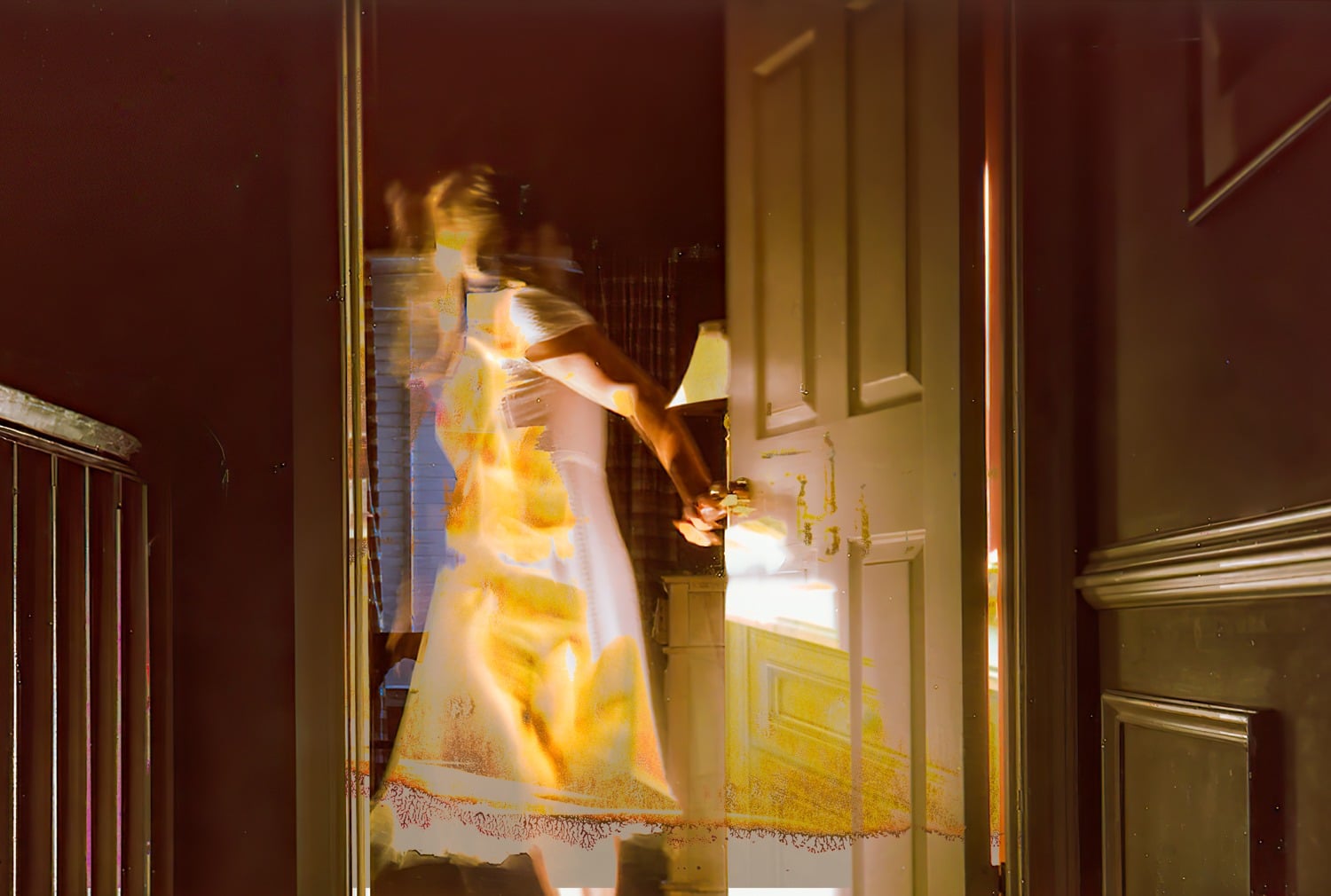
Light entered through windows, doorways, or from the horizon behind the figure, and because of those extended exposures, something strange and beautiful happened. The human form became semi-transparent, seemingly merged with architectural elements: window moldings, walls, doorframes, garden flowers.
“The obsolescence of both the camera and film influenced the content of the images and outcome of this project in significant ways,” Cindy explains. “Due to the absence of a timer, image exposure was managed by ‘manually’ opening and closing the shutter. Walking into and out of the frame flush with light resulted in either distinct repetition of the figure as it moved, or a trail of light following it, reinforcing the sense of the body in time and space.”
Think about that for a moment. The technical limitations of the equipment, features that would normally frustrate a photographer, became the creative engine of the work. The missing timer forced manual shutter control. The expired film introduced unpredictability. The slow aperture demanded direct, intense light. Every “flaw” became a feature.
The next time a piece of gear frustrates you, ask yourself: Is this a limitation or an invitation?

The Figure Is Not the Subject
One of the most striking aspects of this work is Cindy’s presence in the images. These are self-portraits, but call them that and you’ve missed the point entirely.
“My subjectivity is not an element of this work, nor would the subjectivity of any particular person appearing in the images,” she says. “The project images are self-portraits only because it was not practicable to engage the body of another person due to the chance time and place involved in engaging a particular quality of light appearing only minutes before vanishing.”
The figure in these photographs represents something universal, something beyond any individual identity. When we look at these images, we’re looking at our own relationship to the spaces we inhabit, the way we pass through rooms that will outlast us.
This is an important idea. It shapes how this work lands. Most self-portrait photography turns inward, toward the individual. Cindy’s work turns the self inside out, using the body as a stand-in for all of us.
Architecture as Ghost-Holder
The philosophical foundation of this project runs deep, drawing from psychoanalysis, architecture theory, and Cindy’s own experience across both disciplines.
She points to Space & Psyche (CENTER 17, University of Texas at Austin, 2013), a collection of essays by psychoanalysts, architects, and educators, as a major influence. The book explores how designed spaces and the human mind interact, overlap, and shape each other.
One idea from that volume anchors the work. Mark Wigley, former dean of the Graduate School of Architecture, Planning, and Preservation at Columbia University, argues that the house can be more a site of anxiety than safety, producing psychological states like the “uncanny,” where something familiar is also perceived as disturbing and unfamiliar.
This connects to Freud’s concept of the uncanny, where familiar domestic spaces sustain embedded stories and myths. A bedroom. An empty corridor. A basement. A staircase. These spaces are psychologically charged.
Cindy takes this further: “We don’t just pass through life. Life is accumulating, taking residence within us. By remembering houses and rooms we learn to abide within ourselves. This is the inner life, the interiority that needs attention, awareness, and protection.”
Every room you’ve ever loved, feared, felt safe in, or fled from, it’s still inside you. These photographs make that invisible accumulation visible.

Where Psychology, City Planning, and the Darkroom Converge
Cindy’s background reads like a curriculum designed to produce exactly this body of work. She holds training in psychology, urban planning, and darkroom photography, and all three disciplines show up in these images.
“Since early college years, psychology orients my understanding of the world,” she says. “The images in This Room suggest the expanse of what’s inside, where what occurs inside the mind and inside architectural space are fused into one evolving question of being in the world.”
Her architectural thinking extends beyond individual rooms to the scale of cities: “My graduate college training in city planning addresses all aspects of community space including home, institutions, open space, transportation, and health care, architecture on a vast scale, a thing fully perceived only in the course of long spans of time. City design is therefore a temporal art.”
And her darkroom roots echo through the instant film process itself. The chemical development of an instant print mirrors the magic of watching an image emerge in trays of developer, stop bath, and fixer. “The image then emerges as a magical intonation of reality,” she says, “an intimate revelation of the self.”
For our readers who’ve stood in a darkroom and watched a print materialize under safelight: you know that feeling. Cindy found a way to carry it forward into a project that bridges analog and digital, past and present, inner life and outer space.

From 700 Prints to 60: The Edit
Here are some numbers that help us understand the undertaking: Cindy produced over 700 instant prints across the life of this project. The final book contains 60.
That’s a brutal edit ratio, roughly 8.5% of the total body of work. And it didn’t happen all at once.
“Editing these Polaroids occurred continually over the years throughout the evolution of the project,” Cindy explains. “Every ‘location shot,’ that is, the capture of evanescent light and figure against architectural or natural structure or object, generated 3-6 instant prints. Of these 2 or 3 on average were selected based on evocative color and movement of light following behind or through the figure.”
Those selected images were scanned at high resolution, edited (color correction, spot clean-up), and frequently printed for exhibition. From approximately 330 curated files, Cindy distilled the final 60 for the book.
The remaining prints go to good use. A large portion of the original 700 instant prints will be framed individually and hung as a wall installation as part of a mixed-media traveling exhibition accompanying the book.
There’s a lesson about editing that runs through this entire process. The willingness to produce 700 images and publish 60 requires a specific kind of discipline. It requires trusting the process while remaining ruthless about the result.

A Bridge Between Worlds
Cindy’s creative history spans a remarkable range of media: video, CD-ROM, 8mm film, digital, and generative algorithmic work. Each medium taught her something that fed the next.
“Looking back, it is apparent that each previous process I investigated represents a stepping stone toward comfort with digital photography,” she reflects. “Video was the first big step ‘off the page’ toward a version of virtuality. The CD-ROM incorporated hand manipulation and decision making of the viewer with digital software, and finally algorithms set the stage for generation of an unpredictable result.”
The instant film project became the final bridge. “Ultimately my long engagement with instant film capture and processing served to bridge my experience with analog photography with a full embrace of the digital camera and digital image processing.”
This trajectory resonates with many of us who came up through film and found the transition to digital unsettling, even alienating. Cindy’s path suggests that the answer is to find the stepping stones between worlds, the projects and processes that let you carry forward what matters from one medium into the next.

What She Hopes You Feel
Ask a photographer what they want viewers to take away from their work and you’ll often get a vague answer about “connection” or “emotion.” Cindy’s answer is more precise and more generous.
“We are not just passing through life,” she says. “Life passes through us and it inhabits us. The rooms we experience exist in stillness and suspension with our presence and absence, slowly responsive to time.”
“My hope is the viewer of this work becomes curious about their inner life. As they approach a room, they might become aware of themselves as a separate entity from it. They might notice that upon crossing the threshold of the room it slips from consciousness. If one becomes aware of the senses at that moment, they might learn something about themselves and their feelings.”
And then she connects that personal awareness to something larger: “This engagement of interiority makes the ability to reach out to interact with others accessible, and a sense of community and connection possible.”
The work asks us to slow down, pay attention to the spaces we move through, and recognize that those spaces are shaping us even as we move through them.

The Room That Survives
Cindy Konits made over 700 photographs with an obsolete camera and expired film, standing in direct sunlight, manually counting seconds, walking in and out of her own frame. She drew from psychology, architecture, city planning, and decades of darkroom experience to create images that feel like memories.
The next time you walk into a room, pause at the threshold. Notice the light. Notice how the space feels against your skin, inside your chest. Notice the room and notice yourself.
This Room Will Survive Me: Architecture and Interiority by Cindy Konits is available now.
Order the book from the publisher → (https://www.schiltpublishing.com/shop/books/new-releases/this-room-will-survive-me-architecture-and-interiority/)
All images © Cindy Konits. Used with permission.


Elevate Your Vision


Read this story and all the best stories on The Luminous Landscape
The author has made this story available to Luminous Landscape members only. Upgrade to get instant access to this story and other benefits available only to members.
Why choose us?
Luminous-Landscape is a membership site. Our website contains over 5300 articles on almost every topic, camera, lens and printer you can imagine. Our membership model is simple, just $2 a month ($24.00 USD a year). This $24 gains you access to a wealth of information including all our past and future video tutorials on such topics as Lightroom, Capture One, Printing, file management and dozens of interviews and travel videos.
- New Articles every few days
- All original content found nowhere else on the web
- No Pop Up Google Sense ads – Our advertisers are photo related
- Download/stream video to any device
- NEW videos monthly
- Top well-known photographer contributors
- Posts from industry leaders
- Speciality Photography Workshops
- Mobile device scalable
- Exclusive video interviews
- Special vendor offers for members
- Hands On Product reviews
- FREE – User Forum. One of the most read user forums on the internet
- Access to our community Buy and Sell pages; for members only.
You may also like